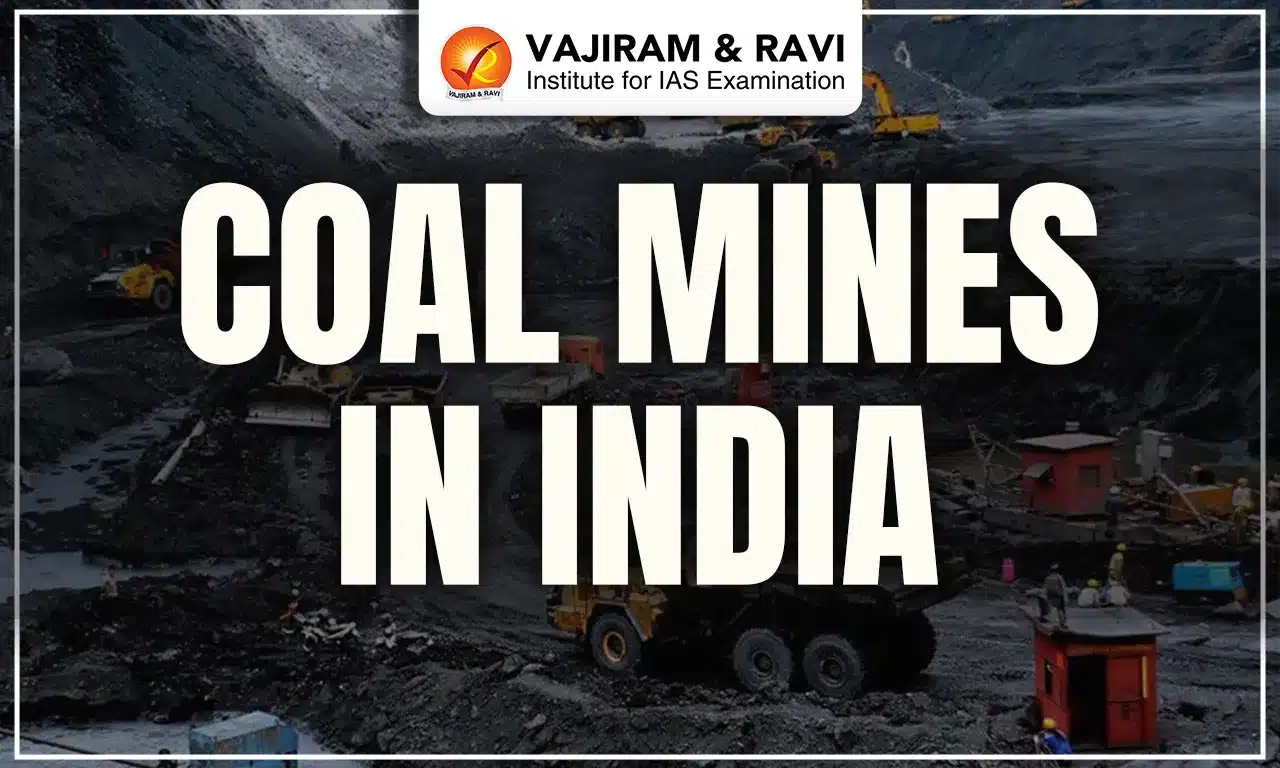
Coal Mining refers to the extraction of coal deposits from both the Earth’s surface and underground layers. Coal played a crucial role as the primary source of energy during the Industrial Revolution, driving industrial expansion and leading to large-scale exploitation of coal reserves. By the late 20th century, open-pit mining gradually replaced underground mining as the dominant method in many industrial nations. With advancements in technology, Coal Mines In India 2026 today whether surface or underground has become a highly mechanized and efficient process. In India, the first coalfield was discovered at Raniganj, where mining began in 1774 under the East India Company. Owing to its vast reserves of ancient hard rocks, India holds significant mineral resources, with coal continuing to be one of its most important.
Coal Mines in India 2026
India holds significant coal reserves of around 400.715 billion tonnes, making it one of the largest coal producers in the world. The major coal-bearing areas are concentrated in the eastern and central regions of the country. The dominant types of coal found in India are bituminous and sub-bituminous, which are widely used for power generation and industrial purposes.
Coal Mines in India are broadly classified into two categories – Gondwana Coal and Tertiary Coal.
- Gondwana Coal, among the oldest and most important reserves globally, is mainly located in central India. It forms the bulk of India’s coal resources.
- Tertiary Coal, comparatively younger in age, is primarily found in the northeastern states, such as Meghalaya, Assam, and Arunachal Pradesh.
Within the Gondwana Reserves, coal is further categorized based on its carbon content into anthracite, bituminous, and sub-bituminous varieties. These categories determine the energy content and suitability of coal for different applications, ranging from domestic use to large-scale power generation and industrial consumption.
Coal Reserves in India 2026
The National Coal Inventory of 2025 Report published by Geological Survey of India estimates the total Coal Resources in India to be 400.715 billion tonnes as of April 2025. As of 2026, 64 Coal Fields are operational which include 45 Gondwana and 19 Tertiary Coalfields. In addition, country has a total 15 Lignite Fields which reserves 47.37 billion tonnes of Lignite Resources (2025).


List of Coal Mines in India 2026
In India, there are several places where coal is mined from the ground. These areas are called coal mines, and they are mainly located in states rich in mineral resources. Some of the famous Coal Mines in India include:
| List of Coal Mines in India 2026 | |
| Coal Mines Name | State |
| Jharia, Dhanbad | Jharkhand |
| Bokaro | |
| Jayanti | |
| Godda | |
| Giridih (Karbhari Coal Field) | |
| Ramgarh | |
| Karanpura | |
| Daltonganj | |
| Raniganj | West Bengal |
| Dalingkot (Darjeeling) Birbhum | |
| Chinakuri | |
| Korba | Chhattisgarh |
| Bishrampur | |
| Sonhat | |
| Jhilmil | |
| Hasdo-Arand | |
| Jharsuguda | Odisha |
| Himgiri | |
| Rampur | |
| Talcher | |
| Singareni | Telangana/ Andhra Pradesh |
| Kothagudem | |
| Kantapalli | |
| Neyveli | Tamil Nadu |
| Kamptee (Nagpur) | Maharashtra |
| Wun field | |
| Wardha | |
| Walarpur | |
| Ghughus | |
| Warora | |
| Ledo | Assam |
| Makum | |
| Najira | |
| Janji | |
| Jaipur | |
| Darrangiri (Garo hills) | Meghalaya |
| Cherrapunji | |
| Liotryngew | |
| Maolong | |
| Langrin | |
| Singrauli | Madhya Pradesh |
| Sohagpur | |
| Johila | |
| Umaria | |
| Satpura | |
What are the Types of Coal?
Coal in India is classified into four main types based on its carbon content, heating capacity, and age. These types range from the oldest and most energy-rich (Anthracite) to the youngest and least carbon-rich (Lignite). Each type has distinct properties and uses, and their distribution varies across regions.
| Coal Types | ||||
|---|---|---|---|---|
|
Type of Coal |
Carbon Content |
Properties |
Major Uses |
Major Deposits in India |
|
Anthracite |
80-95% |
Hard, shiny, highest quality, burns cleanly |
Industrial use, domestic heating |
Jammu & Kashmir |
|
Bituminous |
60-80% |
Black, soft, high heating value |
Power generation, steel industry |
Jharkhand, Odisha, Chhattisgarh, West Bengal |
|
Sub-Bituminous |
45-60% |
Lower heat, burns cleaner than bituminous |
Electricity generation |
Madhya Pradesh, Maharashtra |
|
Lignite |
25-35% |
Brown, soft, high moisture, lowest heating |
Power generation in local plants |
Tamil Nadu (Neyveli), Rajasthan, Gujarat |
Also Check: Critical Minerals
Top 10 Biggest Coal Mines in India 2026
India is home to some of the largest coal mines in the world, which play a crucial role in meeting the country’s energy needs. These mines supply coal for electricity generation, industries, and other everyday uses. Here are some of the most important Largest Coal Mine in India:
1. Gevra Open Cast Mine (Chhattisgarh)
Gevra Open Cast Mine is the Largest Coal Mine of India and Asia and the 2nd Largest Coal Mine in the World. It is operated by South Eastern Coalfields Limited (SECL). The mine recently produced 3,07,716 tonnes of coal in a single day in March 2026 and is expected to surpass the the present Largest Coal Mine in the World 2026 (Black Thunder Mine, USA).
2. Kusmunda Open Cast Mine (Chhattisgarh)
Kusmunda Open Cast Mine is the second largest coal mine in India. In FY 2023-24, it produced more than 50 million tonnes of coal. Along with Gevra Mine, it also uses advanced and environment friendly mining machines such as Surface Miner which extract and cut coal without blast.
3. Dipka Open Cast Project (Chhattisgarh)
Dipka Open Cast Project is a flagship mega mine under SECL. On an average, it produces more than 35 million tonnes of Coal per year and has targeted more than 40 million production in the FY 2026-27.
4. Jharia Coalfield (Jharkhand)
The Jharia Coalfield is located in the Dhanbad district of Jharkhand, popularly known as the “Coal Capital of India”. It is famous for producing high quality metallurgical (coking) coal. It has the Largest Coal Reserve in India 2026 estimating to about 19.4 billion tonnes.
5. Raniganj Coalfield (West Bengal & Jharkhand)
Raniganj Coalfield is the oldest and the second largest coal mining region in West Bengal. The mine was set up and began it’s operations in 1774. It produces high grade non-coking coal.
6. Talcher Coalfield (Odisha)
The Talcher Coalfield is one of the largest coal mines in India. It estimates the reserves of about 15% of the total prognosticated coal resources in India. It is operated by Mahanadi Coalfield. In FY 2022-23, it produced more than 95 million tonnes of Coal and is projected to produce about 300 million tonnes till 2030.
7. Singrauli Coalfield (Madhya Pradesh & Uttar Pradesh)
Singrauli Coalfield is operated by Northern Coalfields Limited (NCL). In FY 2025-26, it has achieved the annual target of producing 140 million tonnes of coal. It is popularly known as the “Energy Capital of India”. It supports two mega mines Jayant and Nigahi that are useful in thermal power generation.
8. Bhubaneswari Open Cast Mine (Odisha)
The Bhubaneswari Open Cast Mine is located in the Angul district of Odisha. It is operated by Mahanadi Coalfields Limited (MCL). The mine has the capacity of producing 30 million tonnes coal.
9. Ib Valley Coalfield (Odisha)
The Ib Valley Coalfield is located in Jharsuguda and Sundargarh districts of Odisha. They are operated by Mahanadi Coalfield. The mine has recently made a record by producing 86,638 tonnes of coal in single day in January 2026.
10. Godavari Valley Coalfield (Telangana)
The Godavari Valley Coalfield is operated by the Singareni Collieries Company Limited (SCCL). The mine is the Largest Gondwana Coalfield in South India. It is crucial for supplying coals to power and cement industries.
Oldest Coal Mines in India 2026
Coal Mining in India has a long history, with some mines operating for more than a century. These mines not only powered industries during the colonial period but also laid the foundation for India’s modern energy sector. Here are two of the Oldest Coal Mines in India:
| Oldest Coal Mines in India 2026 | |||
|
Coalfield / Mine |
Year of Establishment |
State |
Significance |
|
Raniganj Coalfield |
1774 |
West Bengal |
India’s first coal mining area, where operations began in 1774 during British rule. |
|
Jharia Coalfield |
1894 |
Jharkhand |
Known for its rich reserves of coking coal and a long history of underground mining. |
Underground Coal Mines in India 2026
In India, along with the Open Cast Mines several Underground Mines are also operational. These mines are generally used for extraction of deep-seated coal seams which are typically located above 200 feet of depth. The major examples of Underground Coal Mines in India include:
- Jhanjra Mines: It is located in West Bengal. The Jhanjra Mine is the largest highly mechanized underground coal mining project in India. It is operated by Eastern Coalfields Limited and is extended upto 225m of depth below surface.
- Churcha Mine: It is located in the Koriya district of Chhattisgarh and is operated by South Eastern Coalfields Limited (SECL). It has the average capacity of 2.10 million tonnes of coal production.
- Adasa Mine: The coal mine earlier operated as the underground coal mine under Western Coalfields Limited (WCL). However, in 2019 it officially concluded it underground works and reopened in 2020 as an opencast mine. Thus as of 2026 it is no more an underground coal mine of India.
Coal Mines in India Map
An illustration showing the geographical distribution of coal reserves in India is presented in a coal mines map. Such a map highlights the major coalfields and mining regions across the country. You can view an example of this Coal Mines in India Map here.
Also Check: Natural Resources
Coal Mines in India Challenges
Coal Mines in India face a range of challenges that affect its efficiency, safety, and sustainability. Some of the most pressing issues include:
- Environmental Impact: Mining often causes deforestation, soil erosion, air and water pollution, and loss of biodiversity. Balancing energy needs with environmental protection remains a tough task.
- Safety Concerns: Coal mines are hazardous workplaces. Risks include mine collapses, explosions, and long-term health problems like lung diseases among workers.
- Land Acquisition and Rehabilitation: Securing land for mining projects often leads to disputes, displacement, and the need to resettle and rehabilitate affected communities.
- Technological Modernization: Many mines still use outdated techniques. Introducing modern machinery and practices is vital for improving productivity and reducing harm to the environment.
- Sustainable Practices: There is a growing need to restore mined areas, replant forests, and adopt eco-friendly methods to make coal mining more sustainable.
- Regulatory Compliance: Mining companies must navigate complex laws, environmental norms, and safety standards, which can slow down operations if not managed well.
- Social Impact: The displacement of local populations often results in loss of livelihoods and social tensions, making community relations a major challenge.
- Economic Viability: Global coal price fluctuations, rising costs, and competition from renewable energy sources impact the profitability of coal mining.
- Infrastructure Development: Efficient transport systems are critical for moving coal from mines to power plants and industries, but poor infrastructure in some regions adds to the challenge.

 Last updated on Oct, 2026
→ UPSC 2027 Notification will be released on 13 January 2027 at upsconline.nic.in.
→ Check Nobel Prize 2026 Winners List here.
→ Download PIB PRiSM Monthly Magazine 2026 here.
→ Check UPSC Monthly Current Affairs Magazine The Recitals here.
→ Check out the latest UPSC Syllabus here.
→ Download UPSC Model Answers for Mains 2026
→ UPSC Mains Question Paper 2026 is out now for Essay & GS Paper 1, 2, 3 & 4.
→ UPSC Calendar 2027 has been released.
→ Enroll in Vajiram & Ravi’s UPSC Mains Test Series 2027 for structured answer writing practice, expert evaluation, and exam-oriented feedback.
→ Join Vajiram & Ravi’s UPSC Mentorship Program 2027 for personalized guidance, strategy planning, and one-to-one support from experienced mentors.
→ Go through the UPSC Mains Previous Year Papers to enhance your preparation.
→ UPSC has released UPSC Toppers List 2025 with the Civil Services final result on its official website.
→ Also check Best UPSC Coaching in India
Coal Mines In India 2026 FAQs
Q1. What are the top 5 biggest coal mines in India 2026?+
Q2. How many coal mines are there in India?+
Q3. Which state has the biggest coal mine in India?+
Q4. Which city is known as the coal city in India?+
Q5. Which is Asia's largest coal mine in India?+
Tags: coal mines in india economy