Collagen Latest News
A recent investigation has uncovered significant flaws in the research supporting collagen supplements, highlighting the lack of convincing evidence that they meaningfully reverse or slow skin ageing despite claims of promoting firmer, younger-looking skin.
About Collagen
- Collagen is the most abundant protein in your body. It accounts for about 30% of your body’s total protein.
- Your body naturally produces collagen, which you can also obtain through dietary sources, such as chicken and fish skin, as well as collagen supplements.
- Collagen is the primary building block of your body’s skin, muscles, bones, tendons and ligaments, and other connective tissues.
- Collagen constitutes at least 70% of the dry weight of human skin.
- It’s also found in your organs, blood vessels and intestinal lining.
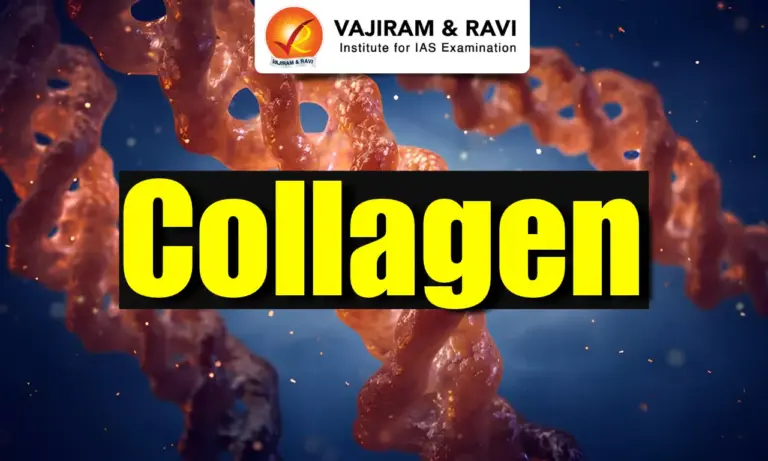
- Proteins are made from amino acids. The main amino acids that make collagen are proline, glycine and hydroxyproline.
- These amino acids group together to form protein fibrils in a triple helix structure.
- Your body also needs the proper amount of vitamin C, zinc, copper and manganese to make the triple helix.
- Types:
- Some 28 types of collagen have been identified.
- They differ by how the molecules are assembled, the cell components that are added and where the collagen is used in your body.
- Type I is the major form of collagen found in the dermis, providing tensile strength in the skin.
- Type III is the other main dermal collagen, particularly in fetal skin.
- All collagen fibrils have at least one triple helix structure.
- Collagen’s specific roles include:
- Helping fibroblasts form in your dermis (middle skin layer), which helps new cells grow.
- Playing a role in replacing dead skin cells.
- Providing a protective covering for organs.
- Giving structure, strength and elasticity to your skin.
- Helping your blood to clot.
- Collagen also contributes to building and maintaining muscle.
- What happens to collagen with ageing?
- Your body produces less collagen as you age, and existing collagen breaks down at a faster rate.
- The collagen is also lower in quality than when you were younger.
- Women experience a significant reduction in collagen production after menopause.
- It’s normal for everyone to experience a decline in collagen production after age 60.
- What diseases and other factors damage collagen?
- Autoimmune diseases (your body’s immune system attacks its own tissue) can damage collagen.
- Rheumatoid arthritis, lupus, dermatomyositis and scleroderma are autoimmune, connective tissue diseases known to damage collagen.
- Genetic mutations can also damage collagen. Collagen construction errors result in conditions such as Ehlers-Danlos syndrome and osteogenesis imperfecta.
- It can be further compromised by lifestyle factors such as smoking, excessive drinking, a diet high in sugar, and overexposure to the sun.
- Autoimmune diseases (your body’s immune system attacks its own tissue) can damage collagen.
News: TH


 Last updated on Nov, 2026
→ UPSC Interview 2026 is scheduled from 7 December 2026 to 12 February 2027.
→ UPSC Interview Guidance Programme (IGP) 2026 by Vajiram & Ravi helps aspirants prepare confidently for the UPSC Personality Test.
→ UPSC DAF 2026 application form is available from 11 to 25 November 2026, till 6:00 PM.
→ UPSC 2027 Notification will be released on 13 January 2027 at upsconline.nic.in.
→ Download PIB PRiSM Monthly Magazine 2026 here.
→ Check UPSC Monthly Current Affairs Magazine The Recitals here.
→ Check out the latest UPSC Syllabus here.
→ UPSC Calendar 2027 has been released.
→ Enroll in Vajiram & Ravi’s UPSC Mains Test Series 2027 for structured answer writing practice, expert evaluation, and exam-oriented feedback.
→ Join Vajiram & Ravi’s UPSC Mentorship Program 2027 for personalized guidance, strategy planning, and one-to-one support from experienced mentors.
→ Go through the UPSC Mains Previous Year Papers to enhance your preparation.
→ UPSC has released UPSC Toppers List 2025 with the Civil Services final result on its official website.
→ Also check Best UPSC Coaching in India
Collagen FAQs
Q1. What is collagen?+
Q2. Approximately what percentage of the body's total protein is made up of collagen?+
Q3. Which tissues and organs of the human body contain collagen?+
Q4. Which amino acids are the main building blocks of collagen?+
Q5. What is the structural arrangement of collagen protein fibrils?+
Tags: Collagen prelims current affairs prelims pointers upsc current affairs