
Cyclone Arnab 2026 is a tropical cyclone that has developed over the Bay of Bengal and is moving towards the eastern coast of India. The India Meteorological Department (IMD) has warned of further intensification, heavy rainfall and strong winds, particularly along the Andhra Pradesh coast and adjoining southern Odisha. Understanding the cyclone’s path, expected landfall, rainfall warnings and preparedness measures is important for assessing its potential effects on coastal communities, agriculture, infrastructure and disaster management.
Cyclone Arnab Latest News
As of October 29, 2026, Cyclone Arnab has weakened into a deep depression after making landfall along the Andhra Pradesh coast on October 28. According to the India Meteorological Department (IMD), the system is very likely to weaken further into a depression by Thursday morning and a well-marked low-pressure area by the evening. The cyclone has caused heavy rainfall, damage to infrastructure and agricultural land, and reported casualties in Andhra Pradesh. Despite weakening, heavy rainfall, strong winds, and potential flooding remain concerns across parts of Andhra Pradesh, Odisha, and neighbouring states.
What is Cyclone Arnab?
Cyclone Arnab is a tropical cyclone over the Bay of Bengal that is expected to intensify into a very severe cyclonic storm before reaching the Andhra Pradesh coast. Its development highlights the importance of timely weather forecasting and coastal disaster preparedness.
- Origin and development: Cyclone Arnab developed from a depression over the east-central and adjoining south-east Bay of Bengal. It subsequently intensified into a deep depression and then a cyclonic storm, according to the India Meteorological Department.
- Expected intensity: The IMD has forecast further intensification into a severe cyclonic storm, followed by a very severe cyclonic storm. The expected intensity indicates the possibility of damaging winds, heavy rainfall and coastal disruption.
- Expected landfall: The cyclone is likely to cross the Andhra Pradesh and Yanam coasts between Bapatla and Visakhapatnam by the forenoon of October 28, 2026. Authorities are preparing vulnerable areas for the potential impact.
- Wind speed: Maximum sustained wind speeds of 115-125 kmph are forecast during landfall, with gusts reaching 140 kmph. Such strong winds can damage structures, uproot trees and disrupt electricity and transport services.
- Cyclone Arnab Tracker Live: The latest available position and movement information places the cyclone over the east-central and adjoining west-central Bay of Bengal. Its projected path is towards the Andhra Pradesh coast, with landfall expected between Bapatla and Visakhapatnam.
Also Read:- Cyclones


Cyclone Arnab Name Origin
The name “Arnab” was proposed by Bangladesh and forms part of the official tropical cyclone naming list adopted in April 2020. The term “Arnab” means “Sea” or “Ocean” in Bengali. Naming of a cyclone helps authorities and the public identify weather systems and communicate warnings clearly. The IMD gives the pronunciation of Arnab as “Ornab”. Using a standard name helps distinguish this weather system from other cyclones and reduces confusion during emergency communication.
Also Read:- Cyclone Arnab
Cyclone Arnab Tracker
The Cyclone Arnab Tracker outlines the storm’s current location, forecast movement, changing wind intensity and expected weakening. The storm is under continuous monitoring by the Doppler Weather Radar at Visakhapatnam. The following timeline is based on the IMD bulletin issued on October 29, 2026.
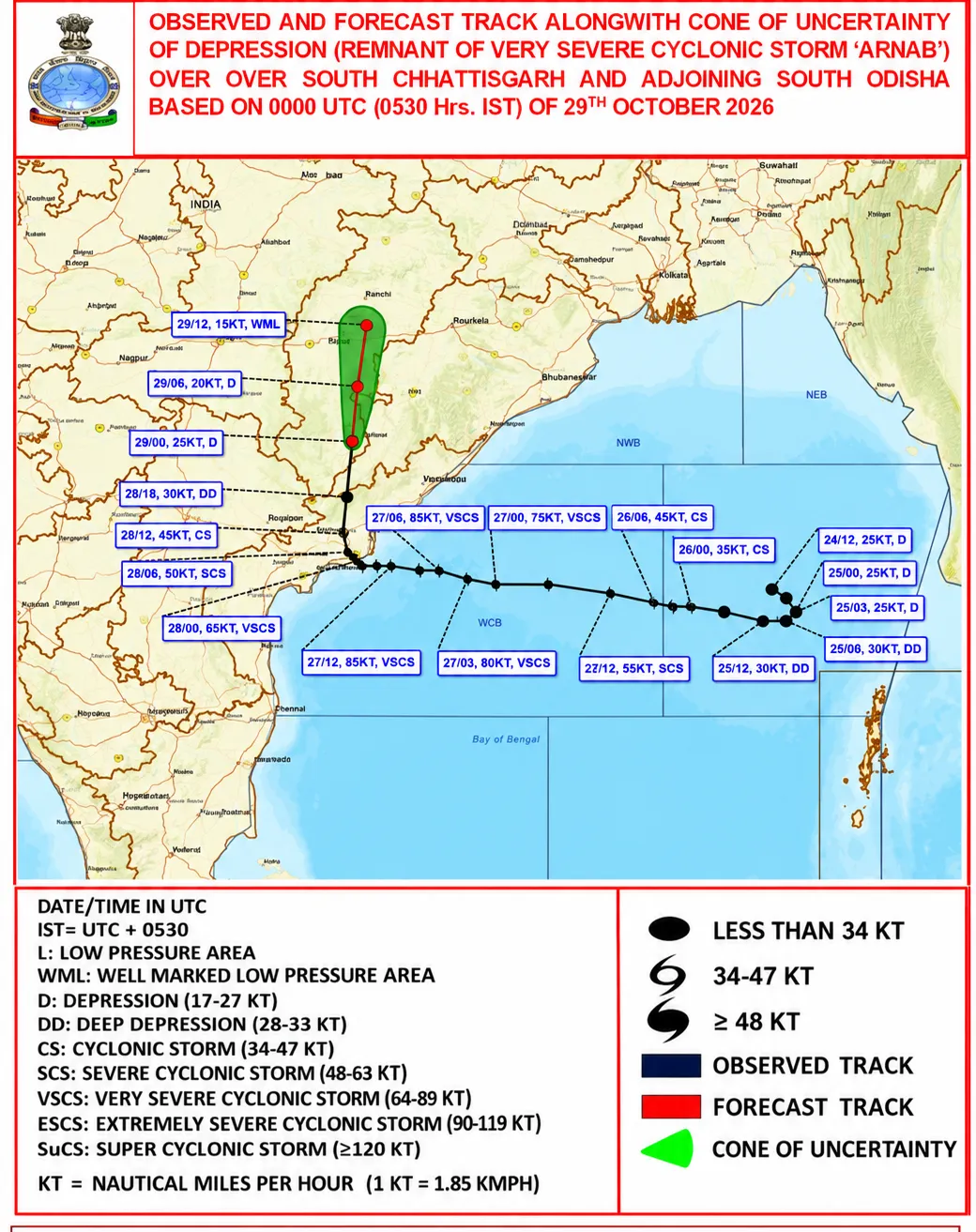
- October 28, 2026 – Landfall nearing completion: Cyclone Arnab, a very severe cyclonic storm, began landfall near Narsapur, Andhra Pradesh, at 1:30 a.m. The IMD reports that the cyclone is moving inland, with landfall expected to conclude within hours. Rainfall of up to 263 mm has been recorded in coastal Andhra Pradesh, while heavy rain and strong winds continue to threaten Odisha and surrounding regions.
- October 29, 2026 – Rainfall warning continues: Odisha is expected to experience very heavy rainfall in association with the weather system. Thunderstorms, lightning and squally conditions may create additional risks for communities, transport networks and agricultural activities.
- October 30, 2026 – Heavy rainfall forecast: The IMD’s Odisha warning schedule indicates heavy rainfall accompanied by thunderstorms, lightning and squally weather. Authorities and residents should continue following official advisories and local instructions.
- October 31, 2026 – No warning: The Odisha sub division forecast lists no warning for this date. However, residents should continue to follow updated official advisories because actual weather conditions may differ from earlier forecasts.
- November 1, 2026 – No warning: No warning is listed for Odisha on November 1. The seven day schedule indicates a gradual reduction in forecast warning levels after the period of intense rainfall and cyclone related activity.
Also Read:- Super Typhoon Champi
Arnab Cyclone Warnings
The IMD has issued warnings for coastal and inland regions amid Arnab Cyclone, highlighting risks from intense rainfall, destructive winds, rough seas, storm surge and flooding. The alerts require appropriate precautions.
- Heavy rainfall warning: On October 29, 2026, heavy to very heavy rainfall is likely over Chhattisgarh, Jharkhand, Bihar, east Uttar Pradesh and east Madhya Pradesh, with heavy rainfall at isolated places in coastal Andhra Pradesh, Odisha, Vidarbha and West Bengal. Heavy rainfall may continue over Bihar, east Uttar Pradesh, West Bengal and Sikkim during October 30–31.
- Wind warning: Squally winds of 35–45 kmph, gusting to 55 kmph, are expected over the northwest Bay of Bengal and along Odisha and West Bengal coasts until noon on October 29. Winds reaching 45–55 kmph, gusting to 65 kmph, may affect parts of south Odisha, south Chhattisgarh and northeast Telangana until the afternoon, weakening thereafter.
- Sea condition warning: Rough sea conditions are expected over the northwest Bay of Bengal and along the West Bengal coast until noon on October 29, with conditions gradually improving thereafter.
- Storm surge warning: A storm surge of approximately 1–1.5 metres above astronomical tide may inundate low-lying coastal areas of Andhra Pradesh during landfall, increasing the risk of coastal flooding.
- Fishermen and marine operations: Fishermen are advised not to venture into the northwest Bay of Bengal and along Odisha and West Bengal coasts until noon on October 29. Fishing activities should remain suspended in affected areas, and small vessels should avoid unsafe sea conditions.
- Expected impact and flooding risks: Heavy rainfall and strong winds may cause damage to standing crops, plantations and vulnerable structures, along with waterlogging, road flooding and traffic disruptions. Riverine flooding, urban flooding and landslides in hilly areas are also possible, particularly in south Odisha, south Chhattisgarh and northeast Telangana.
- Emergency precautions and safety measures: Residents in affected areas are advised to remain indoors, avoid vulnerable structures and waterlogged roads, and follow official weather and traffic advisories. Authorities should regulate road and rail traffic, monitor flood-prone areas and take necessary precautions to minimise damage.
- Emergency response and preparedness: Local authorities and disaster management agencies should monitor weather conditions, maintain emergency response arrangements and protect vulnerable communities. Fisheries departments and harbour authorities should alert fishermen and ensure compliance with the latest IMD marine warnings.
Cyclone Arnab Impacts
Cyclone Arnab may affect coastal communities through strong winds, heavy rainfall, flooding and disruption of essential services. Its expected landfall and associated rainfall also raise concerns about agricultural losses, electricity interruptions, transport difficulties and the safety of people living in low lying areas.
- Heavy rainfall and flooding: Heavy to extremely heavy rainfall is forecast in parts of southern Odisha during the warning period. Intense precipitation may cause waterlogging, local flooding and disruption to movement, particularly in vulnerable and low lying areas.
- Strong winds and structural damage: Forecast winds of 115-125 kmph, with gusts up to 140 kmph, may damage weak structures, uproot trees and affect overhead electricity lines. Coastal districts near the expected landfall require particular attention.
- Agricultural losses: Standing paddy and vegetable crops in southern Odisha face the risk of waterlogging, lodging and physical damage. Prolonged rainfall may affect harvesting and other agricultural activities, creating concerns for farmers and rural livelihoods.
- Electricity supply disruption: Strong winds, fallen trees and damaged electrical infrastructure may interrupt power distribution. Andhra Pradesh power utilities have mobilised personnel, machinery and electrical materials, while control rooms have been established to coordinate emergency response and restoration.
- Fishing and coastal livelihoods: Fishing activities have been suspended as part of cyclone preparedness and more than 4,800 fishing boats have returned safely to the Kakinada coast. Such precautionary measures reduce exposure to dangerous sea conditions.
- Transport and infrastructure: Heavy rainfall and strong winds may disrupt road movement and damage public infrastructure. Waterlogging, fallen trees and localised flooding can complicate emergency access, making advance planning for transport and essential services important.
- Displacement of vulnerable communities: Residents of low lying and exposed coastal settlements may need to move to safer locations. Evacuation planning and the availability of relief shelters can help reduce casualties and provide temporary protection during severe weather.
- Pressure on essential services: Cyclone related damage may increase demand for drinking water, food, medical assistance, electricity restoration and emergency transport. Coordinated action among government departments is essential to maintain basic services and support affected communities.
Cyclone Arnab Preparedness
Preparedness for Cyclone Arnab involves early warnings, evacuation, emergency response teams and continuity of essential services. Andhra Pradesh and Odisha have taken precautionary measures to reduce casualties and limit disruption, with particular attention to vulnerable coastal settlements and districts expecting intense rainfall.
- Early warning and monitoring: The IMD issues forecasts and warnings about cyclone intensity, movement, wind speeds and rainfall. Residents should follow the latest official bulletins and local administration instructions rather than relying on outdated forecasts or unverified information.
- Evacuation of vulnerable areas: Authorities have directed the movement of people from low lying areas to safer shelters where necessary. Timely evacuation is particularly important for coastal communities exposed to strong winds, heavy rainfall and possible flooding.
- Cyclone Arnab Tracker Live Satellite: Satellite based weather observations can help meteorological agencies monitor cloud patterns, cyclone organisation and changes in intensity. For current operational information, the IMD’s latest bulletin remains the appropriate reference for the system’s location and projected movement.
- Deployment of rescue teams: Odisha has kept 302 rescue teams ready for emergency operations. These teams can support evacuation, rescue and relief activities, helping authorities respond more effectively if the cyclone causes flooding or other damage.
- Closure of educational institutions: Schools, colleges and Anganwadi centres in Ganjam, Gajapati, Rayagada, Koraput and Malkangiri are scheduled to remain closed on October 28 and 29. The measure reduces exposure during the period of forecast severe weather.
- Power supply management: Andhra Pradesh power utilities have been instructed to take precautionary measures to maintain electricity supply. APEPDCL has opened 30 divisional control rooms and 11 circle level control rooms to coordinate monitoring, emergency action and power restoration.
- Removal of dangerous structures: Andhra Pradesh authorities have directed officials to remove dangerous hoardings and remain on high alert. Securing vulnerable structures and identifying potential hazards can reduce injuries and damage during periods of strong winds.
- Relief camps and essential supplies: Authorities have identified relief camps and reviewed arrangements for food, drinking water, medical assistance and rehabilitation. Maintaining adequate supplies helps meet immediate needs during evacuation and supports the recovery of affected communities.
- Protection of agriculture: Odisha authorities are focusing on reducing potential damage to standing crops and restoring essential services quickly. Farmers should follow locally issued agricultural advisories and take feasible precautions to protect harvested produce and vulnerable farm assets.
- Coordination among departments: Effective cyclone management requires cooperation among meteorological agencies, district administrations, disaster response teams, power utilities, fisheries departments and health services. Clear responsibilities and timely information sharing improve preparedness and reduce delays during emergencies.
Why is Bay of Bengal Prone to Cyclonic Storms?
The Bay of Bengal exposes the Indian coastline to tropical cyclones, which are influenced by warm ocean waters, atmospheric conditions and seasonal storm tracks. The key reasons for the development of frequent cyclones in Odisha and Andhra Pradesh are:
- Location along the Bay of Bengal: Odisha and Andhra Pradesh lies along a major cyclone corridor on India’s eastern coast. Storms developing over the Bay of Bengal can move towards its coastline, creating recurring exposure to strong winds and heavy rainfall.
- Warm ocean waters: Warm sea surfaces supply heat and moisture that support tropical cyclone development. When atmospheric conditions are favourable, these disturbances can strengthen over the Bay of Bengal and move towards coastal regions.
- Seasonal cyclone activity: October to December is an important period for cyclone activity in the North Indian Ocean. Odisha’s location makes it vulnerable to systems that approach the Odisha-West Bengal coastline during the post monsoon season.
- Favourable atmospheric conditions: Cyclones develop when ocean heat, atmospheric moisture, a weather disturbance, sufficient rotation and relatively weak upper level winds combine. These conditions can allow a low pressure system to intensify into a cyclonic storm.
- Storm movement towards the coast: Larger atmospheric wind patterns influence cyclone tracks. When these systems move west-northwestwards across the Bay of Bengal, Odisha and neighbouring coastal states may experience strong winds, heavy rainfall and associated hazards.

 Last updated on Nov, 2026
→ UPSC 2027 Notification will be released on 13 January 2027 at upsconline.nic.in.
→ Check Nobel Prize 2026 Winners List here.
→ Download PIB PRiSM Monthly Magazine 2026 here.
→ Check UPSC Monthly Current Affairs Magazine The Recitals here.
→ Check out the latest UPSC Syllabus here.
→ Download UPSC Model Answers for Mains 2026
→ UPSC Mains Question Paper 2026 is out now for Essay & GS Paper 1, 2, 3 & 4.
→ UPSC Calendar 2027 has been released.
→ Enroll in Vajiram & Ravi’s UPSC Mains Test Series 2027 for structured answer writing practice, expert evaluation, and exam-oriented feedback.
→ Join Vajiram & Ravi’s UPSC Mentorship Program 2027 for personalized guidance, strategy planning, and one-to-one support from experienced mentors.
→ Go through the UPSC Mains Previous Year Papers to enhance your preparation.
→ UPSC has released UPSC Toppers List 2025 with the Civil Services final result on its official website.
→ Also check Best UPSC Coaching in India
Cyclone Arnab 2026 FAQs
Q1. What is Cyclone Arnab 2026?+
Q2. When and where is Cyclone Arnab expected to make landfall?+
Q3. What is the expected wind speed of Cyclone Arnab?+
Q4. Which areas are likely to be affected by Cyclone Arnab?+
Q5. Who named Cyclone ‘Arnab’?+
Q6. How can I check the Cyclone Arnab Tracker Live and satellite updates?+
Q7. Where is Cyclone Arnab Now?+
Tags: cyclone cyclone arnab cyclone arnab 2026 cyclones