


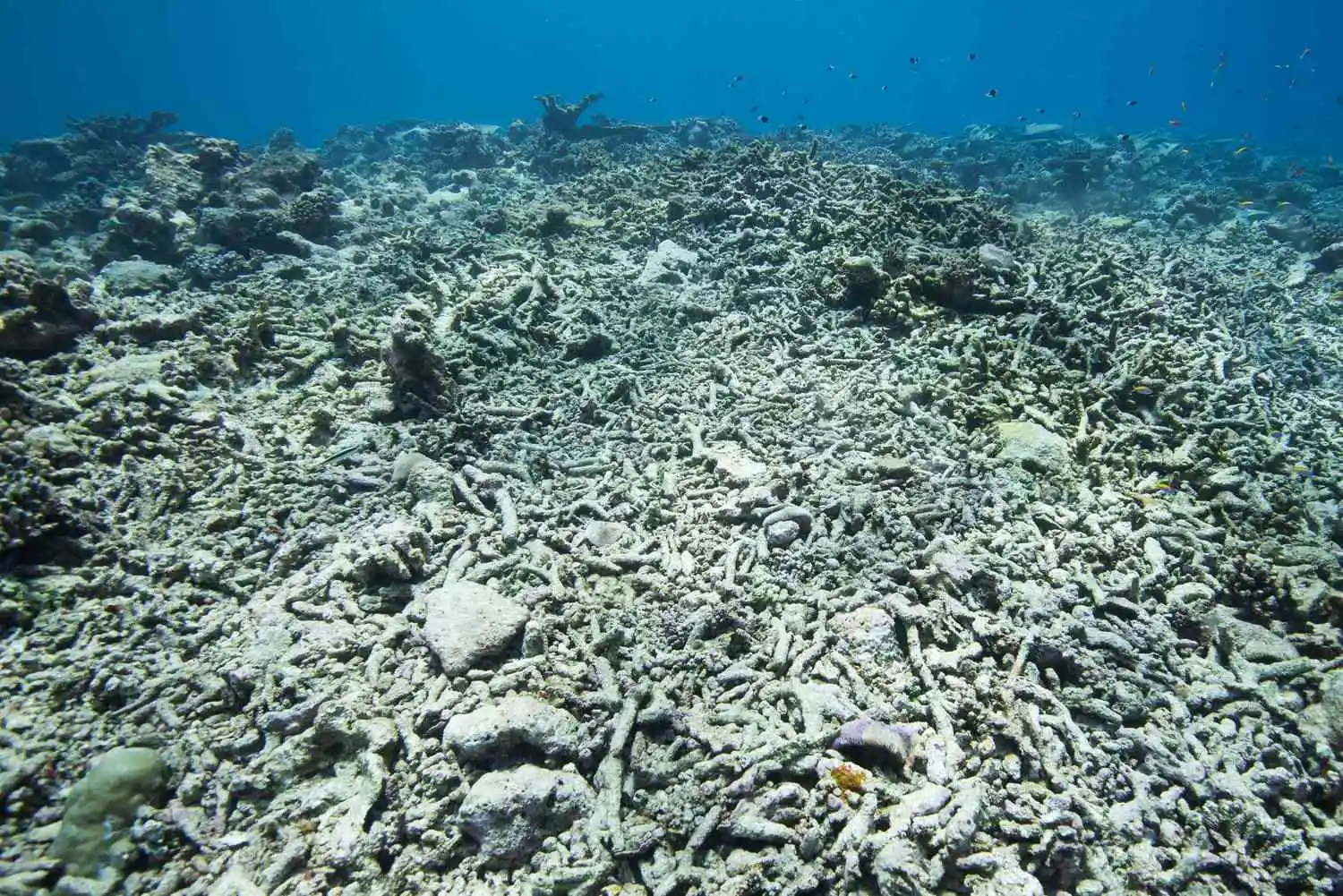
About Dead Zone:
- The term “dead zone” or “hypoxia” refers to low-oxygen areasin the world’s lakes and oceans.
- Because most organisms need oxygen to live, few organisms can survive in hypoxic conditions. That is why these areas are called dead zones.
- Hypoxic zones can occur naturally, but human activities can also lead to the creation of new dead zones or the enhancement of existing ones.
- How are Dead Zones formed?
- A dead zone occurs as a result of eutrophication, which happens when a body of water is inundated with too many nutrients, such as phosphorus and nitrogen.
- At normal levels, an organism called cyanobacteria – or blue-green algae – feeds on these nutrients.
- With too many nutrients, it can cause an overgrowth of algae in a short period of time, also called algae blooms.
- Dead zones form when the algae die, sink to the bottom, and are decomposed by bacteria—a process that strips dissolved oxygen from the surrounding water.
- Dense algal blooms also block sunlight, which prevents underwater grassesfrom growing. In turn, the animals that depend on these grasses for food and shelter suffer, as well.
- Human activities mainly cause these excess nutrients to be washed into the ocean, which is why dead zones are often located near inhabited coastlines.
- Once a dead zone forms, other factors can influence its size and duration.
- For example, wind can mix oxygen from the surface into deeper water and help break up dead zones.
- Hot temperatures can make dead zones worse by warming a layer of surface water that locks colder, denser water below where oxygen from the surface can’t mix in.
- Heavy rainfall increases the amount of pollution washed into waterways.
- Shallow waters are less likely to stratify than deep waters, and so are less likely to develop hypoxic conditions. This is because shallow waters tend to be well-mixed by winds and tides.
Additionally, waters that are shallow and clear enough to allow light to reach the bottom can support primary producers such as phytoplankton, algae and seagrasses that release oxygen during photosynthesis.
Q1: What is green algae?
Chlorophyta are commonly known as green algae and sometimes, loosely, as seaweed. They grow primarily in freshwater and saltwater, although some are found on land. They may be unicellular (one cell), multicellular (many cells), colonial (a loose aggregation of cells), or coenocytic (one large cell). Chlorophyta convert sunlight to starch that is stored in cells as a food reserve.
Source: NOAA forecasts above-average summer ‘dead zone’ in Gulf of Mexico


 Last updated on Oct, 2026
→ UPSC 2027 Notification will be released on 13 January 2027 at upsconline.nic.in.
→ Check Nobel Prize 2026 Winners List here.
→ Download PIB PRiSM Monthly Magazine 2026 here.
→ Check UPSC Monthly Current Affairs Magazine The Recitals here.
→ Check out the latest UPSC Syllabus here.
→ Download UPSC Model Answers for Mains 2026
→ UPSC Mains Question Paper 2026 is out now for Essay & GS Paper 1, 2, 3 & 4.
→ UPSC Calendar 2027 has been released.
→ Enroll in Vajiram & Ravi’s UPSC Mains Test Series 2027 for structured answer writing practice, expert evaluation, and exam-oriented feedback.
→ Join Vajiram & Ravi’s UPSC Mentorship Program 2027 for personalized guidance, strategy planning, and one-to-one support from experienced mentors.
→ Go through the UPSC Mains Previous Year Papers to enhance your preparation.
→ UPSC has released UPSC Toppers List 2025 with the Civil Services final result on its official website.
→ Also check Best UPSC Coaching in India








