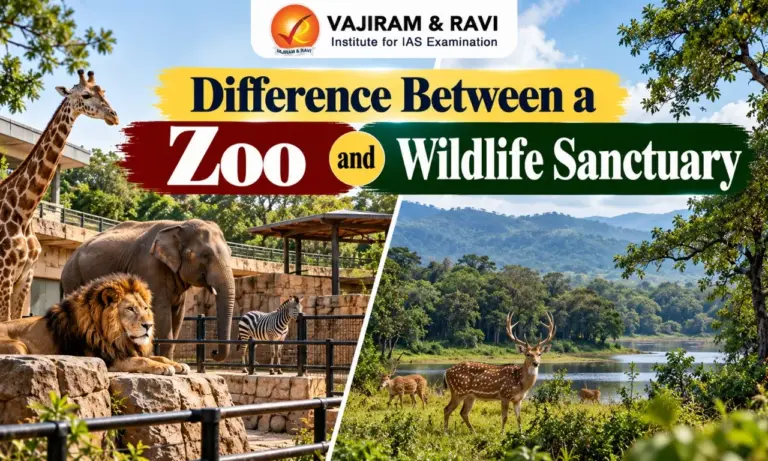
A zoo and a wildlife sanctuary are both important for wildlife conservation, but they differ in their purpose, habitat, animal management, and legal protection. A zoo generally keeps wild animals in managed enclosures for conservation, education, research, and public viewing, whereas a wildlife sanctuary protects wild animals and their natural habitats within a designated area. The Difference between a Zoo and Wildlife Sanctuary have been discussed below in this article.
In India, zoos are regulated primarily under the Wild Life (Protection) Act, 1972, through the Central Zoo Authority, while wildlife sanctuaries are declared and managed under the same Act through a separate legal framework for protected areas.
Difference between a Zoo and Wildlife Sanctuary
A zoo keeps wild animals in managed enclosures for conservation, education, research, and public viewing, whereas a wildlife sanctuary protects wild animals and their natural habitats within a legally designated area.
| Difference between a Zoo and Wildlife Sanctuary | ||
|
Basis of Difference |
Zoo |
Wildlife Sanctuary |
|
Meaning |
A facility where wild animals are kept in managed enclosures. |
A legally protected area established to conserve wildlife and its habitat. |
|
Habitat |
Animals live in designed enclosures that may recreate natural habitats. |
Animals generally live in their natural habitats, such as forests, grasslands, wetlands, and mountains. |
|
Primary objective |
Wildlife conservation, education, research, captive breeding, and public awareness. |
Protection of wild animals, plants, and their habitats from threats such as hunting and habitat destruction. |
|
Animal movement |
Movement is generally restricted to enclosures or designated spaces. |
Animals can generally move freely within the protected area, subject to natural and management-related boundaries. |
|
Food and care |
Food, veterinary care, and shelter are generally provided by zoo authorities. |
Animals usually find their own food and shelter in the wild, with management interventions where necessary. |
|
Animal origin |
Animals may be born in captivity, rescued, or transferred from other authorised facilities. |
Wildlife populations generally consist of animals living in or naturally using the protected area. |
|
Breeding |
Captive breeding may be undertaken for conservation and species recovery. |
Breeding generally occurs naturally, although specific conservation interventions may be undertaken. |
|
Human access |
Usually open to visitors under regulated conditions and specified timings. |
Entry, tourism, and activities are regulated according to conservation needs and applicable laws. |
|
Size |
Usually occupies a comparatively limited, managed area. |
May cover extensive natural landscapes, depending on the ecosystem and notification. |
|
Legal regulation |
Regulated under the Wild Life (Protection) Act, 1972, and applicable zoo recognition rules. |
Declared and regulated under Sections 18–34 of the Wild Life (Protection) Act, 1972. |
|
Examples |
National Zoological Park, New Delhi; Mysuru Zoo, Karnataka. |
Gir Wildlife Sanctuary, Gujarat; Indian Wild Ass Sanctuary, Gujarat. |
What Is a Zoo?
A zoo, or zoological park, is a facility where wild animals are maintained in captivity under human supervision. It provides opportunities for wildlife education, scientific research, veterinary care, conservation breeding, and public awareness.
Modern zoos may develop naturalistic enclosures that resemble the animals’ original habitats rather than using conventional cages.
Key features of a zoo include:
- Captive animal management: Animals are housed in enclosures designed according to their biological and behavioural needs.
- Conservation breeding: Zoos may breed threatened species to support their long-term survival and conservation.
- Education and research: They help visitors understand animal behaviour, biodiversity, and conservation challenges.
- Veterinary care: Animals receive regular health monitoring, nutrition, and treatment.
- Rescue and rehabilitation: Some zoos provide facilities for rescued or confiscated wildlife, subject to applicable authorisations.
Example: The National Zoological Park in New Delhi houses different species of wild animals and birds and supports wildlife education and conservation.


What Is a Wildlife Sanctuary?
A wildlife sanctuary is a protected area declared by the government to conserve wild animals, birds, plants, and their natural habitats. Unlike a zoo, it protects wildlife within a natural ecosystem rather than keeping animals in individual enclosures.
Wildlife sanctuaries support biodiversity conservation, ecological balance, scientific research, and the protection of threatened species. Human activities are regulated to minimise disturbance to wildlife.
Key features of a wildlife sanctuary include:
- Natural habitat protection: Forests, grasslands, wetlands, and other ecosystems are protected to support wildlife.
- Protection against hunting: Hunting and capturing protected wild animals are prohibited, subject to the applicable law.
- In-situ conservation: Species are protected within their natural habitats, allowing ecological relationships to continue.
- Regulated human activities: Tourism, grazing, entry, and other activities are governed by applicable legal provisions and management rules.
- Ecosystem conservation: Protecting habitats also helps conserve plants, soil, water resources, and other components of biodiversity.
Example: Gir Wildlife Sanctuary in Gujarat protects Asiatic lions and their habitat. It forms part of the wider Gir landscape, which is important for lion conservation.
Acts and Rules Governing Zoos and Wildlife Sanctuaries in India
The legal distinction between a zoo and a wildlife sanctuary is important because they operate under different provisions and management frameworks.
| Acts and Rules Governing Zoos and Wildlife Sanctuaries in India | |
|
Act or policy |
Relevance |
|
Wild Life (Protection) Act, 1972 |
Provides the principal legal framework for wildlife protection, protected areas, and zoo regulation. |
|
Recognition of Zoo Rules, 2009 |
Establish standards and requirements for the recognition and management of zoos. These rules were amended in 2013. |
|
National Zoo Policy, 1998 |
Provides policy guidance for zoo management, education, research, and wildlife conservation. |
|
Environment (Protection) Act, 1986 |
Provides a broader framework for environmental protection and related rules and notifications. |
|
Forest (Conservation) Act, 1980, as amended |
Regulates the diversion of forest land for non-forest purposes, subject to its applicable provisions. |

 Last updated on Oct, 2026
→ UPSC 2027 Notification will be released on 13 January 2027 at upsconline.nic.in.
→ Check Nobel Prize 2026 Winners List here.
→ Download PIB PRiSM Monthly Magazine 2026 here.
→ Check UPSC Monthly Current Affairs Magazine The Recitals here.
→ Check out the latest UPSC Syllabus here.
→ Download UPSC Model Answers for Mains 2026
→ UPSC Mains Question Paper 2026 is out now for Essay & GS Paper 1, 2, 3 & 4.
→ UPSC Calendar 2027 has been released.
→ Enroll in Vajiram & Ravi’s UPSC Mains Test Series 2027 for structured answer writing practice, expert evaluation, and exam-oriented feedback.
→ Join Vajiram & Ravi’s UPSC Mentorship Program 2027 for personalized guidance, strategy planning, and one-to-one support from experienced mentors.
→ Go through the UPSC Mains Previous Year Papers to enhance your preparation.
→ UPSC has released UPSC Toppers List 2025 with the Civil Services final result on its official website.
→ Also check Best UPSC Coaching in India
Difference between a Zoo and Wildlife Sanctuary FAQs
Q1. What is the main difference between a zoo and a wildlife sanctuary?+
Q2. Which Act regulates zoos and wildlife sanctuaries in India?+
Q3. What are some examples of zoos in India?+
Q4. What are some examples of wildlife sanctuaries in India?+
Q5. Is a zoo an example of in-situ or ex-situ conservation?+
Q6. Is a wildlife sanctuary an example of in-situ conservation?+
Tags: difference between difference between a zoo and wildlife sanctuary