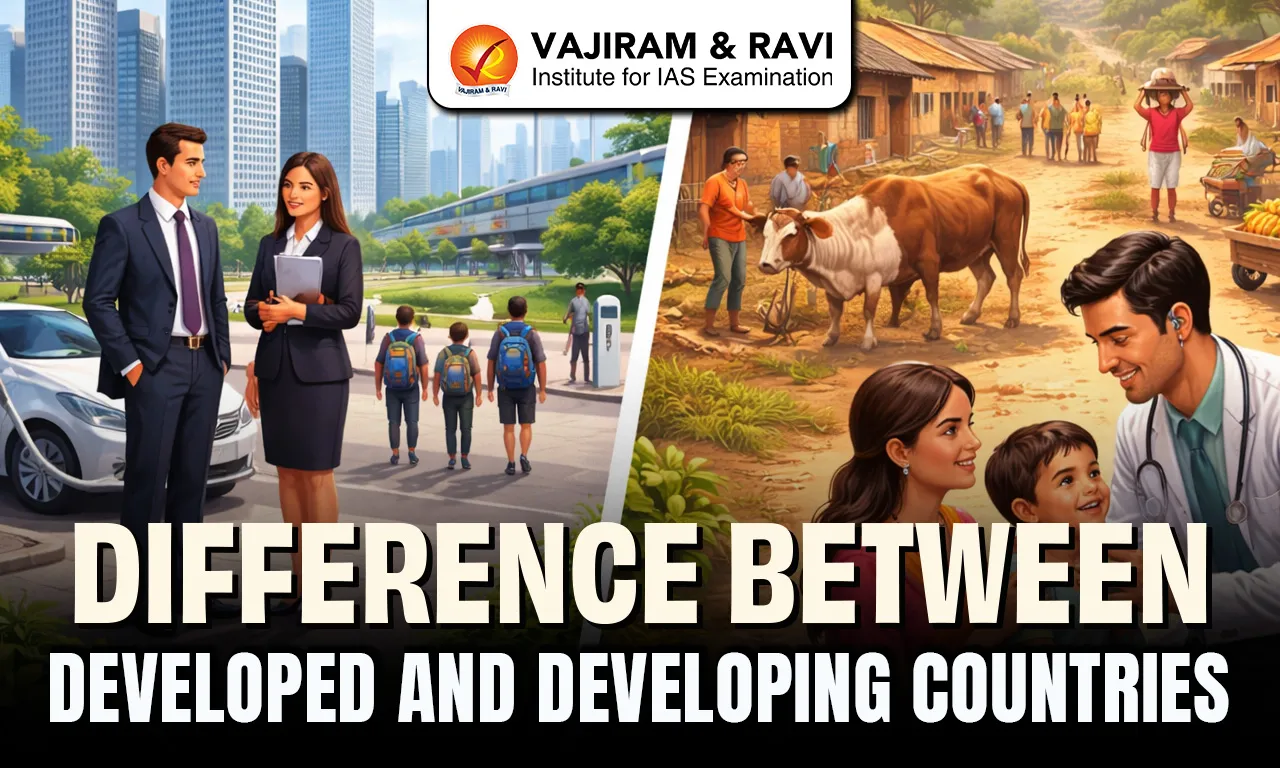
The Difference between Developed and Developing Countries is one of the most fundamental concepts in economics. It helps explain global inequality, patterns of trade, development challenges, and policy priorities. However, there is no single universal definition that clearly separates developed and developing nations. Different international organizations such as the United Nations, World Bank, and IMF use different indicators and criteria to classify countries.
In general, the Difference between Developed and Developing Countries is based on economic performance, quality of life, industrialization, human development, and technological progress.
Meaning of Developed and Developing Countries
Developed Countries: Nations with a high level of economic growth, advanced technological infrastructure, and a high standard of living. They usually have strong industrial and service sectors, high per capita income, and better social indicators such as education, health, and life expectancy.
Examples: United States, Japan, Germany, United Kingdom, France.
Developing Countries: Those countries that are in the process of industrialization and economic growth. They have lower per capita income, moderate or low levels of human development, and challenges related to poverty, infrastructure, education, and health.
Examples: India, Brazil, Indonesia, Mexico.
This basic distinction forms the core of the Difference between Developed and Developing Countries.
Difference between Developed and Developing Countries
The two most widely used methods are income-based classification and the Human Development Index (HDI).
- Income-Based Classification (World Bank): The World Bank classifies countries based on Gross National Income (GNI) per capita into four groups: low-income, lower-middle-income, upper-middle-income, and high-income.
- High-income countries generally have advanced industrial and service sectors, high productivity, and better living standards, and are considered developed.
- Low- and middle-income countries face challenges like limited industrialization, dependence on agriculture, and lower per capita income, and are considered developing.
- Human Development Index (HDI): The HDI provides a broader measure by combining health, education, and income indicators.
- Countries with very high HDI – high life expectancy, literacy, education quality, and income are classified as developed.
- Countries with medium or low HDI face challenges in health, education, and living standards and are considered developing.
By combining GNI and HDI, we understand that the Difference between Developed and Developing Countries is multi-dimensional and cannot be assessed by income alone.
| Difference between Developed and Developing Countries | ||
| Key Aspects | Developed Countries | Developing Countries |
|
Economic Development |
High per capita income, diversified economy, strong industrial and service sectors |
Low to medium per capita income, dependent on agriculture and low-value manufacturing. |
|
Industrialisation and Technology |
Highly industrialized, advanced technology, innovation-driven |
Early or intermediate industrialization, limited technology adoption. |
|
Standard of Living |
High quality of life, better healthcare, housing, and education |
Moderate or low living standards, widespread poverty, limited access to basic services. |
|
Human Development |
High literacy, long life expectancy, low infant/maternal mortality. |
Lower literacy, shorter life expectancy, high infant/maternal mortality. |
|
Demography |
Low birth/death rates, aging population |
High birth rates, young population, potential demographic challenges. |
|
Infrastructure |
Well-developed transport, energy, and digital networks |
Inadequate or uneven infrastructure, particularly in rural areas. |
|
Employment Structure |
Concentrated in formal, high-skill jobs with social protection. |
Predominantly informal, low-skill employment, minimal social protection |
|
Governance |
Strong institutions, transparent governance, robust social welfare. |
Weak institutions, corruption challenges, limited social protection. |
|
Trade |
Exports high-value goods/services, influence the global economy. |
Export low-value goods/raw materials, dependent on global markets. |


Changing Nature of the Difference between Developed and Developing Countries
In recent decades, the distinction has become more complex. Some developing countries like China and India have large economies but lower per capita income.
Many organizations now avoid strict labels because development is multi-dimensional and dynamic. Thus, the Difference between Developed and Developing Countries is not static but constantly evolving.

 Last updated on Oct, 2026
→ UPSC 2027 Notification will be released on 13 January 2027 at upsconline.nic.in.
→ Check Nobel Prize 2026 Winners List here.
→ Download PIB PRiSM Monthly Magazine 2026 here.
→ Check UPSC Monthly Current Affairs Magazine The Recitals here.
→ Check out the latest UPSC Syllabus here.
→ Download UPSC Model Answers for Mains 2026
→ UPSC Mains Question Paper 2026 is out now for Essay & GS Paper 1, 2, 3 & 4.
→ UPSC Calendar 2027 has been released.
→ Enroll in Vajiram & Ravi’s UPSC Mains Test Series 2027 for structured answer writing practice, expert evaluation, and exam-oriented feedback.
→ Join Vajiram & Ravi’s UPSC Mentorship Program 2027 for personalized guidance, strategy planning, and one-to-one support from experienced mentors.
→ Go through the UPSC Mains Previous Year Papers to enhance your preparation.
→ UPSC has released UPSC Toppers List 2025 with the Civil Services final result on its official website.
→ Also check Best UPSC Coaching in India
Difference between Developed and Developing Countries FAQs
Q1. What defines a developed country?+
Q2. What defines a developing country?+
Q3. How does the World Bank classify countries?+
Q4. What is the role of the Human Development Index (HDI)?+
Q5. Is the difference between developed and developing countries fixed?+
Tags: difference between developed and developing countries