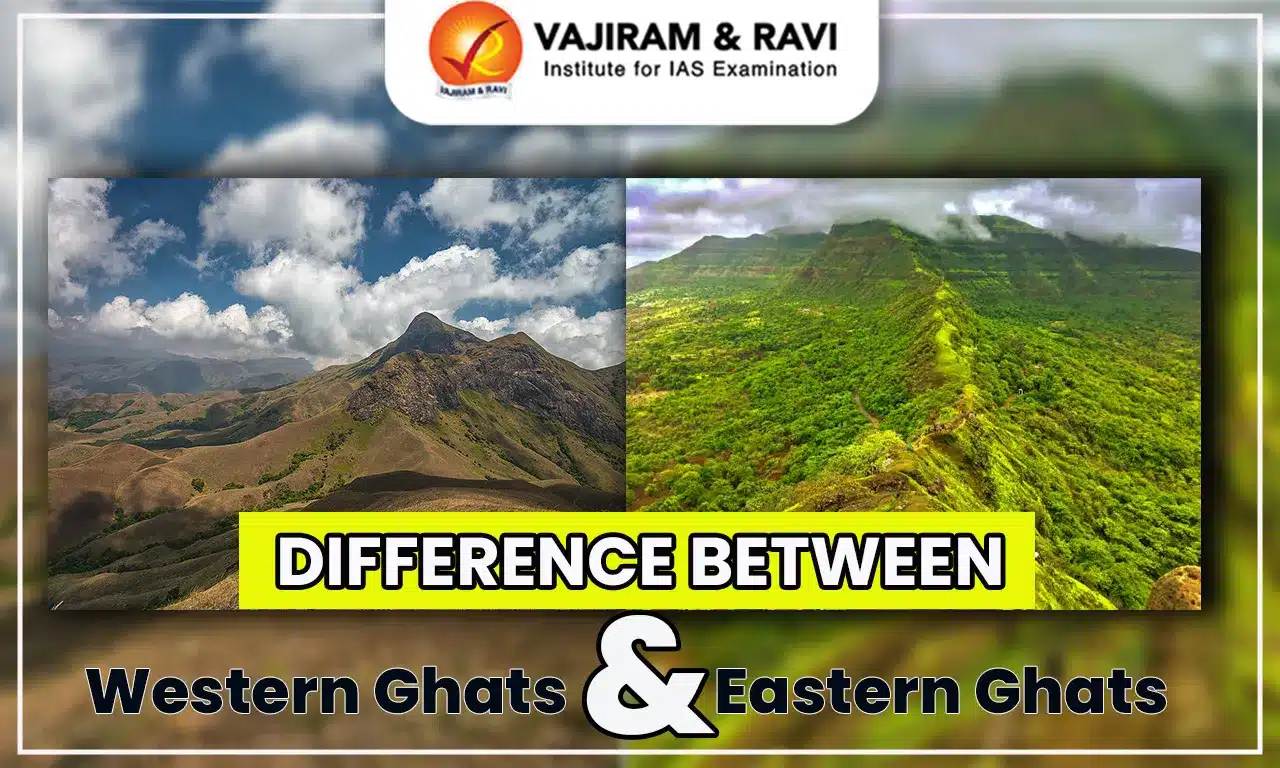
The Western and Eastern Ghats are prominent mountain ranges flanking the western and eastern coasts of India, respectively. The Difference Between Western Ghats and Eastern Ghats lies in the features that the Western Ghats are geologically older and more continuous in structure compared to the Eastern Ghats. In contrast, the Eastern Ghats are fragmented and less elevated, primarily due to prolonged erosion by rivers such as the Godavari, Mahanadi, and Krishna, which have carved through the range over time. Both ranges play a crucial role in shaping India’s climate, biodiversity, and watershed systems.
Physiographic Divisions of India
To understand the Difference Between Western Ghats and Eastern Ghats, it is crucial to know the physiographic divisions of India. The Western Ghats and Eastern Ghats are part of the Peninsular Plateau region, forming the major mountain systems along India’s western and eastern coasts respectively. India can be broadly divided into the following physiographic divisions:
- The Northern and Northeastern Mountains
- The Northern Plains
- The Peninsular Plateau
- The Indian Desert
- The Coastal Plains
- The Islands
Difference Between Western Ghats and Eastern Ghats
The table below includes the Difference Between Western Ghats and Eastern Ghats:
| Difference Between Western Ghats and Eastern Ghats | ||
| Feature | Western Ghats | Eastern Ghats |
|
Location |
Run parallel to the western coast of India |
Run parallel to the eastern coast of India |
|
Extent |
From Gujarat to Kerala (through Maharashtra, Goa, Karnataka, and Tamil Nadu) |
From Odisha to Tamil Nadu (via Andhra Pradesh) |
|
Continuity |
Continuous mountain chain with few passes |
Discontinuous, broken by rivers like Mahanadi, Godavari, Krishna, and Cauvery |
|
Average Elevation |
Higher (900–1600 meters) |
Lower (600–900 meters) |
|
Highest Peak |
Anamudi (2,695 m) in Kerala |
Arma Konda (1,680 m) in Andhra Pradesh |
|
Drainage |
Source of west-flowing rivers like Mandovi, Zuari, and Periyar |
Rivers cut through and drain into the Bay of Bengal |
|
Rainfall |
Heavy rainfall due to southwest monsoon |
Less rainfall due to distance from monsoon winds |
|
Ecological Importance |
Rich biodiversity; UNESCO World Heritage Site |
Comparatively less biodiversity |
|
Climatic Impact |
Blocks monsoon winds, causing heavy rainfall on windward side |
Allows monsoon winds to pass; hence less rainfall |
|
Soil Type |
Red and alluvial soils |
|
|
Agriculture |
Plantation crops like tea, coffee, spices |
Rice, millets, pulses |


What are Western Ghats?
The Western Ghats, also known as the Sahyadri Hills, stretch along the western edge of the Deccan Plateau. They are well-known for their biodiversity and serve as the origin point for several important rivers. Due to their steep slopes, they are less suitable for large-scale settlements but ideal for plantation farming. The region is also home to several national parks and wildlife sanctuaries.
What are Eastern Ghats?
The Eastern Ghats are older and more eroded compared to the Western Ghats. They are not continuous and have been dissected by major rivers that drain into the Bay of Bengal. These hills are rich in minerals and support agriculture, particularly rice cultivation. While their biodiversity is lower than that of the Western Ghats, they still host several endemic species and protected areas.

 Last updated on Oct, 2026
→ UPSC 2027 Notification will be released on 13 January 2027 at upsconline.nic.in.
→ Check Nobel Prize 2026 Winners List here.
→ Download PIB PRiSM Monthly Magazine 2026 here.
→ Check UPSC Monthly Current Affairs Magazine The Recitals here.
→ Check out the latest UPSC Syllabus here.
→ Download UPSC Model Answers for Mains 2026
→ UPSC Mains Question Paper 2026 is out now for Essay & GS Paper 1, 2, 3 & 4.
→ UPSC Calendar 2027 has been released.
→ Enroll in Vajiram & Ravi’s UPSC Mains Test Series 2027 for structured answer writing practice, expert evaluation, and exam-oriented feedback.
→ Join Vajiram & Ravi’s UPSC Mentorship Program 2027 for personalized guidance, strategy planning, and one-to-one support from experienced mentors.
→ Go through the UPSC Mains Previous Year Papers to enhance your preparation.
→ UPSC has released UPSC Toppers List 2025 with the Civil Services final result on its official website.
→ Also check Best UPSC Coaching in India
Difference Between Western Ghats and Eastern Ghats FAQs
Q1. What is the Difference Between Western Ghats and Eastern Ghats in terms of height?+
Q2. What is the highest peak of the Western Ghats?+
Q3. Are the Eastern Ghats continuous?+
Q4. Which ghats receive more rainfall?+
Q5. Why are the Western Ghats ecologically important?+
Tags: difference between western ghats and eastern ghats