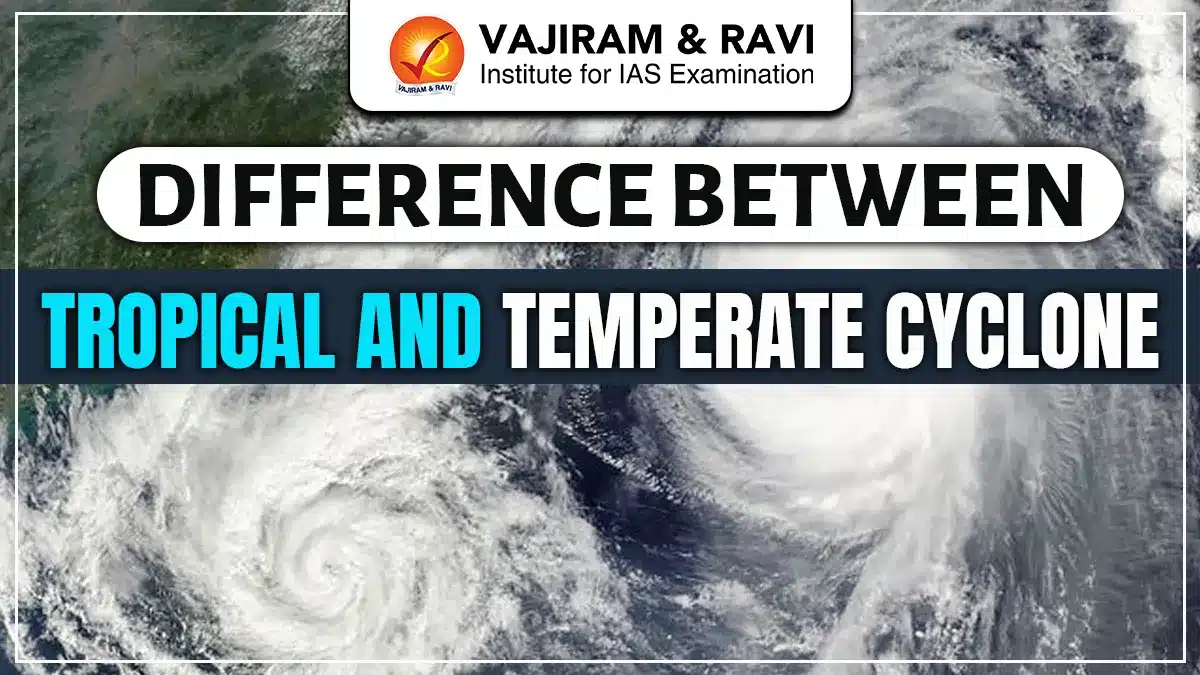
Cyclones are large atmospheric systems with a low pressure center and air moving inward in a circular manner. They play a major role in controlling weather patterns, rainfall, and wind circulation across the Earth. Based on their place of origin and mechanism of development, cyclones are broadly classified into tropical cyclones and temperate cyclones. Though both are low pressure systems, they differ clearly in origin, structure, movement, energy source, lifespan, and weather impacts, making their comparison important for understanding global atmospheric processes.
Difference between Tropical and Temperate Cyclone
The Difference between Tropical and Temperate Cyclone has been tabulated below:
| Difference between Tropical and Temperate Cyclone | ||
| Aspects | Tropical Cyclone | Temperate Cyclone |
|
Region of Origin |
Tropical cyclones develop entirely within tropical air masses between the Tropic of Cancer and Tropic of Capricorn. They mainly form over warm tropical oceans, where high moisture availability and warm conditions support intense low pressure system development. |
Temperate cyclones develop in middle latitudes, generally between 35° and 65° in both hemispheres. They originate in regions where warm and cold air masses interact strongly, especially along polar and subtropical fronts. |
|
Nature of Origin |
Tropical cyclones have a thermal origin. They form due to intense heating, high evaporation, and condensation over warm oceans, which releases large amounts of latent heat and strengthens the low pressure system in a self sustaining manner. |
Temperate cyclones have a dynamic origin. They develop due to horizontal temperature contrasts between air masses. The interaction of warm and cold fronts creates instability, leading to cyclogenesis driven by pressure gradients and atmospheric dynamics. |
|
Source of Energy |
Tropical cyclones derive energy mainly from latent heat released during condensation of moist air. Continuous supply of warm, moist air from the ocean surface is essential to maintain their strength and structure. |
Temperate cyclones derive energy from differences in temperature and density between air masses. The contrast between warm and cold air provides the main driving force rather than latent heat alone. |
|
Movement Pattern |
Tropical cyclones generally move from east to west under the influence of trade winds in lower latitudes. As they move poleward, their paths may curve due to changes in prevailing wind systems. |
Temperate cyclones usually move from west to east, guided by westerly winds and jet streams. Their movement is faster and more predictable compared to tropical cyclones. |
|
Lifespan |
Tropical cyclones usually have a shorter lifespan, generally lasting from a few days up to about one week. They weaken rapidly after moving over land or cooler waters due to loss of energy supply. |
Temperate cyclones have a longer lifespan, often lasting from 3 to 10 days and sometimes up to two weeks. They pass through stages of formation, maturity, and decay in a well defined cycle. |
|
Rainfall Characteristics |
Tropical cyclones produce very heavy rainfall over a short period due to strong convection. If they move slowly or remain stationary, rainfall can continue for several days, causing flooding and waterlogging. |
Temperate cyclones produce widespread but relatively moderate rainfall. Precipitation occurs along frontal zones and may continue for many days, leading to prolonged wet conditions rather than intense downpours. |
|
Impact |
Tropical cyclones are associated with very strong winds, intense rainfall, and severe weather near the center. Their impacts are concentrated but destructive, especially over coastal and low lying regions. |
Temperate cyclones influence large areas with changing weather conditions, including cloud cover, rain, and temperature changes. Their impact is widespread but generally less intense at any single location. |


 Last updated on Oct, 2026
→ UPSC 2027 Notification will be released on 13 January 2027 at upsconline.nic.in.
→ Check Nobel Prize 2026 Winners List here.
→ Download PIB PRiSM Monthly Magazine 2026 here.
→ Check UPSC Monthly Current Affairs Magazine The Recitals here.
→ Check out the latest UPSC Syllabus here.
→ Download UPSC Model Answers for Mains 2026
→ UPSC Mains Question Paper 2026 is out now for Essay & GS Paper 1, 2, 3 & 4.
→ UPSC Calendar 2027 has been released.
→ Enroll in Vajiram & Ravi’s UPSC Mains Test Series 2027 for structured answer writing practice, expert evaluation, and exam-oriented feedback.
→ Join Vajiram & Ravi’s UPSC Mentorship Program 2027 for personalized guidance, strategy planning, and one-to-one support from experienced mentors.
→ Go through the UPSC Mains Previous Year Papers to enhance your preparation.
→ UPSC has released UPSC Toppers List 2025 with the Civil Services final result on its official website.
→ Also check Best UPSC Coaching in India
Difference between Tropical and Temperate Cyclone FAQs
Q1. What is the main Difference between Tropical and Temperate Cyclone?+
Q2. Which Cyclones are more intense in terms of wind speed?+
Q3. Do Temperate Cyclones have fronts?+
Q4. Why do Tropical Cyclones weaken after landfall?+
Q5. Which type of Cyclone affects larger areas?+
Tags: difference between tropical and temperate cyclone