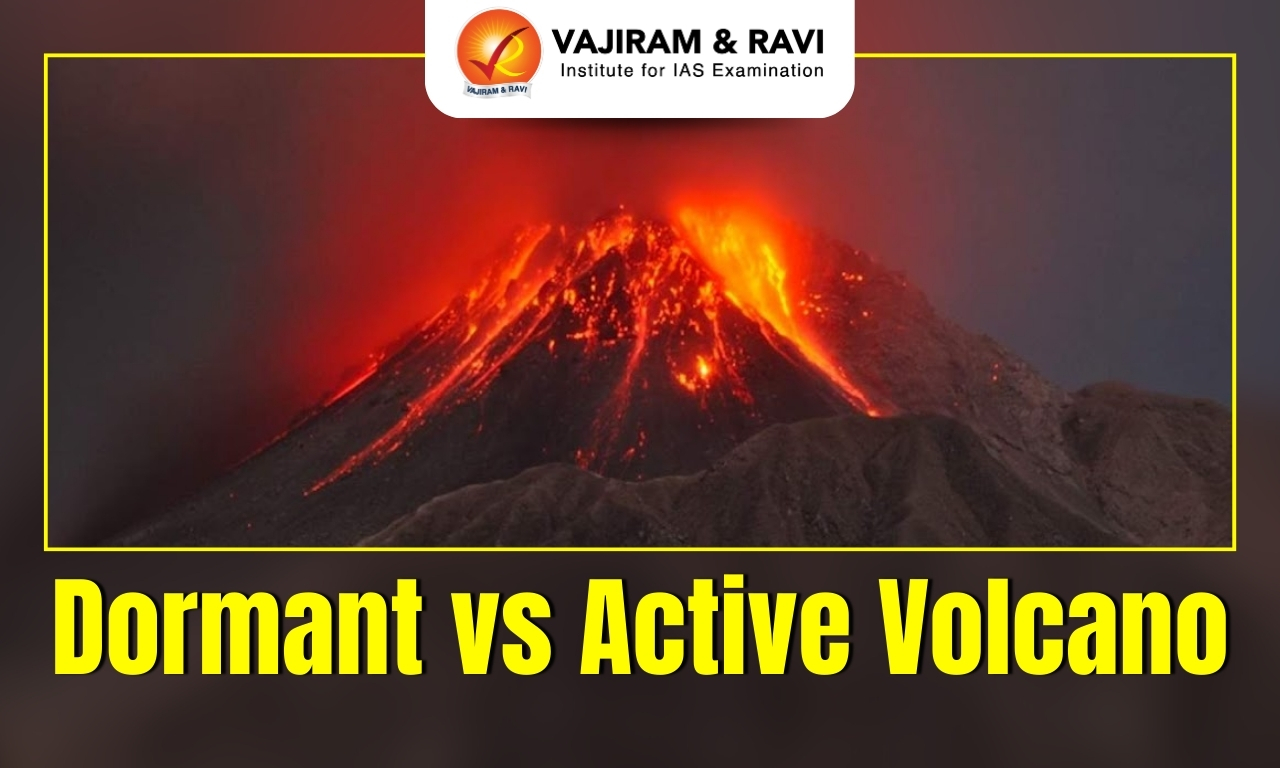
Volcanoes are natural openings in the Earth’s crust through which molten rock, gases, and ash escape from the interior of the planet. They play an important role in shaping the Earth’s surface and influencing geological processes. Based on their activity level, volcanoes are mainly classified into active, dormant, and extinct volcanoes. Among these, understanding the difference between dormant vs active volcano is important for studying volcanic hazards, geological history, and disaster preparedness.
Dormant vs Active Volcano
Dormant vs Active Volcano refers to the classification of volcanoes based on their level of activity and eruption history. The detailed comparison has been shared below in table.
| Dormant vs Active Volcano | ||
|
Basis of Comparison |
Active Volcano |
Dormant Volcano |
|
Definition |
A volcano that is currently erupting or has erupted in recent historical times and may erupt again |
A volcano that has not erupted for a long time but still has the possibility of erupting in the future |
|
Activity Level |
Shows continuous or periodic volcanic activity |
Shows no present activity but is not completely extinct |
|
Signs of Activity |
Lava flow, ash clouds, earthquakes, gas emissions, and steam release |
Usually no visible volcanic activity, but magma may still be present underground |
|
Time Since Last Eruption |
Erupted recently or within historical records |
Has not erupted for hundreds or thousands of years |
|
Risk Level |
High risk of sudden eruptions and volcanic hazards |
Lower immediate risk but still potentially dangerous |
|
Monitoring by Scientists |
Closely monitored due to frequent activity |
Monitored occasionally to detect possible reactivation |
|
Geological Condition |
Magma movement and pressure continue beneath the surface |
Magma chamber may still exist but remains inactive |
|
Common Name |
Often called an active volcano |
Often referred to as a sleeping volcano |
|
Example |
Mount Fuji |
|
Active Volcano
An active volcano is a volcano that has erupted recently or shows signs that it may erupt again in the future. These volcanoes usually display activities such as the release of gases, earthquakes, lava flows, or steam emissions. Active volcanoes are closely monitored by scientists because they can erupt at any time and may cause significant damage to nearby regions.
Examples:
- Mount Etna – One of the most active volcanoes in the world.
- Kilauea – Famous for its frequent lava eruptions.
- Mount Stromboli – Known for continuous small eruptions.


Dormant Volcano
A dormant volcano is a volcano that has not erupted for a long period but still has the potential to erupt again in the future. These volcanoes are often called “sleeping volcanoes” because they appear inactive but are not completely extinct.
Dormant volcanoes may remain quiet for hundreds or even thousands of years before becoming active again. Scientists study geological records and volcanic structures to determine whether a volcano is dormant or extinct.
Examples:
- Mount Fuji – Last erupted in 1707 but is still considered dormant.
- Mount Kilimanjaro – A dormant volcanic mountain in Africa.
- Mauna Kea – Currently dormant but could erupt again.

 Last updated on Oct, 2026
→ UPSC 2027 Notification will be released on 13 January 2027 at upsconline.nic.in.
→ Check Nobel Prize 2026 Winners List here.
→ Download PIB PRiSM Monthly Magazine 2026 here.
→ Check UPSC Monthly Current Affairs Magazine The Recitals here.
→ Check out the latest UPSC Syllabus here.
→ Download UPSC Model Answers for Mains 2026
→ UPSC Mains Question Paper 2026 is out now for Essay & GS Paper 1, 2, 3 & 4.
→ UPSC Calendar 2027 has been released.
→ Enroll in Vajiram & Ravi’s UPSC Mains Test Series 2027 for structured answer writing practice, expert evaluation, and exam-oriented feedback.
→ Join Vajiram & Ravi’s UPSC Mentorship Program 2027 for personalized guidance, strategy planning, and one-to-one support from experienced mentors.
→ Go through the UPSC Mains Previous Year Papers to enhance your preparation.
→ UPSC has released UPSC Toppers List 2025 with the Civil Services final result on its official website.
→ Also check Best UPSC Coaching in India
Dormant vs Active Volcano FAQs
Q1. What is the main difference between dormant and active volcanoes?+
Q2. What is a dormant volcano?+
Q3. What is an active volcano?+
Q4. Is Mount Fuji active or dormant?+
Q5. Why are active volcanoes dangerous?+
Tags: geography geography notes