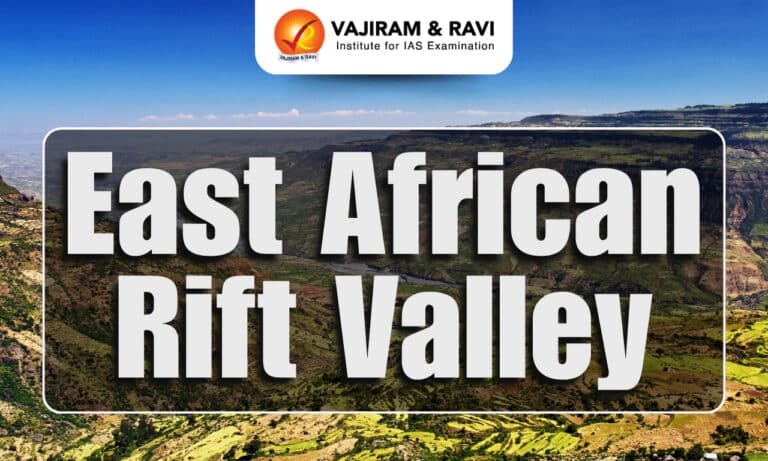
The East African Rift Valley (EARV) is one of the most remarkable geological features on Earth. It represents the largest active continental rift system in the world, extending for nearly 3,500 kilometers from the Red Sea in northeastern Africa to Mozambique in southeastern Africa. This vast tectonic zone is characterized by deep valleys, steep escarpments, active volcanoes, earthquakes, and large freshwater lakes.
East African Rift Valley
The East African Rift Valley is a massive geological depression formed due to the gradual stretching and thinning of the Earth’s continental crust. It marks a divergent plate boundary where the Somali Plate is moving away from the Nubian Plate (part of the African Plate). The East African Rift is considered one of the best natural laboratories for studying continental breakup and plate tectonics.
East African Rift Valley Location
The East African Rift Valley is located in the eastern part of Africa and extends for about 3,500 kilometers from the Red Sea region in northeastern Africa to Mozambique in southeastern Africa. It passes through several countries, including Ethiopia, Kenya, Uganda, Rwanda, Burundi, Tanzania, Malawi, Mozambique, and the Democratic Republic of Congo.


Formation of East African Rift Valley
The East African Rift Valley was formed through the gradual stretching, faulting, and thinning of the Earth’s continental crust due to tectonic plate divergence and mantle upwelling over millions of years.
- Mantle Plume Upwelling: A hot mantle plume rising from deep within the Earth increased heat flow beneath East Africa, causing uplift and weakening of the continental lithosphere.
- Crustal Uplift: The rising mantle material pushed the Earth’s crust upward, creating broad elevated plateaus across Ethiopia, Kenya, and surrounding regions.
- Tectonic Plate Divergence: The Somali Plate began moving away from the Nubian Plate, generating extensional forces that stretched the continental crust.
- Development of Extensional Stress: Continuous plate movement created tensional stress, causing the crust to crack and fracture along weak zones.
- Formation of Normal Faults: Large normal faults developed as blocks of crust moved downward due to extension, creating steep escarpments on both sides of the rift.
- Creation of Horst and Graben Structures: Some crustal blocks subsided to form grabens (rift valleys), while adjacent blocks remained elevated as horsts, producing the characteristic rift valley landscape.
- Crustal Thinning: Ongoing stretching gradually reduced the thickness of the continental crust, making it more vulnerable to faulting and volcanic activity.
- Magma Intrusion: Magma from the mantle rose through fractures and fissures in the weakened crust, further promoting rift development.
- Volcanic Activity: Extensive basaltic lava eruptions and volcanic activity accompanied rifting, covering large areas with volcanic rocks and forming volcanic mountains.
- Formation of Rift Lakes: As sections of the crust subsided, deep depressions filled with water, leading to the formation of major lakes such as Tanganyika, Malawi, and Turkana.
- Expansion of the Rift System: Continued tectonic activity widened and lengthened the rift, resulting in the development of the Eastern and Western Rift branches.
- Ongoing Continental Breakup: The rifting process is still active today, and scientists believe that continued divergence may eventually split eastern Africa from the rest of the continent, creating a new ocean basin.
East African Rift Valley Features
The East African Rift Valley is one of the world’s most active tectonic regions, known for its unique geological formations, volcanic activity, deep lakes, and ongoing continental breakup.
- World’s Largest Active Continental Rift: The East African Rift Valley stretches for approximately 3,500 km from the Red Sea to Mozambique, making it the largest active continental rift system on Earth.
- Divergent Plate Boundary: It marks a zone where the Somali Plate is gradually moving away from the Nubian Plate, causing the Earth’s crust to stretch, thin, and fracture.
- Two Distinct Rift Branches: The rift system is divided into the Eastern Rift Valley and the Western Rift Valley, each displaying different stages of tectonic and geological development.
- Extensive Fault Systems: The region contains numerous normal faults and steep fault scarps formed due to crustal extension, creating the characteristic rift valley landscape.
- Active Volcanic Region: The rift hosts several active and dormant volcanoes, including Erta Ale, Mount Kilimanjaro, Mount Kenya, and Ol Doinyo Lengai, indicating ongoing magmatic activity beneath the crust.
- Frequent Earthquake Activity: Continuous movement of tectonic plates generates regular earthquakes, making the region one of Africa’s most seismically active zones.
- Presence of Deep Rift Lakes: The valley contains some of the world’s deepest freshwater lakes, such as Lake Tanganyika, Lake Malawi, Lake Turkana, Lake Albert, and Lake Kivu, formed through crustal subsidence.
- Afar Triple Junction: The northern part of the rift includes the Afar Triple Junction, where the East African Rift, Red Sea Rift, and Gulf of Aden Rift converge, creating intense tectonic activity.
- Horst and Graben Topography: Alternating uplifted blocks (horsts) and down-faulted depressions (grabens) create dramatic landscapes of mountains, plateaus, and deep valleys.
- High Geothermal Potential: Heat from the Earth’s interior has created significant geothermal resources, particularly in countries like Kenya and Ethiopia, supporting renewable energy production.
- Rich Fossil and Archaeological Sites: The Rift Valley contains important fossil-bearing sediments that have provided valuable evidence about early human evolution and prehistoric life.
- Ongoing Continental Breakup: The rift represents an active stage of continental separation and is expected to eventually lead to the formation of a new ocean basin over geological time scales.
- Unique Biodiversity and Ecosystems: The region supports diverse habitats, including lakes, grasslands, forests, and volcanic highlands, making it an important biodiversity hotspot.

 Last updated on Oct, 2026
→ UPSC 2027 Notification will be released on 13 January 2027 at upsconline.nic.in.
→ Check Nobel Prize 2026 Winners List here.
→ Download PIB PRiSM Monthly Magazine 2026 here.
→ Check UPSC Monthly Current Affairs Magazine The Recitals here.
→ Check out the latest UPSC Syllabus here.
→ Download UPSC Model Answers for Mains 2026
→ UPSC Mains Question Paper 2026 is out now for Essay & GS Paper 1, 2, 3 & 4.
→ UPSC Calendar 2027 has been released.
→ Enroll in Vajiram & Ravi’s UPSC Mains Test Series 2027 for structured answer writing practice, expert evaluation, and exam-oriented feedback.
→ Join Vajiram & Ravi’s UPSC Mentorship Program 2027 for personalized guidance, strategy planning, and one-to-one support from experienced mentors.
→ Go through the UPSC Mains Previous Year Papers to enhance your preparation.
→ UPSC has released UPSC Toppers List 2025 with the Civil Services final result on its official website.
→ Also check Best UPSC Coaching in India
East African Rift Valley FAQs
Q1. What is the East African Rift Valley?+
Q2. Where is the East African Rift Valley located?+
Q3. How was the East African Rift Valley formed?+
Q4. Which tectonic plates are involved in the East African Rift?+
Q5. What is the Afar Triple Junction?+
Q6. Why is the East African Rift Valley important?+
Q7. Which are the major lakes found in the East African Rift Valley?+
Tags: east african rift valley geography geography notes