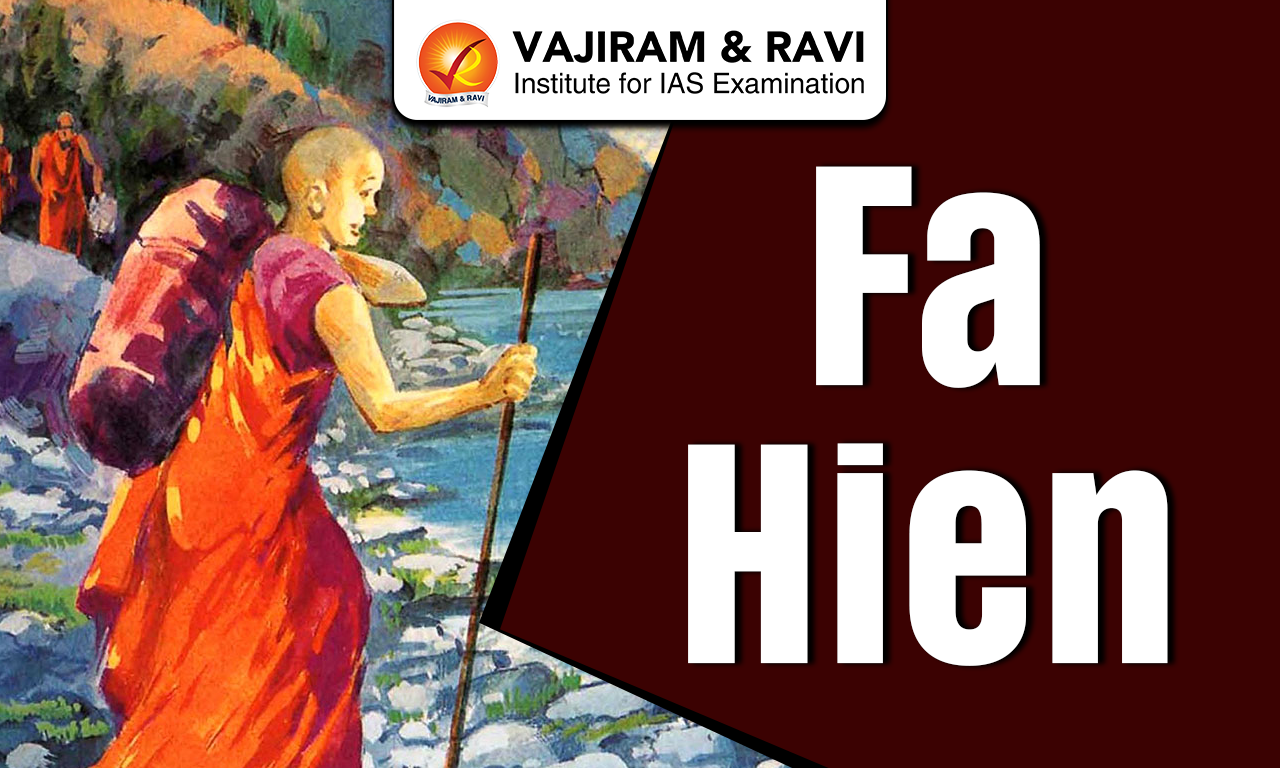
Fa-Hien was a famous Chinese Buddhist monk and traveler who visited India during the reign of Chandragupta II in the early 5th century CE. His journey is considered one of the most important sources for understanding the social, religious, and economic conditions of ancient India, especially during the Gupta period.
His travel account, “Fo-Kwo-Ki” (Record of Buddhist Kingdoms), provides valuable insights for understanding Ancient Indian History.
Fa-Hien’s Early Life and Background
Fa-Hien was born in 337 CE in Pingyang (modern Shanxi province in China). He lost his parents at a young age and was brought up in a Buddhist monastery.
- He became a devoted follower of Buddhism early in life.
- He spent most of his years studying Buddhist scriptures.
- He was particularly interested in the Vinaya Pitaka, which contains rules for monks and nuns.
- During a visit to Chang’an, he found that many Buddhist texts in China were incomplete or corrupted.
Purpose of Fa-Hien’s Visit to India
Fa-Hien’s journey was purely religious and scholarly in nature. His main objectives were:
- To collect original Buddhist texts, especially the Vinaya Pitaka
- To visit important Buddhist pilgrimage sites associated with Gautama Buddha
- To study the original teachings and practices of Buddhism
- To interact with Indian monks and scholars
- To bring back sacred texts to China for translation and preservation


Fa-Hien’s Journey to India
Fa-Hien began his remarkable journey to India in 399 CE from Chang’an with the aim of collecting authentic Buddhist texts and visiting sacred sites associated with Gautama Buddha. Traveling mostly on foot, he crossed dangerous deserts, mountains, and regions of Central Asia before entering India through the northwest.
- Started journey at the age of 62 from Chang’an (modern Xi’an, China)
- Traveled with a group of Buddhist monks on a religious mission
- Crossed the Gobi Desert, facing extreme climatic conditions
- Passed through Central Asian regions like Khotan and Kashgar
- Entered India via the northwestern region (present-day Pakistan)
- First major stop in India was Purushapura (Peshawar)
- Traveled across important cities like Taxila, Mathura, and Pataliputra
- Followed the course of the Ganga River towards eastern India
- Visited major Buddhist pilgrimage sites including Lumbini, Bodh Gaya, and Sarnath
- Reached Tamralipti port on the eastern coast
- Traveled to Sri Lanka by sea and stayed there for about two years
- Returned to China through a difficult and risky sea route
Important Places Visited by Fa-Hien
Fa-Hien visited several important cities and sacred Buddhist sites during his journey across India and nearby regions. His travel accounts provide valuable details about these places, especially their religious significance, prosperity, and cultural life during the Gupta period.
- Purushapura (Peshawar) – One of the first places he visited after entering India; associated with Kanishka and a famous Buddhist stupa
- Taxila – An important center of learning and culture; known for education and Buddhist influence
- Mathura – Described as a prosperous and peaceful city where people followed non-violence, vegetarianism, and moral values
- Pataliputra – Capital of the Gupta Empire; stayed here for about 3 years, learned Sanskrit, and copied Buddhist texts; observed well-developed monasteries
- Vaishali – Important Buddhist site associated with the life and teachings of Gautama Buddha
- Rajgir – Ancient capital of Magadha; known for Buddhist heritage and monasteries
- Bodh Gaya – The place where Gautama Buddha attained enlightenment; major pilgrimage center
- Sarnath – Site of Buddha’s first sermon (Dharmachakra Pravartana)
- Kushinagar – Place where Buddha attained Mahaparinirvana
- Lumbini – Birthplace of Gautama Buddha; an important pilgrimage destination
- Champa – A significant town along the Ganga route during his travels
- Tamralipti – A major eastern port in present-day West Bengal; center of trade and departure point for sea journey
- Sri Lanka (Ceylon) – Stayed for about two years to study Buddhist traditions and collect texts
Political Conditions (As per Fa-Hien)
Fa-Hien describes the political system of India during the time of Chandragupta II as stable, peaceful, and welfare-oriented. His account reflects a benevolent administration where people enjoyed security, prosperity, and freedom.
- Administration was liberal and efficient, ensuring smooth governance
- Empire experienced peace and internal security with very low crime rate
- Taxation was moderate, and people were not overburdened
- Fines were the main form of punishment; harsh penalties were rarely used
- Religious institutions were exempt from taxes, showing tolerance
- State promoted public welfare through rest houses and free hospitals
Economic Conditions
Fa-Hien describes India during the time of Chandragupta II as economically prosperous and well-developed. His account highlights a strong agrarian base, flourishing trade, and effective public welfare systems.
- Agriculture was the main occupation, and land revenue was the primary source of state income
- Tax burden was low, indicating economic stability and prosperity
- Internal and external trade flourished, supported by well-connected routes
- Important ports like Tamralipti facilitated overseas trade and sea voyages
- Rest houses and hospitals were maintained, providing free services to travelers and the poor
- Wealthy individuals actively engaged in charity and donations, supporting temples and monasteries
Social Conditions
Fa-Hien portrays Indian society during the time of Chandragupta II as morally strong, prosperous, and disciplined. His observations highlight a simple lifestyle, high ethical standards, and a well-structured social order.
- People were honest, law-abiding, and followed high moral values
- Majority of the population practiced vegetarianism and avoided alcohol and intoxicants
- Society was organized under the caste system, with clear social divisions
- Untouchability existed, and Chandalas were considered the lowest group
- Charity and donations were common; people supported temples, monasteries, and the poor
- Social practices like slavery, Devadasi system, and discouragement of widow remarriage were present
Religious Conditions
Fa-Hien observed that India during the time of Chandragupta II was marked by religious tolerance and harmony. Different religions, especially Buddhism and Hinduism, coexisted peacefully, and people freely followed their faiths.
- Buddhism and Hinduism flourished together without conflict
- Buddhism was more popular in regions like Punjab, Bengal, and Mathura
- The teachings of Gautama Buddha were widely followed in many areas
- Both Mahayana and Hinayana sects of Buddhism were present
- Monasteries (Viharas) served as centers of learning and residence for monks
- Religious tolerance prevailed, and temples and monasteries received patronage and donations

 Last updated on Oct, 2026
→ UPSC 2027 Notification will be released on 13 January 2027 at upsconline.nic.in.
→ Asian Games 2026 are being held in Aichi-Nagoya, Japan, from 19 September to 4 October.
→ Check Nobel Prize 2026 Winners List here.
→ Download PIB PRiSM Monthly Magazine 2026 here.
→ Check UPSC Monthly Current Affairs Magazine The Recitals here.
→ Check out the latest UPSC Syllabus here.
→ Download UPSC Model Answers for Mains 2026
→ UPSC Mains Question Paper 2026 is out now for Essay & GS Paper 1, 2, 3 & 4.
→ UPSC Calendar 2027 has been released.
→ Enroll in Vajiram & Ravi’s UPSC Mains Test Series 2027 for structured answer writing practice, expert evaluation, and exam-oriented feedback.
→ Join Vajiram & Ravi’s UPSC Mentorship Program 2027 for personalized guidance, strategy planning, and one-to-one support from experienced mentors.
→ Go through the UPSC Mains Previous Year Papers to enhance your preparation.
→ UPSC has released UPSC Toppers List 2025 with the Civil Services final result on its official website.
→ Also check Best UPSC Coaching in India
Fa Hien FAQs
Q1. Who was Fa-Hien?+
Q2. During whose reign did Fa-Hien visit India?+
Q3. What is Fa-Hien famous for?+
Q4. What was the main purpose of his visit?+
Q5. How long did Fa-Hien stay in India?+
Tags: ancient indian history fa-hien