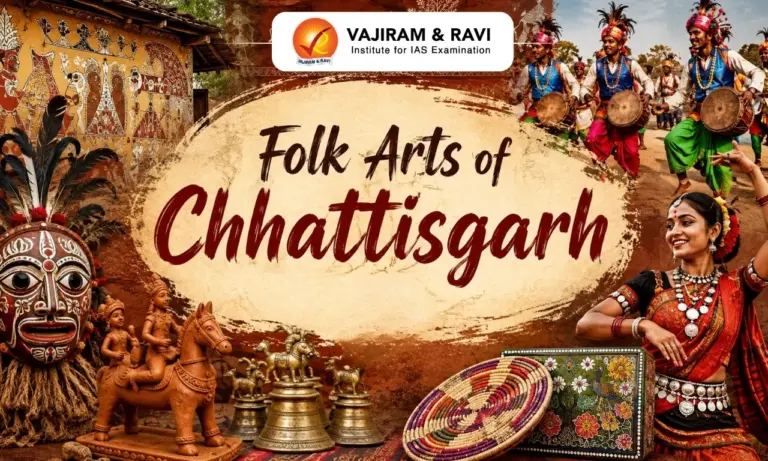
Folk Arts of Chhattisgarh reflect the state’s rich tribal heritage, traditional knowledge and artistic skills. These art forms are closely linked with nature, local customs, beliefs and everyday life. Traditional forms such as Terracotta, Godna, Gond, Muria and Pithora, along with crafts like Dhokra, Kosa silk and Bastar woodcraft, showcase the diverse cultural identity of Chhattisgarh.
Major Folk Arts of Chhattisgarh
The following major folk art forms of Chhattisgarh highlight the state’s diverse tribal traditions, artistic skills and cultural heritage, which are discussed below.
- Terracotta
- Terracotta is an important traditional craft of Chhattisgarh, particularly associated with areas such as Bastar, Raigarh and Ambikapur.
- Artisans use locally available clay, often collected from riverbanks and carefully knead it before giving it different shapes by hand.
- The craft is not limited to decorative objects. Terracotta figures reflect local customs, tribal traditions and community life.
- The designs may represent people’s beliefs, emotions, celebrations and different stages of life, making the craft an expression of the region’s cultural heritage.
- Godna
- Godna is a traditional form of tribal body art that has a strong cultural association with several tribal communities.
- In Chhattisgarh, it is particularly valued among the Baiga community, especially among women, where traditional tattoo designs have been passed down through generations.
- Godna designs commonly include geometric patterns, plants, animals, deities and themes from tribal myths.
- Traditionally, the designs were created by making small marks on the skin and applying natural tattooing material.
- In Chhattisgarh, Godna has also developed as a painting tradition, with Devar Godna of Rajnandgaon and Godi Godna of Surguja being notable examples.
- Muria Art
- Muria art is associated with the Muria tribal community of Bastar, particularly the northern and central parts of the Bastar region.
- Traditionally, Muria communities decorated the walls of their Ghotul and houses with simple designs using locally available materials.
- Muria paintings are generally simple, spontaneous and closely connected with tribal life.
- Red and white clay are commonly used to create patterns, while later forms of the tradition began depicting customs, everyday life and tribal dances. Artists such as Meheru Muria are associated with this painting tradition.
- Gond Art
- Gond art represents the close relationship between tribal communities and nature. It is practised by Gond communities in several central Indian states, including Chhattisgarh.
- The paintings often portray animals, plants, nature, deities and elements of tribal life, reflecting the community’s understanding of the natural world.
- A distinctive feature of Gond painting is the use of small dots, lines, circles and repeated patterns to fill figures and create texture.
- Artists generally begin with an outline and then add colours and patterns to complete the image. The eyes are traditionally completed at the end, symbolically giving the artwork a sense of life.
- Pithora Art
- Pithora is a traditional tribal wall-painting style found in parts of Chhattisgarh as well as neighbouring central and western Indian regions.
- It has an important ritual and religious significance and is associated with the worship of Baba Pithora, regarded as a protective village deity.
- Pithora paintings are usually created on mud-plastered walls and contain images of deities, animals, nature and activities from everyday life such as farming and trade.
- Traditional colours such as red, ochre, yellow and black are used to give the paintings a distinctive appearance.
Also Read:- Tribes of Chhattisgarh
Traditional Folk Paintings and Crafts of Chhattisgarh
These traditional paintings and crafts showcase the artistic skills, tribal traditions and cultural heritage of Chhattisgarh, as discussed below.
- Kosa Silk
- Kosa silk is one of the well-known traditional textile crafts of Chhattisgarh, with Korba and Champa being important production areas.
- It is made from the cocoons of the Indian silkworm Antheraea mylitta, which is associated with trees such as Arjun, Saja and Sal.
- Kosa silk is valued for its durability, attractive appearance and traditional designs. Artisans use natural dyes and skilled weaving techniques to produce sarees and other textile products.
- Since the silk-making process is time-consuming and the cocoons are not easily available, Kosa silk products can be relatively expensive.
- Dhokra Craft
- Dhokra is one of the most recognised traditional metal crafts of Bastar, Chhattisgarh.
- It is made using the lost-wax or hollow-casting technique, through which artisans create figures and decorative objects from non-ferrous metals such as brass and bronze.
- Dhokra artisans, including the Ghadwas of Bastar and Jharas, create a wide range of objects inspired by folk deities, Hindu gods and goddesses, animals and everyday life.
- The process requires considerable patience and precision and the Dhokra bull of Bastar is among the notable examples of this craft.
- Bastar Woodcraft
- Bastar woodcraft is a traditional carving practice that developed from the long-standing use of wood by tribal communities.
- Over time, artisans began using their woodworking skills to create decorative and functional objects, leading to the development of specialised craftsmanship in the region.
- Skilled artisans create doors, ceilings, decorative pieces and life-size figures of gods and goddesses using mostly manual techniques.
- Woods such as teak, sal, shisham and dhudi are commonly used. The craft reflects both the artistic skills of Bastar’s artisans and their traditional connection with forest resources.
- Tuma Craft
- Tuma craft is a distinctive example of using natural materials in traditional handicrafts.
- Tuma, a local wild bottle gourd, is dried and hollowed out before being transformed into useful and decorative objects. Traditionally, it has also been used as a natural container for storing water.
- Bastar artisans use dried Tuma to make lamps, toys, jewellery and other decorative items.
- The surface can be carefully etched with traditional symbols, patterns, myths and folklore. This craft highlights the creativity of local artisans and their ability to turn an ordinary natural material into useful art.
- Stone Carving
- Stone carving is another traditional craft practised in Chhattisgarh, with Bastar being known for its stone craftsmanship.
- Artisans use locally available stone, including Sudapaal stone and shape it with tools such as cutters and chisels.
- The artisans create religious idols, sculptures, pillars and vessels through detailed hand carving.
- Figures of deities such as Shiva, Parvati and Ganesha are among the common subjects. After carving, the finished pieces are polished to improve their appearance and bring out the details of the work.
- Sisal Art
- Sisal art makes use of the strong fibres obtained from sisal plants, which grow in several parts of Chhattisgarh.
- The fibre is valued for being durable and water-resistant, making it suitable for both decorative and everyday products.
- Local artisans use sisal fibre to create items such as mats, baskets, ropes and wall hangings. Its natural appearance, strength and sustainable character have helped increase interest in sisal-based handicrafts.
Also Read:- Festivals of Chhattisgarh


Cultural Significance of Folk Arts in Chhattisgarh
- Folk arts preserve tribal traditions and local identity by passing knowledge, designs and artistic practices from one generation to another. Many of these art forms are closely connected with the customs and beliefs of the communities that practise them.
- Nature has a strong presence in Chhattisgarh’s folk arts. Materials such as clay, wood, stone, natural fibres, silk and bottle gourds are commonly used by artisans. This shows the traditional relationship between local communities and their natural surroundings.
- Religious and cultural beliefs are reflected through art. Paintings and crafts often feature deities, animals, plants, tribal myths and symbols. In forms such as Godna and Pithora, artistic expression is closely linked with traditional beliefs and rituals.
- Folk arts also depict everyday tribal life. Muria and Gond paintings, for example, portray elements of community life, customs, nature and traditional activities. In this way, folk art acts as a visual record of the lifestyle and experiences of local communities.
- These crafts provide livelihood opportunities for local artisans. Traditional skills in areas such as Kosa silk, Dhokra, woodcraft, stone carving and terracotta continue to support handicraft-based economic activities while keeping indigenous techniques alive.
- Chhattisgarh’s folk arts contribute to its cultural tourism. Distinctive crafts such as Bastar Dhokra, Bastar woodcraft, terracotta and stone carving attract visitors interested in tribal culture, traditional craftsmanship and handmade products.

 Last updated on Oct, 2026
→ UPSC 2027 Notification will be released on 13 January 2027 at upsconline.nic.in.
→ Check Nobel Prize 2026 Winners List here.
→ Download PIB PRiSM Monthly Magazine 2026 here.
→ Check UPSC Monthly Current Affairs Magazine The Recitals here.
→ Check out the latest UPSC Syllabus here.
→ Download UPSC Model Answers for Mains 2026
→ UPSC Mains Question Paper 2026 is out now for Essay & GS Paper 1, 2, 3 & 4.
→ UPSC Calendar 2027 has been released.
→ Enroll in Vajiram & Ravi’s UPSC Mains Test Series 2027 for structured answer writing practice, expert evaluation, and exam-oriented feedback.
→ Join Vajiram & Ravi’s UPSC Mentorship Program 2027 for personalized guidance, strategy planning, and one-to-one support from experienced mentors.
→ Go through the UPSC Mains Previous Year Papers to enhance your preparation.
→ UPSC has released UPSC Toppers List 2025 with the Civil Services final result on its official website.
→ Also check Best UPSC Coaching in India
Folk Arts of Chhattisgarh FAQs
Q1. What are the major Folk Arts of Chhattisgarh?+
Q2. Which is the famous tribal art of Chhattisgarh?+
Q3. What is Godna art of Chhattisgarh?+
Q4. What is Dhokra art famous for in Chhattisgarh?+
Q5. What is Kosa silk of Chhattisgarh?+
Q6. What is Bastar woodcraft?+
Q7. What is Pithora art in Chhattisgarh?+
Q8. What is Tuma craft of Chhattisgarh?+
Tags: art and culture art and culture notes folk arts of chhattisgarh