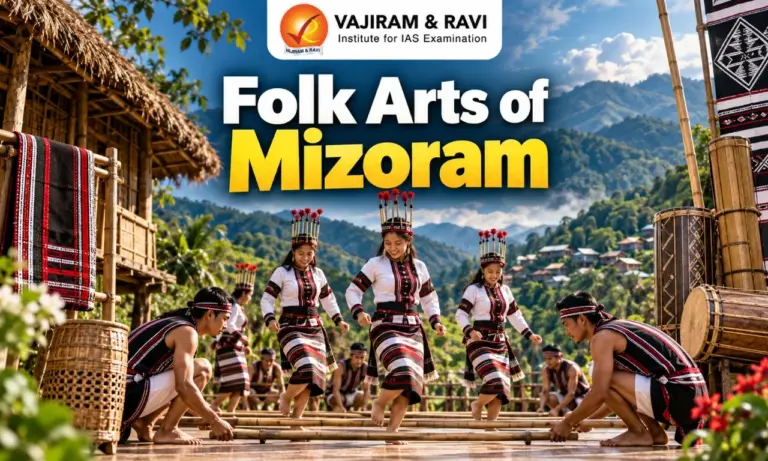
The Folk Arts of Mizoram are closely connected with the agricultural cycle, community life and festivals of the Mizo people. They include traditional dances, folk songs, handwoven textiles and bamboo and cane crafts. Many of these traditions continue to be practised during festivals, social gatherings and cultural events.
Major Folk Arts of Mizoram
The Folk Arts of Mizoram can be broadly grouped into folk dances, music and oral traditions, textiles and crafts. These traditions reflect the diverse communities of the state and their close relationship with nature, agriculture and community life.
Folk Dances
- Cheraw (Bamboo Dance): Cheraw is the most well-known traditional dance of Mizoram and is popularly known as the bamboo dance. Dancers move between pairs of bamboo poles that are opened and closed rhythmically by performers sitting on the ground. The dance is usually performed by women in traditional attire and is now a major feature of festivals and cultural programmes.
- Khuallam: Khuallam, meaning the “Dance of the Guests,” is traditionally performed to welcome guests during important community occasions. Dancers wear traditional shawls and perform to the rhythm of Darbu, a set of traditional gongs. The dance reflects the importance given to hospitality and community participation in Mizo society.
- Sarlamkai: Sarlamkai is a traditional warrior dance associated with the Pawi and Mara communities of southern Mizoram. It was historically connected with celebrations following victory in warfare. The dance is performed in groups to the accompaniment of gongs, drums and cymbals.
- Chailam: Chailam is closely associated with Chapchar Kut, the major spring festival of Mizoram. Men and women dance together in a circle to the accompaniment of drums and other traditional instruments. It remains one of the important group dances performed during the festival.
- Chawnglaizawn: Chawnglaizawn is a traditional dance of the Pawi community. It is performed during festivals and celebrations and is also associated with hunting traditions. Dancers perform in groups to drum beats, using colourful shawls to add movement to the performance.
- Chheihlam: Chheihlam developed from older Mizo traditions of song and dance. It is performed to Chheih hla, with dancers and singers sitting or standing together in a circle. Improvised verses, rhythmic movements, clapping and drum beats are important features of the performance.
- Tlanglam: Tlanglam is a popular traditional dance performed across Mizoram. Both men and women participate in it, and different regions have their own variations. The dance is accompanied by traditional music and is commonly performed during social and festive occasions.
- Zangtalam: Zangtalam is a traditional dance associated with the Paihte community. Men and women participate in the performance, with a drummer guiding the rhythm and movements.
Folk Music and Traditional Instruments
Mizo folk music is closely connected with dance, festivals and community gatherings. Traditional songs preserve stories, memories and aspects of everyday life. Several indigenous instruments accompany these performances.
- Khuang: Khuang is a traditional drum made from a hollowed tree trunk with animal skin stretched over its ends. It is one of the most important instruments in Mizo cultural life and is widely used during dances and community ceremonies.
- Darbu: Darbu consists of a set of three brass gongs of different sizes. It produces different notes and is traditionally played by three performers. It is particularly associated with dances such as Khuallam.
- Bengbung: Bengbung is a traditional xylophone-like instrument made from wooden bars. It was traditionally played by girls and forms part of the older musical traditions of Mizoram.
- Rawchhem: Rawchhem is a traditional wind instrument with a structure similar to a bagpipe. It represents the distinctive character of indigenous Mizo musical traditions.
- Tingtang: Tingtang is a traditional stringed instrument used in Mizo folk music.
- Seki: Seki is a traditional instrument made from the horn of the mithun, an animal with cultural and economic importance in the region.
K.C. Runremsangi, popularly known as the “Queen of Mizo Folk Song,” has received national recognition for her contribution to Mizo folk music, including the Sangeet Natak Akademi Award and the Padma Shri.
Folk Textiles
Traditional weaving is an important part of the Folk Arts of Mizoram. Mizo women have traditionally woven textiles using the loin loom, producing distinctive patterns and colours associated with different communities and occasions.
- Mizo Puanchei: Mizo Puanchei is one of the most colourful traditional textiles of Mizoram. It is an important part of women’s traditional dress and is worn during festivals, dances, ceremonies and other important occasions. It is particularly associated with Cheraw and other cultural performances.
- Tawlhlohpuan: Tawlhlohpuan is a traditionally heavy and compactly woven fabric. Its name is associated with the idea of standing firm and not retreating, reflecting its traditional association with courage and bravery.
- Hmaram: Hmaram is an old traditional textile of the Mizo people. Its designs include motifs inspired by the flora of Mizoram and reflect the close connection between weaving and the natural environment.
- Ngotekherh: Ngotekherh is a traditional cloth woven on the loin loom. It is recognised for its white background and black stripes and forms part of the traditional clothing heritage of Mizoram.
- Pawndum: Pawndum is traditionally a black cloth with coloured stripes. It has been used on different social and ceremonial occasions and is also associated with the Khuallam dance.
Folk Crafts
- Bamboo and Cane Craft: Bamboo and cane are widely used by Mizo artisans to make baskets, mats, furniture, household articles and decorative items. The availability of bamboo and the skills developed around it have made bamboo and cane work an important part of Mizoram’s craft tradition.
- Traditional Ornaments: Traditional Mizo ornaments include necklaces and other accessories made from beads and locally available materials. Examples include Thihu, Thifen and Darthi, which are associated with traditional dress and ceremonies.
- Vakiria: Vakiria is a distinctive traditional bamboo headdress decorated with feathers and beetle wings. It is worn by women during festive dances and is particularly associated with traditional performances such as Cheraw.
Festivals and Folk Arts
Mizo folk arts are closely linked with the traditional Kut festivals, which are connected with the agricultural cycle.
- Chapchar Kut: A spring festival celebrated after the clearing of forests for jhum cultivation. It is marked by traditional dances, music and community celebrations.
- Mim Kut: A harvest-related festival associated with maize and the remembrance of ancestors. It is generally observed around August–September.
- Pawl Kut: A harvest festival celebrated after the paddy harvest and marked by community feasting, music and traditional performances.
These festivals provide an important setting for the continued practice of Mizo dances, songs, traditional dress and crafts.


Folk Arts of Mizoram Significance
- Preserving cultural identity: Folk traditions preserve the customs, stories, clothing and practices of Mizo communities.
- Strengthening community life: Group dances and festivals encourage collective participation and reinforce social bonds.
- Supporting livelihoods: Weaving, bamboo work and other traditional crafts provide income to local artisans.
- Using local resources: Bamboo, cane, wood and natural fibres are widely used in traditional crafts.
- Promoting cultural heritage: GI recognition and cultural festivals have helped bring Mizo textiles and crafts to wider audiences.

 Last updated on Oct, 2026
→ UPSC 2027 Notification will be released on 13 January 2027 at upsconline.nic.in.
→ Check Nobel Prize 2026 Winners List here.
→ Download PIB PRiSM Monthly Magazine 2026 here.
→ Check UPSC Monthly Current Affairs Magazine The Recitals here.
→ Check out the latest UPSC Syllabus here.
→ Download UPSC Model Answers for Mains 2026
→ UPSC Mains Question Paper 2026 is out now for Essay & GS Paper 1, 2, 3 & 4.
→ UPSC Calendar 2027 has been released.
→ Enroll in Vajiram & Ravi’s UPSC Mains Test Series 2027 for structured answer writing practice, expert evaluation, and exam-oriented feedback.
→ Join Vajiram & Ravi’s UPSC Mentorship Program 2027 for personalized guidance, strategy planning, and one-to-one support from experienced mentors.
→ Go through the UPSC Mains Previous Year Papers to enhance your preparation.
→ UPSC has released UPSC Toppers List 2025 with the Civil Services final result on its official website.
→ Also check Best UPSC Coaching in India
Folk Arts of Mizoram FAQs
Q1. What are the major folk dances of Mizoram?+
Q2. Which is the most famous folk dance of Mizoram?+
Q3. Which folk dance of Mizoram is performed with bamboo poles?+
Q4. Which folk dance of Mizoram is associated with Chapchar Kut?+
Q5. Which folk dance of Mizoram is associated with warrior traditions?+
Tags: folk arts of mizoram