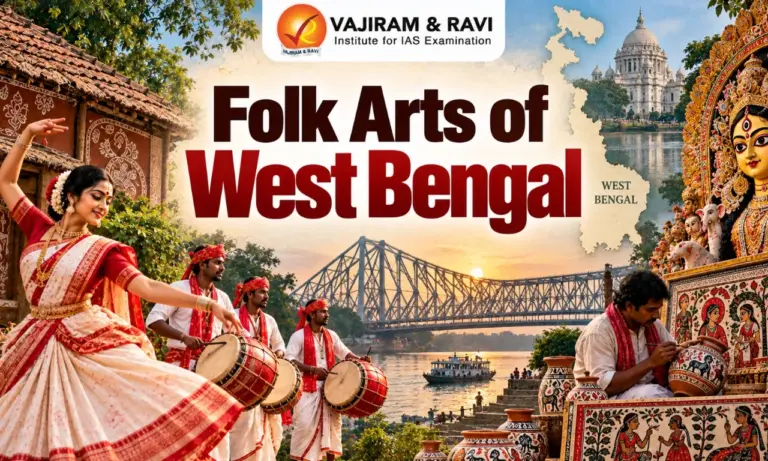
The Folk Arts of West Bengal are closely connected with the state’s festivals, rural life, religious practices and community traditions. They range from the masked movements of Purulia Chhau and the open-air performances of Jatra to Baul music, Patua scroll painting, terracotta, Dokra and traditional textiles.
Major Folk Arts of West Bengal
The Folk Arts of West Bengal can be broadly grouped into folk dances, theatre, music, painting and crafts, with each form reflecting the distinct cultural identity of the community and region where it is practised.
Folk Dances
- Purulia Chhau: Purulia Chhau is one of the most well-known folk dances of West Bengal.
-
- It is performed with large masks, colourful costumes and energetic movements.
- The stories are mainly drawn from the Ramayana, Mahabharata and local folklore.
- Martial movements, mock combat and acrobatics are important features of the dance.
- Chhau has three styles – Purulia Chhau of West Bengal, Seraikella Chhau of Jharkhand and Mayurbhanj Chhau of Odisha. Purulia and Seraikella use masks, while Mayurbhanj is performed without them.
- The dance is traditionally associated with Chaitra Parva, a spring festival.
- Chhau was inscribed on UNESCO’s Representative List of the Intangible Cultural Heritage of Humanity in 2010.
- Gambhira: Gambhira is a popular folk tradition of North Bengal, especially in Malda. It combines song, dialogue and dance, often using humour and satire to comment on social, political and moral issues. Its strong connection with everyday life makes it an important form of folk expression in Bengal.
- Santhal Dance: Santhal dance is a traditional group dance performed by the Santhal community, mainly during festivals and community celebrations.The movements are simple and rhythmic, often accompanied by traditional music. The dance reflects the community’s close connection with nature, social life and local traditions.
- Raibenshe: Raibenshe is a traditional martial dance in which performers display strength, agility and coordinated movements. It reflects the older martial traditions of rural Bengal and is performed with energetic movements and group formations.
- Tusu and Bhadu: Tusu and Bhadu are seasonal folk traditions associated with rural communities, particularly in western Bengal. They are closely connected with village life, local festivals and the agricultural cycle.
- Lathi Dance: Lathi dance uses sticks as an important part of the performance. In Bengal, it has also been associated with Muharram and is performed as a display of physical skill and coordinated movement. The Government of West Bengal identifies Lathi dance among the state’s traditional folk forms.
Folk Theatre
Jatra: Jatra is one of Bengal’s best-known folk theatre traditions. Performances are usually held in open spaces and combine acting, music, singing and dialogue. Traditionally, stories were based mainly on mythology and religion, but Jatra later began addressing social and contemporary issues as well. Its simple and direct style has helped it remain popular, particularly in rural Bengal.
Folk Music
West Bengal has a rich variety of folk music traditions, shaped by its rivers, rural life, occupations and local communities.
- Baul Sangeet: Baul Sangeet is associated with wandering mystic singers of Bengal. Baul philosophy draws from different spiritual traditions and focuses on the search for the divine within oneself rather than strict religious boundaries. Bauls traditionally travel from place to place, singing with instruments such as the ektara, dotara and dubki. The tradition has also influenced Bengali culture and the works of Rabindranath Tagore. UNESCO recognises Baul Songs as a shared cultural tradition of Bengal, with Bauls found in both West Bengal and Bangladesh.
- Bhatiali: Bhatiali is a folk music tradition associated with the rivers and boatmen of Bengal. Its songs often express loneliness, separation and longing, reflecting the experiences of people whose lives are closely connected with rivers.
- Bhawaiya: Bhawaiya is an important folk music tradition of North Bengal. It grew from rural life and often deals with themes of love, separation, longing and everyday experiences.
- Jhumur: Jhumur is popular in western Bengal, particularly Purulia and Bankura. It combines singing and dance and is closely associated with rural and tribal communities. The songs often reflect everyday life, love and local traditions.
- Gambhira Songs: Gambhira songs are an important part of the Gambhira tradition of North Bengal, especially Malda. They use humour and satire to comment on social, political and everyday issues, making them an important form of folk expression.
Folk Painting
- Bengal Patachitra: Bengal Patachitra is a traditional scroll-painting form associated with the Patua community. Its unique feature is the combination of painting and storytelling. The Patua gradually unfolds the scroll while singing the story, a performance known as Pater Gaan. The paintings depict stories from mythology, religious traditions and folklore, and sometimes address contemporary social issues. Pingla in Paschim Medinipur is a major centre of the tradition. Bengal Patachitra also has a GI tag, recognising its distinctive geographical and cultural identity.
- Kalighat Painting: Kalighat painting developed around the Kalighat temple in Kolkata during the 19th century. Its bold lines, simple forms and relatively flat colours made it different from the more detailed painting traditions of the period. Artists painted religious figures as well as scenes from everyday urban life. Satirical paintings commenting on society also became an important part of the tradition. Kalighat therefore provides an example of how popular art responded to the changing social life of colonial Kolkata.
Folk Crafts
- Bankura Panchmura Terracotta: Panchmura in Bankura is famous for its terracotta work, particularly the distinctive Bankura horse. The horse has become one of the most recognisable symbols of Bengal’s traditional craft heritage. Bankura Panchmura Terracotta Craft has a GI tag.
- Bengal Dokra: Dokra is a traditional metal craft made through the lost-wax casting technique. The artisan first creates a wax model and then prepares a mould around it. After the wax is removed, molten metal is poured into the mould. In West Bengal, important centres include Bikna in Bankura and Dariapur in Bardhaman. Bengal Dokra has a GI tag.
- Nakshi Kantha: Kantha developed as a practical way of reusing old cloth by stitching layers together. Over time, the simple running stitch became a form of detailed embroidery, with flowers, animals, human figures and other motifs appearing on the fabric. Nakshi Kantha has a GI tag from West Bengal.
- Santipore Saree: Santipur in Nadia is known for its fine handloom tradition and cotton sarees. The Santipore Saree is a GI-recognised traditional textile of West Bengal.
- Baluchari Saree: The Baluchari tradition is associated with Bengal’s silk-weaving heritage, particularly Bishnupur. Its most distinctive feature is the use of woven figurative and narrative motifs, often depicting scenes from mythology and traditional life. Baluchari Saree has a GI tag.
- Dhaniakhali Saree: Dhaniakhali in Hooghly is known for its cotton sarees. The Dhaniakhali Saree is another GI-recognised textile tradition of West Bengal.
- Purulia Chau Mask: Masks are central to the visual identity of Purulia Chhau. They are brightly painted and represent characters from mythology and folklore. Purulia Chau Mask has a GI tag.
- Wooden Mask of Kushmandi: Kushmandi in Dakshin Dinajpur is known for its traditional wooden masks, which are associated with local performance traditions such as Gomira. Wooden Mask of Kushmandi has a GI tag.
- Madurkathi: Madurkathi is a traditional mat-making craft of Medinipur. Artisans use locally available soft reed to make mats and other products. The craft has traditionally provided livelihood opportunities to local communities, including women artisans. Madurkathi has a GI tag.
- Sholapith Craft: Sholapith is made from the soft white pith of the shola plant. It is used for decorative and religious items and has an important place in the visual traditions associated with festivals such as Durga Puja.
- Santiniketan Leather Goods: Santiniketan is known for handcrafted leather products, including decorated and embossed articles. Santiniketan Leather Goods has a GI tag from West Bengal.
- Sitalpati: Sitalpati is a traditional mat-weaving craft associated particularly with Cooch Behar and North Bengal. It reflects the use of locally available natural materials in everyday life.
Folk Arts of West Bengal Significance
- Preserving community identity: Folk traditions carry the memories, beliefs and customs of communities and help pass them from one generation to another.
- Supporting livelihoods: Painting, weaving, terracotta, metalwork and mask-making continue to provide income to many artisan communities.
- Connecting art with everyday life: These traditions are not limited to galleries or formal stages. They remain linked with festivals, agriculture, religion and community celebrations.
- Using local resources: Terracotta, Madurkathi, Sholapith and other crafts show how traditional artisans have developed useful products from materials available in their surroundings.
- Promoting cultural tourism: GI recognition, cultural festivals and growing interest in traditional crafts have helped bring several traditional art forms to wider audiences.


 Last updated on Oct, 2026
→ UPSC 2027 Notification will be released on 13 January 2027 at upsconline.nic.in.
→ Check Nobel Prize 2026 Winners List here.
→ Download PIB PRiSM Monthly Magazine 2026 here.
→ Check UPSC Monthly Current Affairs Magazine The Recitals here.
→ Check out the latest UPSC Syllabus here.
→ Download UPSC Model Answers for Mains 2026
→ UPSC Mains Question Paper 2026 is out now for Essay & GS Paper 1, 2, 3 & 4.
→ UPSC Calendar 2027 has been released.
→ Enroll in Vajiram & Ravi’s UPSC Mains Test Series 2027 for structured answer writing practice, expert evaluation, and exam-oriented feedback.
→ Join Vajiram & Ravi’s UPSC Mentorship Program 2027 for personalized guidance, strategy planning, and one-to-one support from experienced mentors.
→ Go through the UPSC Mains Previous Year Papers to enhance your preparation.
→ UPSC has released UPSC Toppers List 2025 with the Civil Services final result on its official website.
→ Also check Best UPSC Coaching in India
Folk Arts of West Bengal FAQs
Q1. What are the major Folk Arts of West Bengal?+
Q2. Which folk dance is famous for its use of masks in West Bengal?+
Q3. Which folk music tradition is associated with mystic singers of Bengal?+
Q4. Which painting tradition of West Bengal combines painting with storytelling?+
Q5. Which Folk Arts of West Bengal have GI recognition?+
Tags: folk arts of west bengal