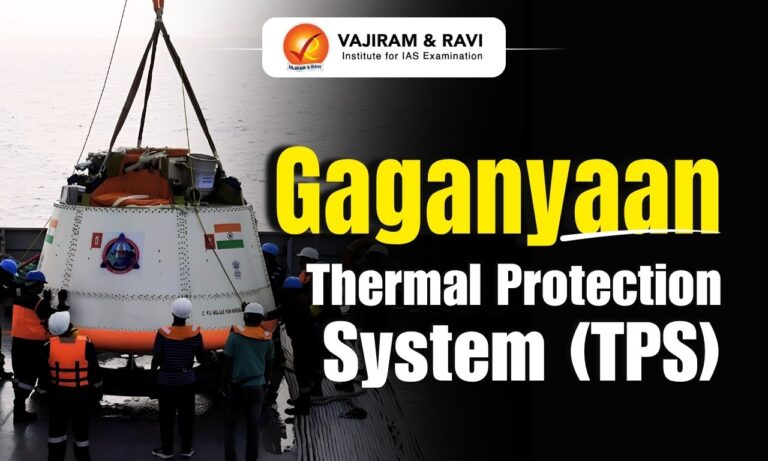
The Gaganyaan mission’s Thermal Protection System (TPS) is in focus for its critical role in protecting the Crew Module during atmospheric re-entry
About Gaganyaan Thermal Protection System (TPS)
The Gaganyaan Thermal Protection System (TPS) is a critical safety system that protects the Crew Module and astronauts from the extreme heat generated during atmospheric re-entry, ensuring their safe return to Earth.
Gaganyaan Thermal Protection System (TPS) Need
The need for the Gaganyaan Thermal Protection System (TPS) arises from the extreme conditions faced by the Crew Module during its return to Earth.
- The Crew Module will re-enter the atmosphere at around 7,500-8,000 m/s, carrying enormous kinetic energy. More than 99% of this kinetic energy will be dissipated into the atmosphere as heat, creating extremely high thermal loads around the spacecraft.
- Even the small portion of heat directed back towards the Crew Module can be intense enough to melt its outer structure without adequate protection. As a result, some regions of the Crew Module may experience temperatures of up to 1,800°C during re-entry.
- The situation is more challenging because re-entry is extremely fast and the deceleration forces continuously change. This leaves astronauts very little time to manually identify and correct a sudden system abnormality. Moreover, once atmospheric descent begins, there is no provision to abort the mission.
Therefore, the Crew Module must be capable of withstanding these extreme conditions through reliable onboard systems. The TPS plays the crucial role of managing the intense re-entry heat and protecting the spacecraft’s structure, keeping its temperature below about 150°C despite the extreme conditions outside.


Gaganyaan Thermal Protection System (TPS) Types and Working
The TPS protects the Crew Module by absorbing, removing or managing the heat generated during re-entry. It is broadly classified into three types based on how it deals with this heat.
- Ablative TPS: It absorbs extreme heat and gradually sacrifices its outer material through chemical and physical decomposition. The material forms a protective char layer, while escaping gases carry heat away and create a cooler boundary layer that reduces further heat transfer to the Crew Module.
- Radiative TPS: It absorbs the intense heat and releases it back into space as electromagnetic radiation, mainly infrared radiation. Unlike an ablative system, it remains largely intact without melting or degrading, making it suitable for reusable re-entry vehicles.
- Heat-Sink TPS: It absorbs and stores the heat, raising its own temperature without melting or changing its physical state. Copper and aluminium are examples of heat-sink materials.
Why Does Gaganyaan Use an Ablative TPS?
The Gaganyaan Crew Module uses an ablative TPS because it is a proven and robust technology suited to the single-use design of the Crew Module.
- Handles extreme heat: It can withstand extreme and fluctuating heat loads during re-entry.
- Protects the structure: It gradually sacrifices its outer material, carrying heat away while protecting the structure underneath.
- Requires less maintenance: Unlike reusable thermal protection systems, it does not require complex maintenance and specialised inspection after use.
- Greater tolerance: Radiative systems are less forgiving of design errors, as localised overheating can quickly cause dangerous heat transfer.
- Safe and cost-effective: The ablative approach provides a suitable combination of safety, reliability and cost-effectiveness for Gaganyaan.
The choice also builds on India’s earlier re-entry experience. The Space Capsule Recovery Experiment (SRE) used carbon-phenolic ablative material on its nose cap, where heat flux was highest. This experience was further strengthened by the LVM-3/CARE mission in 2014, which successfully demonstrated Crew Module re-entry using an ablative TPS. Globally, the same approach is also used in SpaceX’s Crew Dragon, which employs Phenolic Impregnated Carbon Ablator (PICA).

 Last updated on Oct, 2026
→ UPSC 2027 Notification will be released on 13 January 2027 at upsconline.nic.in.
→ Asian Games 2026 are being held in Aichi-Nagoya, Japan, from 19 September to 4 October.
→ Check Nobel Prize 2026 Winners List here.
→ Download PIB PRiSM Monthly Magazine 2026 here.
→ Check UPSC Monthly Current Affairs Magazine The Recitals here.
→ Check out the latest UPSC Syllabus here.
→ Download UPSC Model Answers for Mains 2026
→ UPSC Mains Question Paper 2026 is out now for Essay & GS Paper 1, 2, 3 & 4.
→ UPSC Calendar 2027 has been released.
→ Enroll in Vajiram & Ravi’s UPSC Mains Test Series 2027 for structured answer writing practice, expert evaluation, and exam-oriented feedback.
→ Join Vajiram & Ravi’s UPSC Mentorship Program 2027 for personalized guidance, strategy planning, and one-to-one support from experienced mentors.
→ Go through the UPSC Mains Previous Year Papers to enhance your preparation.
→ UPSC has released UPSC Toppers List 2025 with the Civil Services final result on its official website.
→ Also check Best UPSC Coaching in India
Gaganyaan Thermal Protection System (TPS) FAQs
Q1. What is the Gaganyaan Thermal Protection System (TPS)?+
Q2. Why is the Gaganyaan Thermal Protection System (TPS) needed?+
Q3. Which type of Thermal Protection System (TPS) does Gaganyaan use?+
Q4. What are the three types of Thermal Protection System (TPS)?+
Q5. How is India’s experience with the Gaganyaan Thermal Protection System (TPS)?+
Tags: gaganyaan thermal protection system