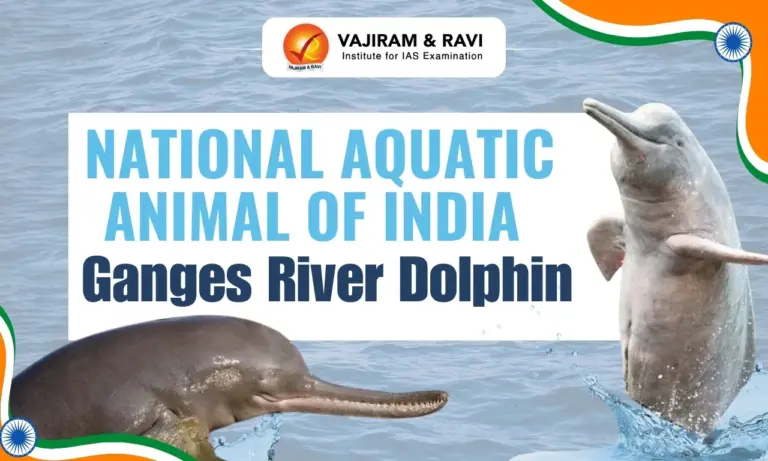
The National Aquatic Animal of India is the Ganges River Dolphin, also known as “Tiger of the Ganges”. It is a mammal found mainly in South Asian river systems. It is a freshwater species and one of the few river dolphins found worldwide. The species is scientifically known as Platanista gangetica. It is nearly blind and uses ultrasonic sounds to locate prey in muddy and fast flowing waters.
What is the National Aquatic Animal of India?
The Ganga River Dolphin is the National Aquatic Animal of India. India declared it the National Aquatic Animal on 5 October 2009 because it reflects the health of river ecosystems. It was formally notified on 10 May 2010. The National Aquatic Animal of India inhabits across Nepal, India and Bangladesh.
Ganges River Dolphin
The Gangetic Dolphin has unique physical and behavioural adaptations that help it survive in freshwater rivers and hunt efficiently despite extremely limited vision.
- Scientific Name: The scientific name of the Ganges River Dolphin is Platanista gangetica. The species was officially discovered in 1801 and is adapted exclusively to freshwater habitats.
- Appearance: It has a long, thin snout, rounded belly, stocky body and large flippers. Its skin is smooth and hairless in adulthood.
- Other Names: It is also known as the Gangetic Dolphin, Ganga River Dolphin, Gangetic River Dolphin, Ganges susu, hihu, blind dolphin, side swimming dolphin, South Asian River Dolphin and Indian River Dolphin.
- Size and Weight: The species can weigh up to 150 kg. Females are larger than males, reaching 2.67 metres compared with the male maximum of 2.12 metres.
- Colour: Calves are chocolate brown at birth. Adults develop a greyish brown body with smooth, hairless skin.
- Vision: The eyes of the Ganges River Dolphin lack a lens. This makes it essentially blind and explains the common name “Blind Dolphin”.
- Echolocation: It produces ultrasonic sounds that bounce off fish and other objects. The returning signals help the dolphin form an image and locate prey.
- Breathing: Being a mammal, it cannot breathe underwater. It regularly surfaces for air, with breathing sounds giving rise to the popular name ‘Susu’.
- Diet: Fish form the major part of its diet. It generally occupies counter current areas of the main river channel where suitable prey is available.
- Distribution: Its natural range includes the Ganga–Brahmaputra–Meghna and Karnaphuli-Sangu river systems of Nepal, India and Bangladesh. Much of its historical range has disappeared.
- Population: India recorded 6,327 river dolphins in the first nationwide survey conducted under Project Dolphin (2020). The Ganges dolphin population has fallen by over 50% since 1957, along with a 25% reduction in its range.
- Social Behaviour: Ganges River Dolphins are commonly found alone or in small groups. Mothers and calves may travel together and females generally give birth to one calf every two to three years.
- Ecological Role: The Ganges River Dolphin is a reliable indicator of freshwater ecosystem health. Protecting its habitat also supports fish, river biodiversity, water quality and wider ecological stability.


Ganges River Dolphin Protection Status
The Ganges River Dolphin faces serious habitat and survival pressures. Its conservation therefore requires legal protection, scientific monitoring, habitat management, pollution control and community participation.
- IUCN Red List: The Ganges River Dolphin is listed as Endangered on the IUCN Red List. Its Ganges River Dolphin IUCN Status reflects the serious risks facing its populations and habitats.
- Legal Protection: Under the Wildlife (Protection) Act 1972, it receives Schedule I protection. Schedule I species receive the highest level of legal protection and strict penalties for offences.
- CITES and CMS: The species is included in CITES Appendix I and CMS Appendix II. These listings support strict international protection and conservation cooperation for threatened migratory species.
Ganges River Dolphin Threats
Several challenges and threats including Bycatch, pollution, dams, irrigation projects, vessel traffic, fishing pressure, habitat fragmentation and declining prey availability threaten the survival of the Ganges River Dolphin species.
- Bycatch: Dolphins and fishing communities often use fish rich areas with slower currents. Accidental entanglement in fishing nets therefore causes dolphin deaths and increases human-wildlife conflict.
- Pollution: Industrial, agricultural and domestic pollution degrades freshwater habitats. Around the river, 9,000 tons of pesticides and 6 million tons of fertilizers are used annually.
- Dams and Infrastructure: More than 50 dams and irrigation related projects have fragmented dolphin populations. Barriers restrict movement, affect fish migration and reduce access to suitable habitat.
- Endocrine Disrupting Chemicals: A WII study found harmful EDCs in fish consumed by Gangetic dolphins. DEHP, DnBP, DDT, Lindane, arsenic, mercury and cadmium can damage hormonal and reproductive systems.
- Other Challenges: Fishing gear entanglement, poaching, dams, water extraction and vessel noise threaten Gangetic dolphins. Agricultural runoff, untreated industrial effluents, vehicle emissions and poor waste management worsen pollution.
Ganges River Dolphin Conservation Measures
Various measures and government initiatives promoting the conservation and protection of the Ganges River Dolphin Species has been discussed below:
- Conservation Action Plan: The Conservation Action Plan for the Ganges River Dolphin 2010-2020 identified population assessment, threats, river traffic, irrigation canals, prey depletion, protected areas, ecosystem restoration and community participation.
- Project Dolphin: Project Dolphin was announced by the Prime Minister in the Independence Day Speech 2020. It was planned on the lines of Project Tiger to strengthen dolphin conservation.
- Dolphin Sanctuary: The Vikramshila Ganges Dolphin Sanctuary in Bihar provides protected habitat for the species and represents an important area based conservation initiative.
- National Ganga River Dolphin Day: The National Mission for Clean Ganga observes 5 October as National Ganga River Dolphin Day. The day highlights awareness and conservation of the species.
- First Satellite Tagging: In December 2024, India conducted its first ever Ganges River Dolphin tagging in Assam. The Wildlife Institute of India, Assam Forest Department and Aaranyak implemented the initiative with National CAMPA funding.
- Purpose of Satellite Tagging: Satellite tagging helps study movement patterns, seasonal behaviour, distribution, home range and habitat use. It is especially valuable for understanding dolphins living in fragmented and disturbed river systems.
- Recent Conservation Progress: The National Mission for Clean Ganga has highlighted a population of over 6,000 dolphins in the Ganga. Ganga Praharis and local communities are contributing to river conservation.
- Rescue Support: The Dolphin Rescue Ambulance of TSAFI was inaugurated to provide rapid and scientifically equipped assistance to dolphins in distress. It strengthens emergency response and conservation efforts.
- Constitutional Support: Article 48A directs the State to protect the environment, forests and wildlife. Article 51A requires citizens to protect the natural environment, rivers, lakes and wildlife.
- Conservation Significance: Protecting the National Aquatic Animal Of India requires maintaining healthy river flows, reducing pollution, preventing accidental fishing deaths, restoring habitats and strengthening scientific monitoring across its range.

 Last updated on Oct, 2026
→ UPSC 2027 Notification will be released on 13 January 2027 at upsconline.nic.in.
→ Asian Games 2026 are being held in Aichi-Nagoya, Japan, from 19 September to 4 October.
→ Check Nobel Prize 2026 Winners List here.
→ Download PIB PRiSM Monthly Magazine 2026 here.
→ Check UPSC Monthly Current Affairs Magazine The Recitals here.
→ Check out the latest UPSC Syllabus here.
→ Download UPSC Model Answers for Mains 2026
→ UPSC Mains Question Paper 2026 is out now for Essay & GS Paper 1, 2, 3 & 4.
→ UPSC Calendar 2027 has been released.
→ Enroll in Vajiram & Ravi’s UPSC Mains Test Series 2027 for structured answer writing practice, expert evaluation, and exam-oriented feedback.
→ Join Vajiram & Ravi’s UPSC Mentorship Program 2027 for personalized guidance, strategy planning, and one-to-one support from experienced mentors.
→ Go through the UPSC Mains Previous Year Papers to enhance your preparation.
→ UPSC has released UPSC Toppers List 2025 with the Civil Services final result on its official website.
→ Also check Best UPSC Coaching in India
Ganges River Dolphin FAQs
Q1. Why are Ganges River Dolphins endangered?+
Q2. Is there any Dolphin in Ganga River?+
Q3. How many Ganges River Dolphins are left?+
Q4. What is the IUCN status of Ganga Dolphins?+
Q5. What is the National Aquatic Animal of India?+
Q6. What is the scientific name of the Ganges River Dolphin?+
Q7. Why is the Ganges River Dolphin called a blind dolphin?+
Q8. What is the Ganges River Dolphin IUCN status?+
Q9. Where is the Ganges River Dolphin found?+
Tags: national aquatic national aquatic animal national aquatic animal of india