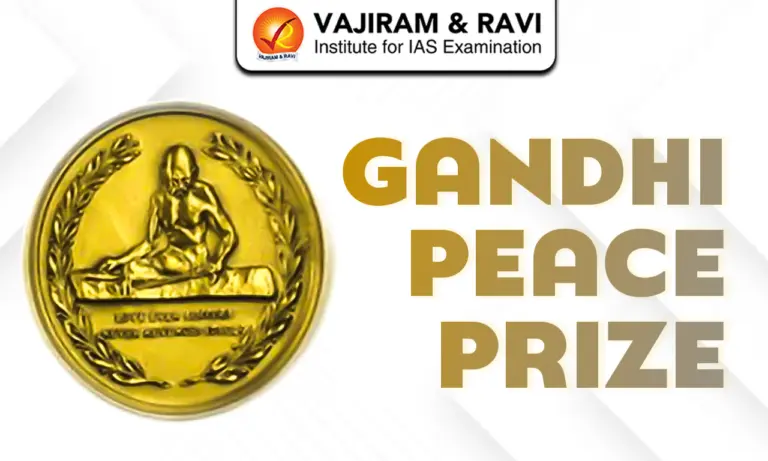
The Gandhi Peace Prize is an international civilian award instituted by the Government of India in 1995 to commemorate the 125th birth anniversary of Mahatma Gandhi. Administered by the Ministry of Culture, it honours individuals and organisations for their outstanding contribution to peace, non-violence, social justice and humanitarian service through Gandhian principles. The award is open to recipients from all countries and is one of India’s highest international honours.
About Gandhi Peace Prize
The Gandhi Peace Prize is an international award instituted by the Government of India in 1995 to commemorate the 125th birth anniversary of Mahatma Gandhi.
- It honours individuals, institutions and organisations for their outstanding contribution to social, economic and political transformation through non-violence and other Gandhian methods.
- The award reflects India’s commitment to Mahatma Gandhi’s ideals of truth, non-violence, peace, social justice and service to humanity.
- It is administered by the Ministry of Culture, Government of India, and is one of India’s highest international honours in the field of peace and humanitarian service.
- The award is international in nature and is open to eligible individuals and organisations from all countries.
- The Gandhi Peace Prize has not been conferred every year. The Jury may decide not to confer the award in a particular year if no nomination is considered suitable for the honour.
Gandhi Peace Prize Objective
The Gandhi Peace Prize recognises outstanding contributions in areas such as:
- Promotion of peace, non-violence and communal harmony.
- Social, economic and political transformation through Gandhian methods.
- Upliftment of disadvantaged and marginalised communities.
- Rural development and sustainable development.
- Humanitarian service and international cooperation.


Gandhi Peace Prize Eligibility
- The award is open to individuals, associations, institutions and organisations from across the world.
- It recognises contributions that have significantly advanced peace, non-violence, social justice and humanitarian welfare through Gandhian principles.
- Normally, achievements made during the preceding ten years are considered, although earlier contributions may also be recognised if their significance is realised later.
- The award is not ordinarily conferred posthumously.
- The Jury may confer the award jointly on two recipients if both are found equally deserving.
Gandhi Peace Prize Selection Process
The Gandhi Peace Prize is decided by a five-member Jury comprising:
- Prime Minister of India (Chairperson)
- Chief Justice of India
- Leader of Opposition in the Lok Sabha (or the leader of the single largest Opposition party where no recognised Leader of Opposition exists)
- Two eminent persons nominated by the Prime Minister for a period of three years
The decision of the Jury is final.
Gandhi Peace Prize Prize Components
The Gandhi Peace Prize comprises:
- Cash award of ₹1 crore
- Citation
- Plaque
- Traditional handicraft or handloom item
The award is presented by the President of India.
Gandhi Peace Prize Major Awardees
The list of major Gandhi Peace Prize awardees has been tabulated below, highlighting distinguished individuals and organizations recognized for their exceptional contributions to peace, social harmony, humanitarian service, and sustainable development.
| Year | Awardee | Contribution |
|
1995 |
Julius K. Nyerere (Tanzania) |
First recipient of the Gandhi Peace Prize. Recognised for promoting African unity, peaceful development and social justice through the philosophy of Ujamaa. |
|
1996 |
Dr. A. T. Ariyaratne (Sri Lanka) |
Founder of the Sarvodaya Shramadana Movement, recognised for promoting rural development, self-reliance and non-violent social transformation. |
|
1997 |
Dr. Gerhard Fischer (Germany) |
He was a German diplomat and humanitarian worker recognised for his dedicated work for the rehabilitation and welfare of persons affected by leprosy and polio in India. |
|
1998 |
Honoured for its contribution to education, healthcare, disaster relief and humanitarian service inspired by the teachings of Swami Vivekananda. |
|
|
1999 |
Baba Amte (India) |
Recognised for his lifelong service to persons affected by leprosy and for promoting social justice, rehabilitation and rural development. |
|
2000 |
Nelson Mandela (South Africa) (Joint Award) |
Honoured for his leadership in the struggle against apartheid and his contribution to democracy, reconciliation and peace. |
|
2000 |
Grameen Bank (Bangladesh) (Joint Award) |
Recognised for pioneering microfinance and empowering economically weaker sections, especially women, through financial inclusion. |
|
2001 |
John Hume (Ireland) |
Honoured for his contribution to the Northern Ireland peace process through democratic dialogue and conflict resolution. |
|
2005 |
Archbishop Desmond Tutu (South Africa) |
Recognised for promoting human rights, racial equality and reconciliation through non-violent means. |
|
2014 |
Honoured for applying space technology to national development, disaster management, communication, education and public welfare. |
|
|
2015 |
Vivekananda Kendra, Kanyakumari |
Recognised for its work in education, rural development, natural resource management and nation-building inspired by Swami Vivekananda. |
|
2016 |
Akshaya Patra Foundation (Joint Award) |
Honoured for improving child nutrition and supporting school education through one of the world’s largest mid-day meal programmes. |
|
2016 |
Sulabh International (Joint Award) |
Recognised for promoting sanitation, public health, social reform and the eradication of manual scavenging. |
|
2018 |
Yohei Sasakawa (Japan) |
Honoured for his global contribution towards the elimination of leprosy and the welfare of persons affected by the disease. |
|
2019 |
Sultan Qaboos bin Said Al Said (Oman) |
Recognised for promoting peace, diplomacy, regional stability and strengthening India–Oman relations. |
|
2020 |
Bangabandhu Sheikh Mujibur Rahman (Bangladesh) (Posthumous) |
Honoured for his historic leadership in Bangladesh’s Liberation Movement and his lifelong commitment to democracy, justice and the welfare of the people. |
|
2021 |
Gita Press, Gorakhpur |
Recognised for its century-long contribution to preserving and disseminating India’s spiritual, cultural and literary heritage through affordable publications. |
Gandhi Peace Prize Significance
The Gandhi Peace Prize:
- Promotes Mahatma Gandhi’s philosophy of truth and non-violence at the international level.
- Reflects India’s commitment to peace, humanitarian values and inclusive development.
- Strengthens India’s soft power and moral leadership in global affairs.
- Recognises outstanding contributions to social justice, rural development and human welfare.
- Encourages peaceful and non-violent approaches to resolving national and international challenges.

 Last updated on Oct, 2026
→ UPSC 2027 Notification will be released on 13 January 2027 at upsconline.nic.in.
→ Check Nobel Prize 2026 Winners List here.
→ Download PIB PRiSM Monthly Magazine 2026 here.
→ Check UPSC Monthly Current Affairs Magazine The Recitals here.
→ Check out the latest UPSC Syllabus here.
→ Download UPSC Model Answers for Mains 2026
→ UPSC Mains Question Paper 2026 is out now for Essay & GS Paper 1, 2, 3 & 4.
→ UPSC Calendar 2027 has been released.
→ Enroll in Vajiram & Ravi’s UPSC Mains Test Series 2027 for structured answer writing practice, expert evaluation, and exam-oriented feedback.
→ Join Vajiram & Ravi’s UPSC Mentorship Program 2027 for personalized guidance, strategy planning, and one-to-one support from experienced mentors.
→ Go through the UPSC Mains Previous Year Papers to enhance your preparation.
→ UPSC has released UPSC Toppers List 2025 with the Civil Services final result on its official website.
→ Also check Best UPSC Coaching in India
Gandhi Peace Prize FAQs
Q1. Why was the Gandhi Peace Prize instituted?+
Q2. Which ministry administers the Gandhi Peace Prize?+
Q3. Who selects the recipients of the Gandhi Peace Prize?+
Q4. Is the Gandhi Peace Prize open only to Indian citizens?+
Q5. Is the Gandhi Peace Prize awarded every year?+
Tags: gandhi peace prize