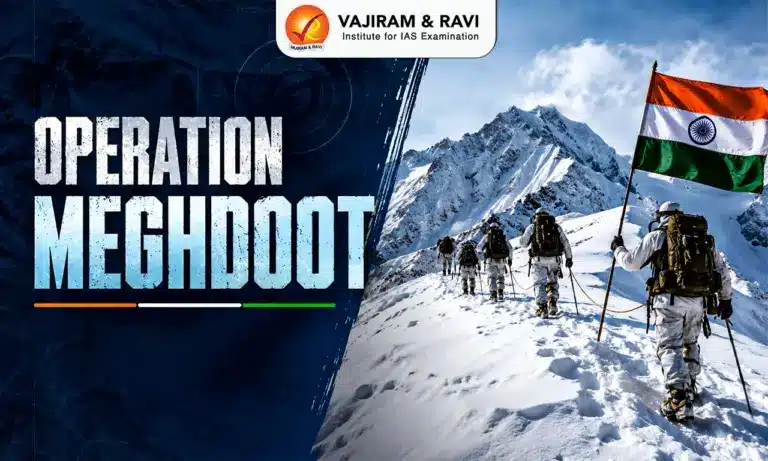
Operation Meghdoot was one of India’s most significant high altitude military operations. It was launched on 13 April 1984 to secure the strategically important Siachen Glacier in Northern Ladakh. The operation was conducted jointly by the Indian Army and the Indian Air Force (IAF). It became the world’s first military operation on the highest battlefield.
The operation enabled India to secure the Siachen Glacier, the Saltoro Ridge and key mountain passes, giving it a decisive strategic advantage that continues even today. In 2024, Operation Meghdoot completed 40 years, highlighting four decades of continuous military presence in one of the world’s harshest environments.
What was Operation Meghdoot 1984?
Operation Meghdoot was India’s military operation to secure control over the Siachen Glacier before Pakistan could occupy its strategic heights.
- Launch: Operation Meghdoot was launched on 13 April 1984 by the Indian Army with extensive operational and logistical support from the Indian Air Force to secure the dominating heights of Northern Ladakh.
- Objective: The primary objective was to prevent Pakistan from occupying the Siachen Glacier and the Saltoro Ridge while ensuring Indian control over this strategically vital high altitude region.
- Joint Operation: The operation involved seamless coordination between the Indian Army and the IAF, with transport aircraft and helicopters airlifting troops, equipment and supplies onto inaccessible glacier positions.
- Highest Battlefield: Operation Meghdoot became the world’s first military assault conducted on the highest battlefield, where most deployments were made above 18,000 feet under extreme climatic conditions.
- Areas Secured: The operation enabled India to secure the nearly 70 km long Siachen Glacier, its tributary glaciers and the important Saltoro Ridge passes of Sia La, Bilafond La and Gyong La.
Siachen Glacier
The Siachen Glacier is among the world’s most strategically important glaciers because of its geography, altitude and military significance.
- Location: The glacier lies in the Eastern Karakoram Range of Ladakh, between the Saltoro Ridge in the west and the Karakoram Range in the east.
- Length and Altitude: Siachen stretches for about 75 km, begins near Indira Col at around 21,000 feet and descends towards Partapur Base Camp at nearly 12,000 feet.
- Highest Battlefield: The glacier is recognised as the world’s highest active battlefield, where military personnel operate under extreme weather, snowstorms, thin oxygen and severe terrain challenges.
- Strategic Position: Siachen overlooks the routes connecting Gilgit-Baltistan, Leh, the Karakoram Pass and the Shaksgam Valley, making it strategically important for regional security.
- Climate: Temperatures frequently fall between minus 20°C and minus 40°C during winter, while higher areas remain below freezing for most of the year.


Operation Meghdoot Background
The origins of Operation Meghdoot lie in the unresolved boundary issue and Pakistan’s increasing attempts to strengthen its claim over Siachen.
- Karachi Agreement: Following the Karachi Agreement of July 1949, the ceasefire line ended at NJ 9842, leaving the Siachen region undemarcated because of its inaccessible terrain.
- Territorial Dispute: India maintained that the line extended northwards from NJ 9842, whereas Pakistan interpreted it towards the Karakoram Pass, resulting in competing territorial claims.
- Cartographic Aggression: During the late 1970s and early 1980s, Pakistan encouraged foreign mountaineering expeditions and issued permits showing Siachen as its territory to strengthen its claim.
- Intelligence Gathering: Colonel Narinder “Bull” Kumar led expeditions in 1978 and by 1981 completed detailed mapping, photographs and surveys of the glacier, providing valuable strategic information.
- Immediate Trigger: Intelligence reports revealed Pakistan’s planned Operation Ababeel and procurement of specialised snow equipment, leading India to launch Operation Meghdoot before Pakistani forces could occupy the heights.
Operation Meghdoot Reasons
Operation Meghdoot was launched to secure India’s strategic interests and prevent Pakistan from gaining military advantage in the Siachen region.
- Pre-emptive Action: India acted before Pakistan could occupy the glacier after receiving intelligence regarding its planned military deployment under Operation Ababeel.
- Protect Strategic Heights: Securing the Saltoro Ridge prevented Pakistan from dominating the surrounding valleys, passes and communication routes leading towards Ladakh.
- Counter Cartographic Claims: Pakistan’s repeated efforts through maps and foreign expeditions required a firm military response to prevent its claims from gaining legitimacy.
- Prevent Strategic Linkages: Control over Siachen denied any possibility of a direct strategic connection between Pakistan and China across the sensitive northern region.
- Border Security: Holding the glacier strengthened India’s surveillance over the surrounding areas and protected approaches leading towards Leh and other important locations in Ladakh.
Operation Meghdoot Course and Events
Operation Meghdoot was executed through careful planning, rapid troop deployment and continuous air support in one of the world’s toughest operational environments.
- Planning: Following approval from Prime Minister Indira Gandhi, the operation was directed by Gen. Arun Vaidya, Lt Gen P. N. Hoon and senior military commanders.
- Initial Deployment: Troops from the Kumaon Regiment and Ladakh Scouts underwent specialised snow and survival training before moving to the Siachen Base Camp for deployment.
- IAF Airlift: Aircraft including An-12, An-32 and IL-76 transported troops and supplies, while Mi-17, Mi-8, Chetak and Cheetah helicopters ferried personnel onto glacier positions.
- Strategic Occupation: Around 300 soldiers quickly occupied the dominating heights of Sia La, Bilafond La and Gyong La before Pakistan could establish its presence, providing India with a lasting tactical advantage.
- Continued Air Operations: Fighter operations began from Leh in September 1984 with Hunter aircraft, later joined by MiG-23, MiG-29, while newer platforms including Rafale, Su-30MKI, Chinook, Apache, LCH Prachand, C-17, C-130J, IL-76 and An-32 continue supporting Operation Meghdoot.
Operation Meghdoot Outcomes
Operation Meghdoot permanently altered the strategic situation in the Siachen region and established India’s long term military presence.
- Success: India successfully secured the entire Siachen Glacier, its tributary glaciers and the dominant heights of the Saltoro Ridge before Pakistan’s military deployment.
- Strategic Control: Indian forces presently control nearly the 76 km glacier, approximately 2,553 sq. km area and the strategically important mountain passes.
- Military Advantage: Early occupation of commanding heights ensured continued operational superiority despite repeated Pakistani attempts to regain lost positions.
- Long Term Operations: The Indian Army has maintained continuous deployment since April 1984, with IAF helicopters remaining the only lifeline for logistics, casualty evacuation and emergency response.
Operation Meghdoot Leaders
Several military leaders and officers played vital roles in planning, intelligence gathering and successful execution of Operation Meghdoot.
- Political Leadership: Prime Minister Indira Gandhi approved the operation after intelligence reports indicated Pakistan’s preparations for occupying the glacier.
- Military Command: The operation was directed under Gen. Arun Vaidya, Lt Gen P. N. Hoon, Lt Gen Manohar Lal Chibber and Maj Gen Shiv Sharma, who supervised planning and execution.
- Field Leadership: Maj R. S. Sandhu led important operational activities during the initial deployment, while Capt. Sanjay Kulkarni participated in securing Bilafond La.
- Bull Kumar’s Contribution: Colonel Narinder “Bull” Kumar provided crucial reconnaissance, mapping and intelligence through expeditions conducted between 1978 and 1981, forming the operational foundation of Meghdoot.
Operation Meghdoot Significance
Operation Meghdoot remains one of India’s most important strategic military achievements because of its lasting impact on border security and regional stability.
- Strategic Dominance: Control over the Saltoro Ridge allows India to dominate the surrounding region, including approaches towards Gilgit-Baltistan, Leh, Shaksgam Valley and the Karakoram Pass.
- National Security: The operation prevented Pakistan from establishing control over Siachen and blocked any strategic advantage that could have emerged from closer Pakistan-China military coordination.
- Operational Excellence: The operation showcased exceptional coordination between the Indian Army and the IAF in executing sustained military operations under extreme altitude and weather conditions.
- Air Power Role: Continuous support by transport aircraft, helicopters and fighter aircraft has ensured uninterrupted logistics, surveillance, reinforcement and medical evacuation for over four decades.
- Historic Achievement: Operation Meghdoot remains the world’s first and longest continuously sustained military deployment on the highest battlefield, reflecting India’s capability to defend strategically important high altitude frontiers.

 Last updated on Oct, 2026
→ UPSC 2027 Notification will be released on 13 January 2027 at upsconline.nic.in.
→ Check Nobel Prize 2026 Winners List here.
→ Download PIB PRiSM Monthly Magazine 2026 here.
→ Check UPSC Monthly Current Affairs Magazine The Recitals here.
→ Check out the latest UPSC Syllabus here.
→ Download UPSC Model Answers for Mains 2026
→ UPSC Mains Question Paper 2026 is out now for Essay & GS Paper 1, 2, 3 & 4.
→ UPSC Calendar 2027 has been released.
→ Enroll in Vajiram & Ravi’s UPSC Mains Test Series 2027 for structured answer writing practice, expert evaluation, and exam-oriented feedback.
→ Join Vajiram & Ravi’s UPSC Mentorship Program 2027 for personalized guidance, strategy planning, and one-to-one support from experienced mentors.
→ Go through the UPSC Mains Previous Year Papers to enhance your preparation.
→ UPSC has released UPSC Toppers List 2025 with the Civil Services final result on its official website.
→ Also check Best UPSC Coaching in India
Operation Meghdoot 1984 FAQs
Q1. What was Operation Meghdoot 1984?+
Q2. Why was Operation Meghdoot launched?+
Q3. What was the outcome of Operation Meghdoot?+
Q4. What is the strategic significance of the Siachen Glacier?+
Q5. Which mountain passes were secured during Operation Meghdoot?+
Q6. Which is the Highest Battlefield in the World 2026?+
Q7. The Operation Meghdoot was launched in 1984 to secure which strategic area?+
Tags: defence operation operation meghdoot