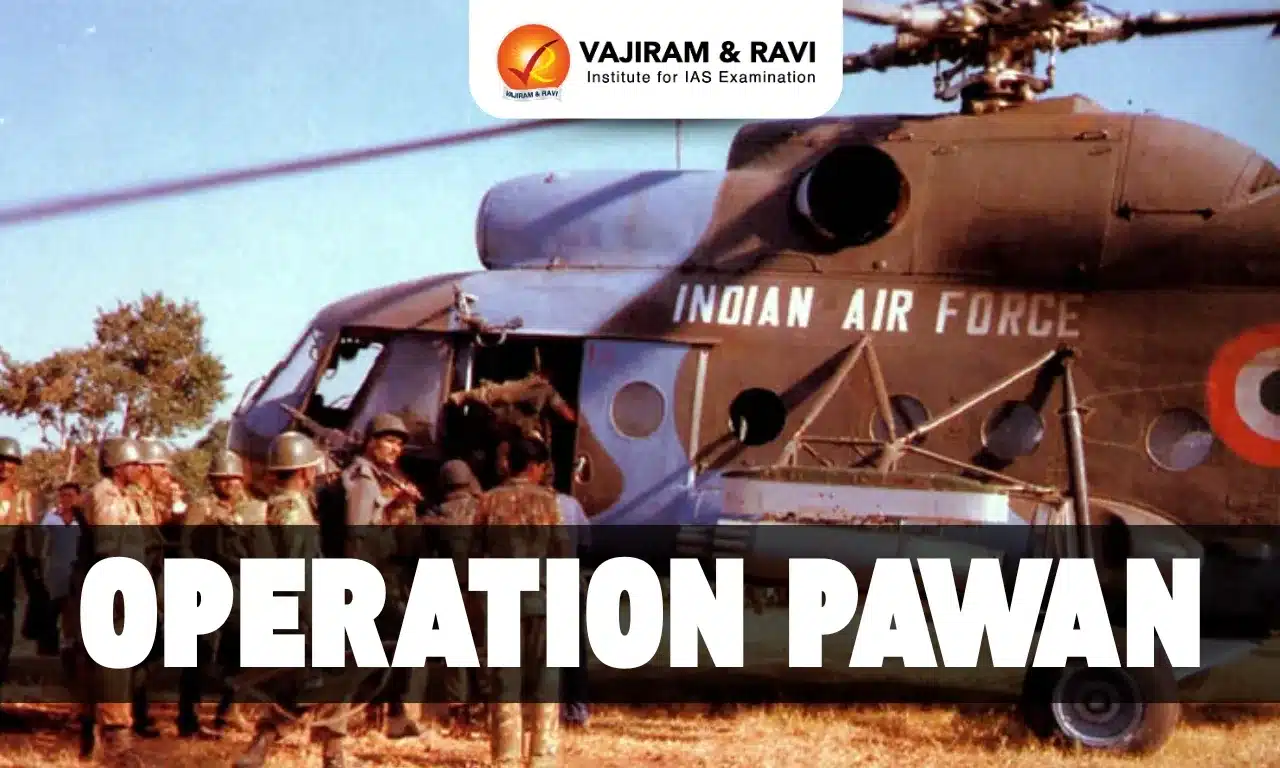
Operation Pawan was the military mission undertaken by the Indian Peace Keeping Force (IPKF) in Sri Lanka as part of the 1987 Indo-Sri Lanka Accord. Conducted during the Sri Lankan Civil War (1983–2009), it marked India’s first major international peacekeeping deployment after Independence. The operation aimed to restore peace, enforce the disarmament of militant groups, and help implement the provisions of the peace accord.
Operation Pawan Background
Operation Pawan emerged from the growing ethnic conflict in Sri Lanka and India’s efforts to restore peace through the 1987 Indo-Sri Lanka Accord.
- The Sri Lankan Civil War (1983–2009) was fought between the Sri Lankan government and the Liberation Tigers of Tamil Eelam (LTTE).
- The conflict stemmed from long-standing ethnic tensions between the Sinhalese majority and the Tamil minority.
- To end the violence, Prime Minister Rajiv Gandhi of India and President J. R. Jayewardene of Sri Lanka signed the Indo-Sri Lanka Accord on 29 July 1987.
- Under the Accord, India deployed the Indian Peace Keeping Force (IPKF) to oversee the surrender of weapons by militant groups and support peace implementation.
- The LTTE later refused to disarm and resumed armed resistance against the IPKF.
- This led to the launch of Operation Pawan, a military campaign to remove LTTE control from the Jaffna Peninsula and restore order.
Operation Pawan Objectives
The primary objectives of Operation Pawan included:
- Eliminate LTTE control over the Jaffna Peninsula.
- Enforce the disarmament of the LTTE and other militant groups.
- Implement the provisions of the 1987 Indo-Sri Lanka Accord.
- Restore law and order in conflict-affected areas.
- Assist the Sri Lankan government in maintaining peace and stability.


Role of the Indian Peace Keeping Force (IPKF)
The Indian Peace Keeping Force (IPKF) was deployed in Sri Lanka under the 1987 Indo-Sri Lanka Accord to enforce peace, oversee the disarmament of militant groups, and assist in restoring stability in the conflict-affected regions.
- Implemented the Indo-Sri Lanka Accord: Deployed to ensure the provisions of the 1987 agreement were carried out effectively.
- Oversaw Disarmament: Tasked with collecting weapons from the Liberation Tigers of Tamil Eelam (LTTE) and other Tamil militant groups.
- Conducted Counter-insurgency Operations: Engaged in military operations after the LTTE refused to surrender its arms and resumed hostilities.
- Secured the Jaffna Peninsula: Captured key strategic locations and prevented the LTTE from re-establishing control over Jaffna.
- Maintained Law and Order: Assisted in restoring normalcy and protecting civilians in conflict-affected areas.
- Supported Humanitarian Efforts: Helped facilitate the delivery of essential supplies and humanitarian assistance in affected regions.
- Strengthened Regional Security: Demonstrated India’s commitment to maintaining peace and stability in South Asia.
Operation Pawan Outcome
Operation Pawan achieved several short-term military objectives but faced significant operational and political challenges, making it one of India’s most complex overseas military missions.
- IPKF captured the Jaffna Peninsula, significantly weakening the LTTE’s control over the region.
- Prevented the LTTE from immediately retaking Jaffna through sustained counter-insurgency operations.
- The LTTE was not completely eliminated and continued its insurgency using guerrilla warfare tactics.
- The peacekeeping mission evolved into a prolonged military conflict after the LTTE refused to disarm.
- The Indian Peace Keeping Force (IPKF) remained deployed from December 1987 to March 1990 before being withdrawn from Sri Lanka.
- The Indo-Sri Lanka Accord could not be fully implemented, as political differences and continued violence persisted.
- Operation Pawan highlighted the challenges of peace enforcement, counter-insurgency, and military intervention in internal conflicts.
Operation Pawan Significance
Operation Pawan remains a landmark in India’s military history as its first major overseas peacekeeping and counter-insurgency mission after Independence, offering important strategic, diplomatic, and operational lessons.
- First Major Overseas Military Mission: It marked India’s first large-scale international peacekeeping deployment after Independence.
- Strengthened Regional Security Role: Demonstrated India’s willingness to contribute to peace and stability in South Asia.
- Counter-insurgency Experience: Provided the Indian Armed Forces with valuable experience in urban warfare, jungle warfare, and counter-insurgency operations.
- Test of Peacekeeping Operations: Highlighted the complexities of enforcing peace when a peacekeeping mission transforms into active combat.
- Enhanced Military Preparedness: Led to improvements in operational planning, intelligence gathering, logistics, and joint military coordination.
- Diplomatic Lessons: Underscored the importance of aligning military objectives with political and diplomatic strategies during regional interventions.

 Last updated on Oct, 2026
→ UPSC 2027 Notification will be released on 13 January 2027 at upsconline.nic.in.
→ Check Nobel Prize 2026 Winners List here.
→ Download PIB PRiSM Monthly Magazine 2026 here.
→ Check UPSC Monthly Current Affairs Magazine The Recitals here.
→ Check out the latest UPSC Syllabus here.
→ Download UPSC Model Answers for Mains 2026
→ UPSC Mains Question Paper 2026 is out now for Essay & GS Paper 1, 2, 3 & 4.
→ UPSC Calendar 2027 has been released.
→ Enroll in Vajiram & Ravi’s UPSC Mains Test Series 2027 for structured answer writing practice, expert evaluation, and exam-oriented feedback.
→ Join Vajiram & Ravi’s UPSC Mentorship Program 2027 for personalized guidance, strategy planning, and one-to-one support from experienced mentors.
→ Go through the UPSC Mains Previous Year Papers to enhance your preparation.
→ UPSC has released UPSC Toppers List 2025 with the Civil Services final result on its official website.
→ Also check Best UPSC Coaching in India
Operation Pawan FAQs
Q1. What was Operation Pawan?+
Q2. Why was Operation Pawan launched?+
Q3. What was the objective of Operation Pawan?+
Q4. What was the role of the Indian Peace Keeping Force (IPKF)?+
Q5. When was Operation Pawan conducted?+
Tags: operation pawan upsc current affairs