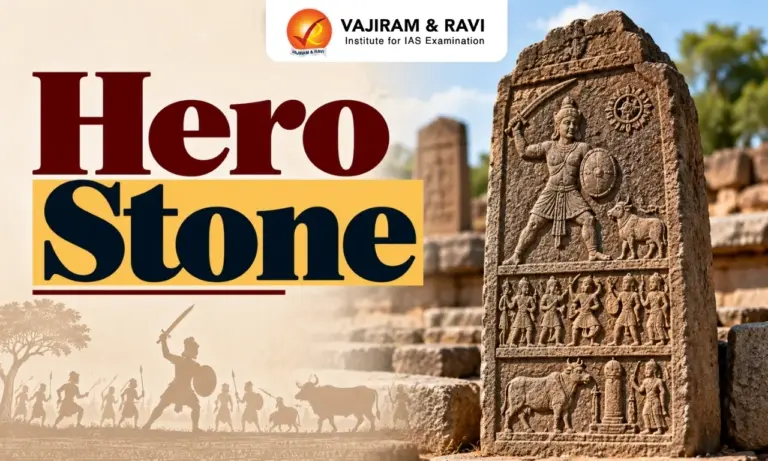
A Hero Stone, known as veeragallu in Kannada and nadukal in Tamil, is a carved memorial stone raised in honour of a warrior or villager who died bravely in battle, in a cattle raid, or while protecting a village. These stones usually show the hero’s death, journey to heaven and worship of a deity in three panels. The tradition began in the Sangam period and continued until about the 19th century CE. Hero Stones are found across India, mainly in Karnataka, Tamil Nadu, Andhra Pradesh, Telangana and Maharashtra.
What Is a Hero Stone?
A Hero Stone is a carved memorial stone raised to honour someone who died bravely while protecting others. It is the village’s way of saying, “we will never forget this sacrifice.”
- A Hero Stone is called veeragallu in Kannada, nadukal (meaning “planted stone”) in Tamil, and virgal in some other places.
- It honours a warrior, hero or chieftain who died in battle, in a cattle raid, or while protecting a village, its women or its livestock.
- Such people were treated almost like demigods. Villagers or relatives placed the stone in front of a temple or in the village meeting place.
- Most Hero Stones have three panels:
- The bottom panel shows how the hero died, such as fighting enemies or saving cattle.
- The middle panel shows apsaras carrying the hero to heaven (swarga).
- The top panel shows the hero worshipping a deity, often with the sun and moon for lasting glory.
- Some stones carry inscriptions in scripts like Old Kannada, Tamil-Brahmi or Vattezhuthu, naming the hero, the ruling king and the event. About half of all Hero Stones have no inscription.
- In Karnataka, Hero Stones are grouped by the cause of death:
- Yuddha (battle)
- Ooralivu (defending the village)
- Gadi Kalaga (defending the border)
- Go Grahana or Thurugol (protecting cattle)
- Pendirudeyurchu (protecting women)
- Bete (hunting)
- Cattle were seen as wealth in those days, so a cattle raid was a serious insult to a village. Even the Mahabharata mentions one at Viratanagari.
- Hero Stones were not only for humans. The Atakur inscription (949 CE) honours a brave dog that died killing a wild boar. At Melagani in Kolar, two 10th-century stones honour the hounds Loga and Dhalaga.
Hero Stones in India Origin
The tradition began in the early historic period of South India, with its oldest known examples in Tamil Nadu. It then spread and continued for about two thousand years.
- Most Hero Stones were raised between the second half of the first millennium BCE and the 18th century CE. The practice is also described as going back to the Sangam period and lasting until the 19th century.
- The oldest inscribed examples come from Tamil Nadu. In 2006, Tamil-Brahmi stones were found at Puliyamkombai in Theni district, and one records a man who died in a cattle raid at Kudalur.
- Scholars dated four such stones to the 2nd or 3rd century BCE. Most were set up for men who died in cattle raids, which matches what Sangam poems describe.
- The custom is thought to be linked to the funeral practices of the Megalithic period. Many early Hero Stones were built like small shrines, with upright stones and a capstone.
- Early stones from the Sangam and post-Sangam period carried no figure of the warrior. Examples at Pulimankombai, Aappanur and Mallikapuram show this.
- A Sangam-period Hero Stone was found at Malayadipatti in Tenkasi district, Tamil Nadu, in a brick well with steps. It measures about 1 m by 0.30 m.
- Its four-line inscription is in a script between Tamil-Brahmi and Vattezhuthu. It names Karukkan, Sulagan, Nannang and Kodiyan, and is read as a memorial to Nannang Kodiyan, son of Karukkan Sulagan.
- The earliest Hero Stone in Karnataka dates to the 5th century CE.
- The art reached its peak between the 5th and 14th centuries CE, under dynasties like the Chalukyas, Gangas and Hoysalas. This is when the detailed three-panel carvings became common.


Hero Stones Geographical Distribution
Hero Stones are found across India, but the largest numbers are in Karnataka, Tamil Nadu, Andhra Pradesh, Telangana and Maharashtra.
- Karnataka has the richest collection, and Hero Stones are called a unique feature of its inscription tradition. Major clusters are in Kolar, Shimoga, Tumkur, Bangalore and Haveri.
- Tamil Nadu, Andhra Pradesh and Maharashtra also have many Hero Stones, partly because of their closeness to Karnataka.
- In western India, the tradition appears as the paliya or khambhi, which is similar to South Indian Hero Stones. These are most common in Saurashtra and Kutch in Gujarat.
- Rajasthan has its own types, mainly paliyas (single-panel stones) and sculpted pillars. Odisha calls them Veer Shila.
- Famous examples include the Begur Veeragallu, now in the Bangalore Museum, and the Dekabbe memorial at Belathur (1057 CE). Some of these are regarded as unmatched in India for their detailed scenes and inscriptions.
- Many Karnataka stones show attacks on forts. Examples are at Abblur, Mavali, Hamsabhavi and Lakshmeshwar in Gadag district.
- The Doddahundi memorial (9th century) shows the ritual death of the Western Ganga king Ereganga Nitimarga I.
- Hero Stones usually stand in front of village temples, in village squares, at borders, or beside ponds. Many are still worshipped as village deities.
- A recent find at Neeragunda in Karnataka turned up two Hero Stones during temple renovation. One inscription is dated 11 December 1141 CE and mentions a soldier who sacrificed his life after the death of the Hoysala king Vishnuvardhana at Bankapura.
Significance of Hero Stones in Indian History
Hero Stones are real historical records. They tell us about wars, rulers, village life, art and beliefs, including the lives of ordinary people that royal records often skipped.
- Evidence for dates and events: Inscribed stones name kings, dates and battles. The Neeragunda stone may help settle the long-standing confusion about when Vishnuvardhana died.
- Remembering ordinary people: They keep alive the stories of villagers and soldiers who would otherwise be forgotten. Rulers often rewarded the families of fallen men with land, titles or wealth, and paid for a Hero Stone to honour the dead.
- Beliefs about life after death: The three panels show the journey from death to heaven to worship, which tells us how people imagined what came after life.
- Values of the time: They reflect loyalty, integrity and sacrifice for one’s community, master or land. The idea behind them can be summed up as “Duty Before Self.”
- Other memorial stones: Hero Stones belong to a wider family of memorials, especially in Karnataka.
- Masti stones are for women who ended their lives after their husbands’ deaths. They usually show a raised right hand. Historians note that in Karnataka this was voluntary and not forced.
- Keelgunte stones are for those who gave their lives on the death of their master or king.
- Sidithale stones are for ritual self-sacrifice by beheading.
- Dharmika stones are for religious deaths, such as the Jain Sallekhana (marked by nisidi stones), and Jataka stones are linked to Buddhist tales.
- Art and writing: The carvings show weapons, horses, elephants, forts, and even ships. On the western coast, some stones show naval battles on the lowest panel. Early Tamil-Brahmi stones also suggest that writing was not limited to a small elite in ancient Tamil Nadu.
- Pastoral and tribal history: The many cattle-raid stones show how important herding communities were. They also help us study regions and groups that written histories rarely cover.

 Last updated on Oct, 2026
→ UPSC 2027 Notification will be released on 13 January 2027 at upsconline.nic.in.
→ Check Nobel Prize 2026 Winners List here.
→ Download PIB PRiSM Monthly Magazine 2026 here.
→ Check UPSC Monthly Current Affairs Magazine The Recitals here.
→ Check out the latest UPSC Syllabus here.
→ Download UPSC Model Answers for Mains 2026
→ UPSC Mains Question Paper 2026 is out now for Essay & GS Paper 1, 2, 3 & 4.
→ UPSC Calendar 2027 has been released.
→ Enroll in Vajiram & Ravi’s UPSC Mains Test Series 2027 for structured answer writing practice, expert evaluation, and exam-oriented feedback.
→ Join Vajiram & Ravi’s UPSC Mentorship Program 2027 for personalized guidance, strategy planning, and one-to-one support from experienced mentors.
→ Go through the UPSC Mains Previous Year Papers to enhance your preparation.
→ UPSC has released UPSC Toppers List 2025 with the Civil Services final result on its official website.
→ Also check Best UPSC Coaching in India
Hero Stone FAQs
Q1. What is a Hero Stone in simple words?+
Q2. What is a Hero Stone called in Kannada and Tamil?+
Q3. What do the three panels of a Hero Stone show?+
Q4. How old are Hero Stones in India?+
Q5. Where are Hero Stones mainly found in India?+
Q6. Why are Hero Stones important for Indian history?+
Q7. Do all Hero Stones have inscriptions?+
Tags: hero stone