What’s in today’s article?
- Why in News?
- How is Defamation Defined under the Indian Law?
- The SC Verdicts on Defamation and the Right to Free Speech
- What is the Recent Case and What has SC Ruled?
Why in News?
The Supreme Court restrained a trial court from proceeding with a defamation case against Delhi Chief Minister for retweeting a YouTube video against the BJP’s IT cell.


How is Defamation Defined under the Indian Law?
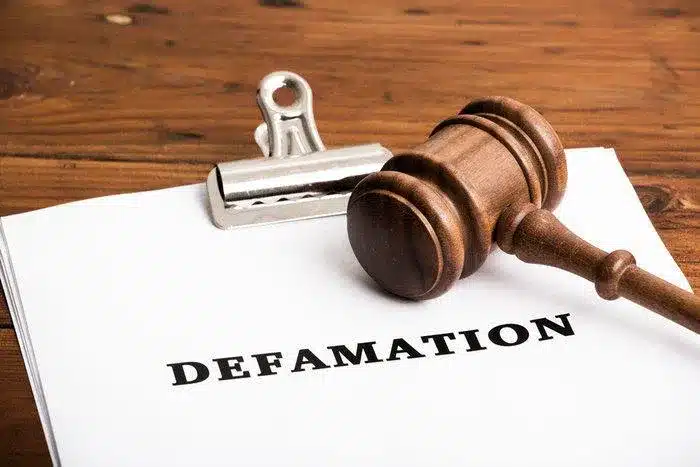
- Under Indian law, defamation can be a civil wrong or a criminal offence.
- Civil defamation can be libel (through writing) or slander (spoken word), and is based on tort law (law imposing civil liability).
- It is punishable with financial compensation, and damages are computed based on probabilities.
- In criminal cases, defamation must be proven beyond reasonable doubt. Section 499 of the Indian Penal Code (criminal defamation) says:
- “Whoever, by words or by signs or by visible representations, makes or publishes any imputation concerning any person intending to harm the reputation of such person, is said to defame that person.”
- Criminal defamation can attract a jail term up to two years, with or without fine (Section 500 IPC).
The SC Verdicts on Defamation and the Right to Free Speech
- Subramanian Swamy vs. Union of India (2016): The SC upheld the constitutionality of IPC Sections 499 and 500. It held that –
- The right to reputation is protected under Article 21 (Protection of life and personal liberty) of the Constitution,
- And that criminal defamation is a reasonable restriction on the right to freedom of expression.
- While Article 19(1)(a) of the Constitution protects the right to speech and expression, Article 19(2) allows the state to impose “reasonable restrictions” on this right in the interest of
- Sovereignty and integrity of India,
- The security of the State,
- Friendly relations with Foreign States,
- Public order, decency or morality or in relation to contempt of court, defamation or incitement to an offence.
- Kaushal Kishore vs Union of India (2017): The SC ruled that no additional restrictions can be imposed on free speech except those under Article 19(2).
- Shreya Singhal vs. Union of India (2015): The SC quashed Section 66A of the IT Act 2000, which had criminalised sending “offensive messages” by means of “a computer resource or a communication device”. This provision was quashed –
- In view of the ambiguity in the definition of the term “offensive”, and
- On the ground that the provision was violative of Article 19(1)(a) and not saved under Article 19(2).
What is the Recent Case and What has SC Ruled?
- The SC was hearing the Delhi CM’s challenge to a Delhi HC order upholding the summons issued to him in a criminal defamation case for retweeting an allegedly defamatory video posted by a YouTuber in 2018. The HC had observed that –
- Retweeting a content which is allegedly defamatory on the Twitter account and projecting it to be as if his own views, will prima facie attract the liability under Section 499 of IPC.
- The large social media following of a CM undoubtedly implies a wider reach, making any retweet a form of public endorsement or acknowledgment.
- The SC ruled that retweeting need not always mean endorsement.
Q.1. What is the new name of the Indian Penal Code (IPC)?
The Bharatiya Nyaya Sanhita 2023 is the criminal code which replaces the Indian Penal Code (IPC) 1860. The BNS covers all aspects of criminal law, including offences, punishments, defences and procedures.
Q.2. What is the Article 19(2) of the Indian Constitution?
Article 19(2) of the Indian Constitution permits the government to impose reasonable restrictions upon the freedom of speech and expression in the interests of public order.

 Last updated on Oct, 2026
→ UPSC 2027 Notification will be released on 13 January 2027 at upsconline.nic.in.
→ Check Nobel Prize 2026 Winners List here.
→ Download PIB PRiSM Monthly Magazine 2026 here.
→ Check UPSC Monthly Current Affairs Magazine The Recitals here.
→ Check out the latest UPSC Syllabus here.
→ Download UPSC Model Answers for Mains 2026
→ UPSC Mains Question Paper 2026 is out now for Essay & GS Paper 1, 2, 3 & 4.
→ UPSC Calendar 2027 has been released.
→ Enroll in Vajiram & Ravi’s UPSC Mains Test Series 2027 for structured answer writing practice, expert evaluation, and exam-oriented feedback.
→ Join Vajiram & Ravi’s UPSC Mentorship Program 2027 for personalized guidance, strategy planning, and one-to-one support from experienced mentors.
→ Go through the UPSC Mains Previous Year Papers to enhance your preparation.
→ UPSC has released UPSC Toppers List 2025 with the Civil Services final result on its official website.
→ Also check Best UPSC Coaching in India