India-Australia Relations Latest News
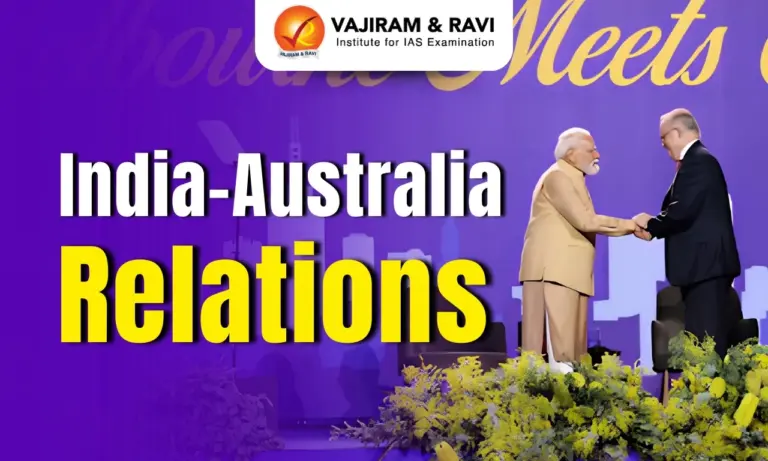
- At the 3rd India–Australia Annual Summit (2026) in Melbourne, the Indian PM and Australian PM (Anthony Albanese) signed a series of landmark agreements.
- The summit reflects the growing convergence between the two Indo-Pacific democracies amid evolving geopolitical challenges, particularly China’s assertiveness and disruptions to maritime trade.
Strategic Significance of the Summit
- India and Australia reaffirmed their commitment to:
- The leaders described the partnership as one between vibrant democracies, multicultural societies and major maritime powers with shared regional and global interests.


Major Defence and Maritime Outcomes
- Joint declaration on defence and security cooperation: A new declaration was adopted to significantly deepen defence ties through –
- Enhanced strategic consultations.
- Greater interoperability between armed forces.
- Expansion of bilateral and multilateral military exercises.
- Collaboration in defence science, technology and industrial supply chains.
- Stronger defence industrial partnerships.
- India–Australia defence innovation corridor: The initiative aims to connect defence start-ups and industries, promote co–development and innovation in defence technologies, and strengthen indigenous defence manufacturing.
- Maritime security roadmap: Both countries agreed to expand maritime domain cooperation in the Indo-Pacific; collaborate in shipbuilding, ship repair and maintenance; and enhance maritime security and regional stability.
Civil Nuclear Cooperation
- A major breakthrough was the operationalisation of the 2014 India–Australia Civil Nuclear Agreement through the finalisation of an administrative arrangement.
- Key significance: This will –
- Enable Australian uranium exports to India for peaceful purposes.
- Support India’s clean energy transition by expanding non-fossil fuel electricity generation.
- Provide Australia with a stable export market while strengthening India’s long-term energy security.
Economic, Trade and Investment Cooperation
- Fast-tracking CECA:
-
- Both sides agreed to accelerate negotiations on the Comprehensive Economic Cooperation Agreement (CECA), and the Bilateral Investment Treaty (BIT).
- The objective is to create a balanced, ambitious and mutually beneficial economic partnership.
- Building on ECTA: The leaders acknowledged positive outcomes from the India–Australia Economic Cooperation and Trade Agreement (ECTA) and agreed to:
- Reduce non-tariff barriers.
- Improve institutional financing.
- Encourage greater private-sector investment.
Other Agreements
- Energy security:
- Critical minerals for strategic security: The two countries expanded cooperation in critical mineral supply chains, renewable energy technologies, and energy security.
- A joint rooftop solar training academy: It will be established in Gujarat under the PM Surya Ghar Yojana to train women and youth, and to build technical skills in rooftop solar installation and maintenance.
- Technology and supply chain resilience:
- PACTS initiative: The Partnership on Cyber, Critical Technologies and Supply Chains (PACTS) is launched focusing on cybersecurity, digital resilience, semiconductor research, etc.
- ACITI trilateral MoU: Australia, Canada and India signed the Australia–Canada–India Technology and Innovation (ACITI) framework to strengthen trusted technology cooperation among the three Commonwealth partners.
- Education and skill development: The summit expanded educational collaboration (to strengthen higher education, vocational training and workforce development) through:
- Flinders University receiving a Letter of Intent to establish a campus in Bengaluru.
- Victoria University obtaining approval for a campus in Gurgaon.
- Establishing a National Centre of Excellence for Skilling in Mining at the National Skill Training Institute, Bhubaneswar.
- Cultural diplomacy and repatriation of antiquities:
- Australia agreed to return three stolen antiquities from Tamil Nadu after provenance verification:
- Granite Nandi sculpture (11th–12th century).
- Bronze Trident with Bhadrakali (11th century).
- Basalt six-headed Skanda (Karthikeya) (12th century).
- Reciprocal gesture: India agreed to repatriate the remains of an Australian First Nations ancestor currently housed in the Government Museum, Chennai.
- Australia agreed to return three stolen antiquities from Tamil Nadu after provenance verification:
India-Australia Relations
- Since both nations were part of the British Empire, they are members of the Commonwealth of Nations.
- Sharing a “Comprehensive Strategic Partnership“, trade and migration, security, lingual and sporting ties have emerged as a strong foundation of cultural connection between the two nations.
- Bilateral trade stands at approx. US$32.6 billion (with India having a trade deficit of ~US$14 billion).
- Australia is a vital supplier of natural resources (coal, LNG, and uranium), while India acts as a major market for Australian higher education, IT services, and pharmaceuticals.
- Military cooperation between Australia and India includes the regular joint naval exercise AUSINDEX (Navy) and AUSTRAHIND (Army).
- Both countries are part of the Quad along with the US and Japan.
- The relationship is supported by the Centre for Australia-India Relations, a government centre within Australia’s foreign affairs portfolio.
Conclusion
The agreements reinforce both nations’ shared commitment to a stable, rules-based Indo-Pacific, resilient supply chains and sustainable economic growth, making the partnership a key pillar of India’s Act East policy and Indo-Pacific strategy.

 Last updated on Oct, 2026
→ UPSC 2027 Notification will be released on 13 January 2027 at upsconline.nic.in.
→ Check Nobel Prize 2026 Winners List here.
→ Download PIB PRiSM Monthly Magazine 2026 here.
→ Check UPSC Monthly Current Affairs Magazine The Recitals here.
→ Check out the latest UPSC Syllabus here.
→ Download UPSC Model Answers for Mains 2026
→ UPSC Mains Question Paper 2026 is out now for Essay & GS Paper 1, 2, 3 & 4.
→ UPSC Calendar 2027 has been released.
→ Enroll in Vajiram & Ravi’s UPSC Mains Test Series 2027 for structured answer writing practice, expert evaluation, and exam-oriented feedback.
→ Join Vajiram & Ravi’s UPSC Mentorship Program 2027 for personalized guidance, strategy planning, and one-to-one support from experienced mentors.
→ Go through the UPSC Mains Previous Year Papers to enhance your preparation.
→ UPSC has released UPSC Toppers List 2025 with the Civil Services final result on its official website.
→ Also check Best UPSC Coaching in India
India-Australia Relations
Q1. How does the 2026 India–Australia Summit strengthen India's Indo-Pacific strategy?+
Q2. What is the significance of operationalising the India–Australia Civil Nuclear Agreement?+
Q3. What is the strategic importance of India–Australia cooperation in critical minerals?+
Q4. How do education, skill development and technology partnerships contribute to the India–Australia partnership?+
Q5. What is the role of cultural diplomacy in strengthening bilateral relations between India and Australia?+
Tags: india-australia relations