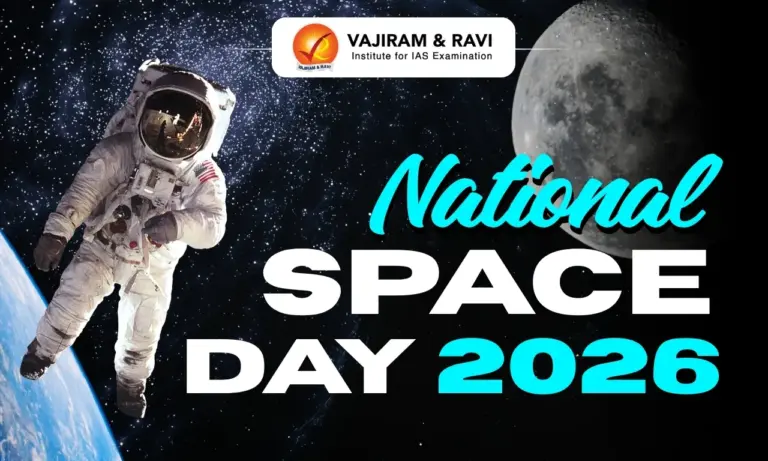
National Space Day 2026 in India is observed every year on 23 August. It commemorates the successful soft landing of Chandrayaan 3 on the Moon in 2023. The day highlights India’s achievements in space science, technology, exploration and human spaceflight. National Space Day 2026 also provides an opportunity to understand India’s expanding space ecosystem, private participation, major missions and future plans.
What is National Space Day 2026 About?
National Space Day 2026 will be observed on 23 August. The occasion marks India’s historic Chandrayaan 3 achievement and celebrates the country’s growing capabilities in space exploration and applications. 2026 National Space Day in India marks the third anniversary of this milestone. India celebrated its 1st National Space Day on 23 August 2024.
National Space Day Theme 2026
The National Space Day Theme 2026 has not been announced yet. The 2025 theme was “Aryabhatta to Gaganyaan: Ancient Wisdom to Infinite Possibilities.” The National Space Day 2026 theme is expected to connect India’s astronomical wisdom with its modern space ambitions, encouraging young minds toward science careers.


National Space Day 2026 History
National Space Day 2026 was announced after Chandrayaan 3 achieved a historic lunar landing on 23 August 2023.
- Chandrayaan 3 Achievement: On 23 August 2023, Vikram Lander successfully soft landed on the Moon, followed by deployment of the Pragyan Rover.
- Historic lunar milestone: India became the fourth country to successfully land on the Moon and the first country to land near its southern polar region.
- National recognition: Prime Minister of India Narendra Modi proclaimed 23 August as National Space Day to recognise this major achievement in India’s space programme.
Chandrayaan 3 Mission
Chandrayaan 3 Mission remains India’s most celebrated space achievement, showcasing indigenous engineering skill during a challenging lunar landing attempt.
- Launch and landing: The chandrayaan 3 launch date was 14 July 2023. The Vikram Lander achieved a soft landing on 23 August 2023 near the lunar south pole.
- Lunar south pole: Chandrayaan 3 made India the first country to achieve a soft landing near the Moon’s south pole and the fourth nation to soft land on the Moon.
- Pragyan Rover: The successful deployment of Pragyan Rover enabled in situ scientific investigations on the lunar surface after Vikram’s landing.
- Scientific Findings: Instruments aboard Pragyan rover confirmed the presence of Sulphur on the lunar surface through direct elemental analysis.
- Global Ranking: Chandrayaan 3 achievement made India the fourth nation worldwide, after the USA, Russia and China, to soft land on the Moon.
- Chandrayaan Missions:
- Chandrayaan 1 detected water molecules in 2008.
- Chandrayaan 2 captured 30 cm resolution lunar images in 2019.
- Chandrayaan 4 is planned for 2027 and will demonstrate lunar sample collection, ascent from the lunar surface and sample return to Earth.
- Chandrayaan 5/ LUPEX mission under ISRO-JAXA will study lunar volatiles, including water, near the Moon’s south polar region.
National Space Day in India 2026
National Space Day in India 2026 will focus on awareness of India’s space achievements and inspiring wider participation in science, technology, engineering and mathematics.
- Digital Learning Resources: Platforms like Diksha, Nishtha and the India on the Moon portal keep students informed about space exploration.
- National Space Day ISRO Events: These include expert sessions, live demonstrations and scientist interactions to inspire young students across India.
- Public awareness: A national space day drawing, national space day quiz and educational activities can help communicate India’s space achievements in simple formats.
Space Sector in India
India’s space sector evolved from limited government control into a thriving ecosystem combining public institutions, private industry and global collaboration.
- Origin and Background: India’s space journey began with the Aryabhata satellite launch in 1975, aboard a Soviet rocket, marking its first satellite.
- Private Participation: India opened the space sector to private participation in 2020. The Indian Space Policy 2023 further expanded participation across the space value chain.
- Foreign Investment Rules: FDI norms were liberalised in February 2024, permitting up to 100% investment in satellite component manufacturing activities.
- Global Partnerships: India has signed over 300 space cooperation agreements with 61 countries and 5 multilateral organisations for joint research.
- Launch vehicles: India has operationalised PSLV, GSLV, GSLV Mk III and SSLV for Earth observation, communication, navigation, scientific, exploration and commercial missions.
- Launch infrastructure: Sriharikota has two operational launch pads. A third launch pad is being established. Kulasekarapattinam is developing as India’s second rocket launch site.
- Earth observation: The EO-PPP framework is developing India’s first privately owned Earth observation satellite constellation with around ₹1,200 crore in private investment commitments.
Space Missions in India
India’s major missions cover lunar and planetary exploration, solar science, astronomy, navigation, human spaceflight, docking, Earth observation and future space infrastructure.
- Aryabhata: India’s first satellite was launched in 1975 by the Soviet Union. It marked an early milestone in India’s space journey.
- Chandrayaan 1: Launched in 2008, India’s first Moon mission detected water molecules and hydroxyl on the lunar surface.
- Chandrayaan 2: Launched in 2019, its orbiter operated at 100 km altitude and captured lunar images with resolution up to 30 cm.
- Mars Orbiter Mission: Mangalyaan entered Martian orbit on 24 September 2014. It operated for more than eight years against its planned six month mission life.
- AstroSat: India’s first dedicated astronomy mission studies celestial sources simultaneously across X ray, optical and ultraviolet spectral bands.
- Aditya L1: Launched in 2023, India’s first solar mission observes the Sun from the Sun-Earth L1 point nearly 1.5 million km from Earth. More than 27 TB of solar data has been publicly released.
- XPoSat: Launched in January 2024, XPoSat expanded India’s capabilities in X ray polarization astronomy and studies extreme cosmic sources.
- SPADEX: Conducted in January 2025, the Space Docking Experiment made India the fourth nation to demonstrate autonomous space docking and undocking.
- Axiom 4: Launched on 25 June 2025, Group Captain Shubhanshu Shukla became India’s first astronaut to journey to the International Space Station. The mission concluded on 15 July 2025.
- NISAR: Jointly developed by ISRO and NASA, NISAR was launched on 30 July 2025. It monitors land, glaciers, forests, oceans and environmental changes.
- TRISHNA: The ISRO-CNES mission is scheduled for launch in 2026. It will provide high resolution thermal observations for agriculture, water resources, ecosystems and climate studies.
- Gaganyaan: The programme aims to send three Indian astronauts to a 400 km orbit for a three day mission. The first uncrewed experimental mission is targeted for Q4 2026, with the crewed mission targeted by 2027.
- Chandrayaan 4: Planned for 2027, this mission will demonstrate lunar sample collection, ascent and return of samples to Earth.
- Chandrayaan 5/ LUPEX: The ISRO-JAXA mission will investigate lunar water and other volatiles near the south polar region.
- Venus Orbiter Mission: Targeted for March 2028, it will study Venusian geology, atmosphere and ionosphere while demonstrating aerobraking and advanced thermal management technologies.
- SPADEX 2 and SPADEX 3: These missions are being studied to advance docking, sample transfer, crew transfer and power, fluid and propellant transfer capabilities.
- NGLV: India is developing a partially reusable Next Generation Launch Vehicle using LOX-Methane propulsion. It is intended to provide higher payload capability and more frequent launches.
- Bharatiya Antariksh Station: India’s planned space station, with its first module BAS 01 targeted for launch by 2028, fully operational by 2035.

 Last updated on Oct, 2026
→ UPSC 2027 Notification will be released on 13 January 2027 at upsconline.nic.in.
→ Asian Games 2026 are being held in Aichi-Nagoya, Japan, from 19 September to 4 October.
→ Check Nobel Prize 2026 Winners List here.
→ Download PIB PRiSM Monthly Magazine 2026 here.
→ Check UPSC Monthly Current Affairs Magazine The Recitals here.
→ Check out the latest UPSC Syllabus here.
→ Download UPSC Model Answers for Mains 2026
→ UPSC Mains Question Paper 2026 is out now for Essay & GS Paper 1, 2, 3 & 4.
→ UPSC Calendar 2027 has been released.
→ Enroll in Vajiram & Ravi’s UPSC Mains Test Series 2027 for structured answer writing practice, expert evaluation, and exam-oriented feedback.
→ Join Vajiram & Ravi’s UPSC Mentorship Program 2027 for personalized guidance, strategy planning, and one-to-one support from experienced mentors.
→ Go through the UPSC Mains Previous Year Papers to enhance your preparation.
→ UPSC has released UPSC Toppers List 2025 with the Civil Services final result on its official website.
→ Also check Best UPSC Coaching in India
National Space Day 2026 FAQs
Q1. When is the National Space Day 2026 celebrated in India?+
Q2. What is National Space Day about?+
Q3. What is the National Space Day Theme 2026?+
Q4. Is National Space Day an international space day?+
Q5. What is the Chandrayaan 3 national space day connection?+
Tags: national space day national space day 2026