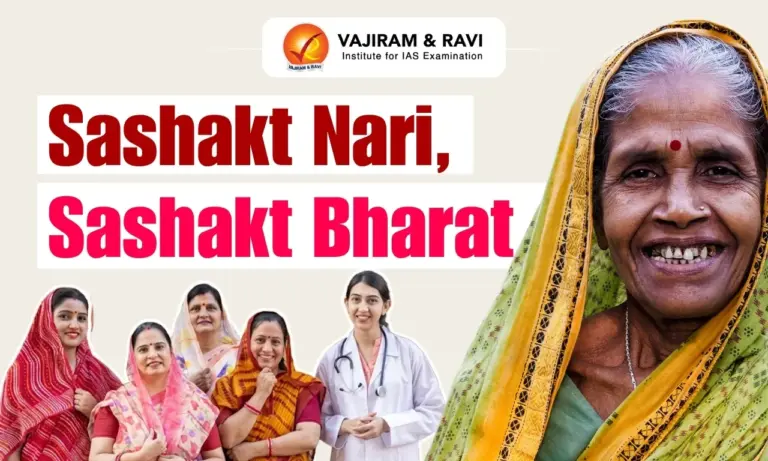
India’s Sashakt Nari, Sashakt Bharat approach views women’s empowerment as a continuous life-cycle process, beginning with the girl child and extending through adolescence, education, health, skills, livelihoods, financial inclusion, safety and leadership. The approach is moving beyond women as beneficiaries of welfare schemes towards women as active contributors to economic and social development, recognising Nari Shakti as a key driver of Viksit Bharat @2047.
1. Girl Child: Survival, Protection and Education
The life cycle begins with ensuring that girls survive, remain in school and build the capabilities needed for adulthood.
Beti Bachao Beti Padhao
The Beti Bachao Beti Padhao (BBBP) programme addresses the declining Child Sex Ratio and promotes the protection and education of girls.
- It focuses on institutional deliveries, girls’ secondary-school enrolment, reducing dropouts and antenatal-care registration.
- The National Family Health Survey-5 (2019-21) recorded a sex ratio of 1,020 females per 1,000 males, compared with 943 in Census 2011.
Sukanya Samriddhi Yojana
The Sukanya Samriddhi Yojana encourages long-term savings for the girl child and supports future education and marriage needs.
- Deposits can begin with ₹250, while the scheme provides tax benefits and permits partial withdrawal for higher education and marriage.
- Total deposits under the scheme exceeded ₹3.33 lakh crore as of December 2025.
Samagra Shiksha and KGBVs
Samagra Shiksha and Kasturba Gandhi Balika Vidyalayas (KGBVs) strengthen girls’ access to school education, particularly for disadvantaged groups.
- Female school enrolment reached 11.96 crore in 2025-26.
- KGBV enrollment increased from 6.07 lakh in 2020-21 to 7.58 lakh in 2025-26.
- The Gender Inclusion Fund under the National Education Policy 2020 provides targeted support for disadvantaged girls.
2. Adolescence: Nutrition, Skills and New-Age Education
As girls enter adolescence, the focus expands from basic access to nutrition, higher education, vocational skills and participation in STEM.
Nutrition and Adolescent Health
Mission Saksham Anganwadi and POSHAN 2.0 is an integrated programme that strengthens Anganwadi services and nutrition support for children, adolescent girls, pregnant women and lactating mothers, while upgrading Anganwadi Centres into Saksham Anganwadis.
- As of 31 July 2026, more than 8.94 crore beneficiaries were being served, including 15.68 lakh adolescent girls.
- Around 1.29 lakh Anganwadi Centres were upgraded as Saksham Anganwadis in the last five years to provide improved services.
STEM and Higher Education
Targeted interventions are helping more girls enter science, technology, engineering and mathematics (STEM) and higher education.
- The Vigyan Jyoti Scheme had benefited more than 1.12 lakh girls across 300 districts by March 2026.
- Supernumerary seats in IITs and NITs helped raise women’s participation from below 10% to above 20%.
- Women accounted for more than 53% of UGC NET-JRF scholars in STEM subjects in 2024-25.
- Female enrolment in higher education increased to 2.18 crore in 2022-23, from 1.57 crore in 2014-15.
Scholarships and Vocational Skills
Financial and skill support is helping girls transition from education to employment.
- The AICTE PRAGATI Scholarship offers 10,000 scholarships annually, with nearly 36,000 girls benefiting by 2024-25.
- The National PG Scholarship provides ₹1.5 lakh annually to selected students, including 3,000 women each year.
- The Pradhan Mantri Kaushal Vikas Yojana (PMKVY) provides industry-aligned training, with nearly 45% of beneficiaries being women.
- NAVYA, launched in 2025, trains girls aged 16-18 in digital marketing, cybersecurity and Artificial Intelligence-enabled services; 1,060 girls had been trained by June 2026.


3. Reproductive and Maternal Health: Safe Motherhood
The next stage of the life cycle focuses on safe pregnancy, institutional delivery and financial support during motherhood.
Pradhan Mantri Matru Vandana Yojana
The Pradhan Mantri Matru Vandana Yojana (PMMVY) provides maternity benefits through Direct Benefit Transfer.
- Women receive ₹5,000 for the first living child and ₹6,000 for a second child if the child is a girl.
- As of 31 July 2026, 5.13 crore beneficiaries had enrolled, 4.37 crore had received payments and ₹20,571 crore had been paid.
Pradhan Mantri Surakshit Matritva Abhiyan
The Pradhan Mantri Surakshit Matritva Abhiyan (PMSMA) provides free antenatal check-ups at government facilities on the 9th of every month, particularly focusing on high-risk pregnancies.
- As of 13 August 2026, more than 7.50 crore pregnant women had been examined through PMSMA.
- More than 6.85 crore antenatal check-ups had been conducted and 1.03 crore high-risk pregnancies identified for focused digital tracking.
Janani Shishu Suraksha Karyakram
The Janani Shishu Suraksha Karyakram (JSSK) provides free delivery, including Caesarean section, along with transport, diagnostics, medicines, blood and diet in public health institutions.
- During 2024-25, more than 1.99 crore pregnant women and 16.85 lakh sick infants received support.
- Since 2014-15, more than 18.05 crore beneficiaries have received assistance.
Maternal Health Outcomes
These interventions have been accompanied by improvements in key maternal-health indicators.
- First-trimester antenatal visits increased from 58.6% in NFHS-4 to 76.2% in NFHS-6.
- Women completing four or more antenatal-care visits increased from 51.2% to 65.2%.
- Institutional births increased from 78.9% to 90.6%.
4. Adult Women: Health, Nutrition and Well-being
Beyond motherhood, the focus shifts towards continuous healthcare, preventive screening and financial protection.
Ayushman Bharat
The Ayushman Bharat-Pradhan Mantri Jan Arogya Yojana (AB-PMJAY) provides cashless secondary and tertiary healthcare.
- As of 12 August 2026, 45.5 crore Ayushman cards had been created, including 22.48 crore cards issued to women.
- More than 5.25 crore hospital admissions under the scheme were of women.
- More than 1.86 lakh Ayushman Arogya Mandirs were functional, providing primary and preventive healthcare.
- Under the Ayushman Bharat Digital Mission (ABDM), more than 110 crore health records had been digitally linked, while women accounted for 49.72% of ABHA accounts.
Preventive Health
Preventive interventions are increasingly being integrated into women’s healthcare.
- As of March 2026, 3.96 crore pregnant women were registered on the U-WIN platform for digital immunisation tracking.
- More than 8.73 crore women had been screened for cervical cancer as of February 2026.
- A nationwide Human Papillomavirus (HPV) vaccination campaign was launched on 28 February 2026 for about 1.2 crore eligible 14-year-old girls; 52.10 lakh girls had received the vaccine by 15 July 2026.
5. Economic Empowerment: From Beneficiary to Earner
The life-cycle approach ultimately seeks to give women income, financial independence, access to credit and control over economic opportunities.
Self Help Groups and Lakhpati Didi
The Deendayal Antyodaya Yojana-National Rural Livelihoods Mission (DAY-NRLM) has created a large women-led Self Help Group ecosystem.
- SHGs had accessed more than ₹12.18 lakh crore in bank credit through over 50,548 trained Bank Sakhis as of February 2026.
- By June 2026, 4.32 lakh enterprises had been supported under the Start-up Village Entrepreneurship Programme (SVEP).
- Lakhpati Didi aims to enable SHG women to earn a sustainable annual household income of at least ₹1 lakh; by March 2026, the initiative covered 10.14 crore SHG members across 34 States/UTs and 757 districts.
Financial Inclusion and Credit
Formal financial access has expanded significantly among women.
- As of August 2026, 32.68 crore of the 58.90 crore Jan-Dhan accounts belonged to women.
- Under the Pradhan Mantri Mudra Yojana (PMMY), about two-thirds of sanctioned loans have gone to women entrepreneurs.
- Under PM Street Vendor’s AtmaNirbhar Nidhi (PM SVANidhi), women accounted for 46% of beneficiaries as of August 2026.
Women, Technology and Markets
Government initiatives are also connecting women with technology-based livelihoods and organised markets.
- NaMo Drone Didi trains women Self Help Group members to operate drones for agricultural applications; 1,094 drones had been distributed to women SHGs since inception.
- Womaniya on Government e-Marketplace (GeM) had more than 2.1 lakh women-led enterprises registered and secured ₹28,000 crore+ in contract value during FY 2025-26.
- Self Help Entrepreneur Mart (SHE-Mart), announced in Union Budget 2026-27, aims to benefit 1 crore women by supporting sustainable enterprises.
6. Safety, Dignity and Living Standards
Economic empowerment cannot be sustained without personal safety, protection from harassment and secure living conditions.
Mission Shakti
Mission Shakti combines the Sambal and Samarthya verticals for women’s safety and empowerment.
- One Stop Centres and Nari Adalats provide institutional support and grievance redressal for women.
- The Women Helpline (181) had supported more than 1.05 crore women with 24×7 assistance by 31 July 2026.
- The SHe-Box portal enables online reporting of workplace sexual harassment.
Housing
Housing schemes strengthen women’s security and ownership of household assets.
- Under Pradhan Mantri Awas Yojana-Gramin (PMAY-G), more than 96.06 lakh houses, or 24.73% of houses, had been allotted exclusively to women as of 13 August 2026.
- Under PMAY-Urban 2.0, 1 crore houses had been allotted to women as of 9 August 2026.
7. Leadership: From Economic Agency to Decision-Making
The final stage of empowerment is reflected in women’s growing presence in grassroots governance, electoral politics and national institutions.
- Women accounted for more than 47.15 crore of the 96.88 crore electors on the final electoral roll as of February 2026.
- Around 14.5 lakh women were elected Panchayati Raj representatives as of March 2025, nearly 46% of all representatives.
- The Nari Shakti Vandan Adhiniyam, 2023, or the 106th Constitutional Amendment Act, provides for 33% reservation for women in the Lok Sabha, State Legislative Assemblies and Delhi Legislative Assembly, following the prescribed census and delimitation exercise.
- The first batch of 17 women cadets graduated from the National Defence Academy in 2025, while 158 women cadets had joined the NDA since 2022 by early 2026.
Conclusion
Sashakt Nari, Sashakt Bharat represents a shift from a welfare-oriented approach to women-led development. A girl’s education, an adolescent’s skills, a mother’s access to safe healthcare, a woman’s financial independence and her participation in governance are interconnected stages of the same empowerment journey. Strengthening this life-cycle continuum can make Nari Shakti a central driver of Viksit Bharat @2047.

 Last updated on Oct, 2026
→ UPSC 2027 Notification will be released on 13 January 2027 at upsconline.nic.in.
→ Check Nobel Prize 2026 Winners List here.
→ Download PIB PRiSM Monthly Magazine 2026 here.
→ Check UPSC Monthly Current Affairs Magazine The Recitals here.
→ Check out the latest UPSC Syllabus here.
→ Download UPSC Model Answers for Mains 2026
→ UPSC Mains Question Paper 2026 is out now for Essay & GS Paper 1, 2, 3 & 4.
→ UPSC Calendar 2027 has been released.
→ Enroll in Vajiram & Ravi’s UPSC Mains Test Series 2027 for structured answer writing practice, expert evaluation, and exam-oriented feedback.
→ Join Vajiram & Ravi’s UPSC Mentorship Program 2027 for personalized guidance, strategy planning, and one-to-one support from experienced mentors.
→ Go through the UPSC Mains Previous Year Papers to enhance your preparation.
→ UPSC has released UPSC Toppers List 2025 with the Civil Services final result on its official website.
→ Also check Best UPSC Coaching in India
Sashakt Nari Sashakt Bharat FAQs
Q1. What does the life-cycle approach to women’s empowerment mean?+
Q2. How are women contributing to India’s economic growth?+
Q3. How do Self Help Groups promote women’s empowerment?+
Q4. How is technology creating new opportunities for women?+
Q5. What is the significance of the Nari Shakti Vandan Adhiniyam, 2023?+
Tags: sashakt nari sashakt bharat