India Electrical Fire Risk Latest News
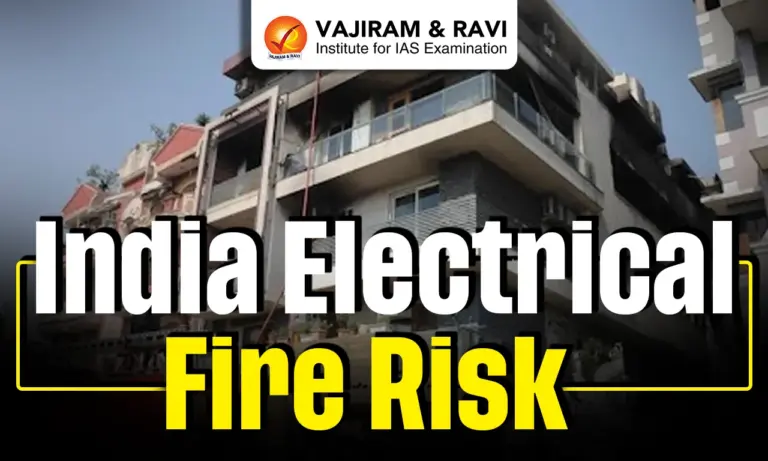
- A deadly fire in East Delhi’s Vivek Vihar in May 2026, which killed nine people, has renewed concerns over India’s growing electrical fire risk, with suspected causes including an AC blast or short circuit.
- Data from Delhi and Mumbai indicate that a large majority of urban fires are linked to electrical faults, though official figures may understate the problem due to poor categorisation.
- Rising electricity demand, extreme heat, and rapid growth in air-conditioner use are increasing stress on ageing electrical infrastructure, especially in older buildings not designed to handle modern high-load appliances.
Why Older Homes Face Higher Electrical Fire Risks
- Studies in Europe show that ageing electrical installations remain a major fire risk, with many residential buildings operating on outdated wiring systems that were never upgraded.
- India faces similar electrical fire vulnerability, but the core problem is not just ageing housing stock.
- It is driven by rapid growth in electricity consumption, poor-quality wiring, and inadequate maintenance.
Mismatch Between Old Wiring and Modern Demand
- Many homes built decades ago were designed for minimal electrical use such as lights and fans.
- Today, the same systems are expected to support: air conditioners, induction cooktops, geysers etc.
- Electrical systems installed in earlier decades were not designed for these heavy modern loads, making overloads, short circuits, and fire hazards increasingly likely.


Electrical Risks Linked to Air Conditioners
- Air Conditioners as High-Risk Appliances – Air conditioners pose significant electrical fire risks because they are among the heaviest power-consuming appliances in households.
- High Start-Up Load – ACs draw a large surge of electricity during start-up, often six to eight times their normal running current, placing sudden stress on electrical circuits.
- Shared Circuit Overload – In many homes, ACs are connected to circuits shared with other heavy appliances, increasing the risk of overloading, overheating, and short circuits.
- The Hidden Harmonics Problem – Modern inverter-based ACs draw electricity in irregular pulses, creating harmonic distortion—electrical disturbances at multiples of the standard 50 Hz frequency.
- Impact on Building Wiring – In three-phase buildings, some harmonic currents accumulate in the neutral wire, which is typically not designed to carry heavy loads, causing silent overheating.
- Potential Fire Trigger – When overheating caused by harmonics combines with loose electrical joints or damaged insulation, it can create ignition points that lead to electrical fires.
Major Causes of Electrical Fires
- Common triggers include short circuits, overloaded circuits, loose or corroded connections, arc faults, ground faults, and ageing electrical equipment.
- These are often linked to poor-quality wiring, counterfeit electrical components, inadequate maintenance, weak switchboard connections, and harmonic distortion that overheats wiring.
- Loose connections are particularly dangerous, as they can create hidden hot spots over time before causing ignition.
- Major incidents such as the SUM Hospital and AMRI Hospital fires in India also originated from electrical short circuits.
Preventing Electrical Fires Through Regular Inspections
- Countries such as Japan and South Korea significantly reduced electrical fire incidents by making periodic inspection of domestic electrical installations mandatory.
- Regular inspections in these countries reportedly led to nearly a 90% decline in recorded fire incidents, highlighting the effectiveness of preventive maintenance.
- The European Union’s 2024 Energy Performance of Buildings Directive recognises modern electrical systems such as heat pumps, solar panels, batteries, and EV chargers as emerging fire-safety risks requiring greater regulatory attention.
Lessons for India’s Electrical Safety Framework
- Bureau of Indian Standards has established electrical safety norms through the National Electrical Code of India 2023, while the National Building Code 2016 includes fire and life safety provisions.
- Electrical installations typically require contractor certification and inspector approval before power connection.
- In many European countries, utilities require formal inspection reports before meter connections, reflecting stricter pre-energisation safety checks.
- Arc-fault circuit interrupters (AFCIs), which detect dangerous electrical arcs and cut power before fires start, have been mandatory in U.S. homes since 1999.
- However, such protective devices are largely absent in Indian residential buildings and are not widely mandated under Indian electrical codes.
- The Fire and Security Association of India has pointed to a major shortfall in fire safety infrastructure, indicating systemic weaknesses in prevention and response mechanisms.
- India faces a severe shortage of trained fire forensic engineers, leading to dependence on provisional explanations such as “short circuit” instead of detailed scientific root-cause investigations, even in major fire incidents.
Policy Measures to Strengthen Fire Safety
- Introduce harmonic compliance and power-quality monitoring standards for high-load buildings such as hospitals, commercial complexes, data centres, and EV-charging facilities.
- Adopt regular inspection systems similar to Japan, South Korea, and Europe, especially after major electrical load additions like rooftop solar, EV chargers, or battery storage.
- Create a transparent forensic investigation mechanism for major electrical fires to identify root causes and improve accountability.
- Develop a harmonised national dataset by integrating information from fire departments, crime records, and standards agencies for better policy planning.
Source: TH

 Last updated on Oct, 2026
→ UPSC 2027 Notification will be released on 13 January 2027 at upsconline.nic.in.
→ Check Nobel Prize 2026 Winners List here.
→ Download PIB PRiSM Monthly Magazine 2026 here.
→ Check UPSC Monthly Current Affairs Magazine The Recitals here.
→ Check out the latest UPSC Syllabus here.
→ Download UPSC Model Answers for Mains 2026
→ UPSC Mains Question Paper 2026 is out now for Essay & GS Paper 1, 2, 3 & 4.
→ UPSC Calendar 2027 has been released.
→ Enroll in Vajiram & Ravi’s UPSC Mains Test Series 2027 for structured answer writing practice, expert evaluation, and exam-oriented feedback.
→ Join Vajiram & Ravi’s UPSC Mentorship Program 2027 for personalized guidance, strategy planning, and one-to-one support from experienced mentors.
→ Go through the UPSC Mains Previous Year Papers to enhance your preparation.
→ UPSC has released UPSC Toppers List 2025 with the Civil Services final result on its official website.
→ Also check Best UPSC Coaching in India
India Electrical Fire Risk FAQs
Q1. Why is India electrical fire risk increasing?+
Q2. Why are air conditioners considered major fire risks?+
Q3. What are the major causes of electrical fires?+
Q4. What lessons can India learn from other countries?+
Q5. What policy measures can improve electrical fire safety in India?+
Tags: India electrical fire risk mains articles upsc current affairs upsc mains current affairs