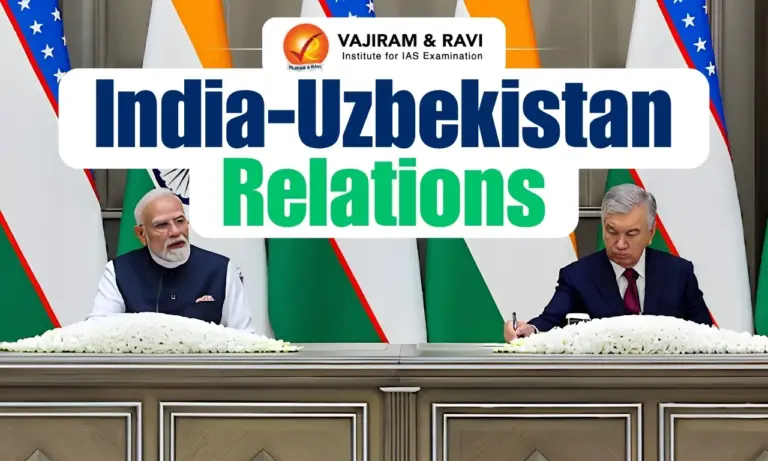
India-Uzbekistan Relations Latest News
- India and Uzbekistan have elevated their bilateral relationship to a Comprehensive Strategic Partnership, marking a new phase in ties on the 15th anniversary of their Strategic Partnership.
- During the Indian PM’s visit to Tashkent, the two sides agreed to deepen cooperation in civil nuclear energy, trade, defence, critical minerals, connectivity, counter-terrorism, pharmaceuticals, technology and education.
Civil Nuclear Cooperation – Uranium Supply
- A major new area of cooperation is the proposed long-term arrangement for uranium supplies from Uzbekistan to India.
- India has been exploring uranium imports to support its expanding civilian nuclear energy programme and strengthen energy security. The agreement is reportedly close to being finalised.
- For India, diversified uranium sourcing can reduce dependence on a limited number of suppliers and support the long-term expansion of nuclear power as a low-carbon baseload energy source.


Trade and Economic Partnership
- The two countries set an ambitious target of raising annual bilateral trade from around USD 1 billion to USD 5 billion by 2030.
- Key areas identified include trade and investment, agriculture and pharmaceuticals, energy and critical minerals, jewellery and mining, and infrastructure and connectivity.
- To achieve the target, India and Uzbekistan intend to address market-access barriers, connectivity constraints, banking and payment mechanisms.
- Significance: Uzbekistan is an important gateway to Central Asia, while India seeks greater economic engagement with the resource-rich and strategically located region.
Defence and Counter-Terrorism
- Defence cooperation:
- It is being expanded from traditional military exchanges towards defence-industrial collaboration.
- Both sides will promote direct linkages between defence industries. Focus will be placed on co-development and co-production of military equipment.
- The Joint Working Group on Military Cooperation is exploring new avenues in defence-industrial cooperation.
- The Dustlik joint military exercise continues to strengthen operational cooperation.
- Zero tolerance on terrorism:
-
- The two countries unequivocally condemned terrorism, including cross-border terrorism, and rejected its justification on any grounds.
- They agreed to strengthen –
- Intelligence sharing
- Law-enforcement cooperation
- Countering violent extremism
- Action against terrorist financing
- Tackling safe havens and terrorist infrastructure
- Combating organised crime and illicit drug trafficking
- Cooperation against cyber threats
- This has particular significance given the security uncertainties in Afghanistan and their implications for Central Asia.
Critical Minerals and Strategic Resources
- Critical minerals and mining have emerged as important pillars of the relationship.
- Uzbekistan possesses significant mineral resources, while India is seeking to diversify its sources of critical minerals essential for clean energy, electronics, advanced manufacturing and strategic technologies.
- This cooperation can contribute to India’s broader objective of building resilient and diversified global supply chains.
Connectivity and People-to-People Ties
- Connectivity remains a key challenge in India–Central Asia relations because India lacks direct overland access to the region.
- The partnership therefore assumes significance in the context of India’s broader Connect Central Asia Policy and efforts to develop alternative connectivity corridors.
- Other measures include –
- Uzbekistan’s decision to remove visa requirements for Indian citizens for stays up to 30 days, facilitating tourism and business.
- Expansion of digital payment connectivity, with UPI-enabled applications expected to become usable in Uzbekistan.
- Cooperation in tourism, culture and education.
- Strategic relevance: Improved connectivity and digital-payment integration can strengthen India’s economic and societal presence in Central Asia.
Culture, Education and Heritage
- The partnership also has a strong civilisational dimension.
- A Letter of Intent was agreed for restoration and conservation of the Buddhist sites of Fayaz Tepa and Kara Tepa in Uzbekistan.
- 100 Lal Bahadur Shastri Hindi scholarships were announced.
- An ICCR Sanskrit Chair will be established at Tashkent State University of Oriental Studies.
- Cooperation will also cover Ayurveda, education and culture.
- These initiatives leverage the historical links between the Indian subcontinent and Central Asia.
Institutional Mechanism and Environmental Cooperation
- The upgraded partnership will receive stronger institutional mechanisms –
- A Foreign Minister-level Coordination Group will be established.
- The existing Joint Commission will be elevated from the secretary level to the ministerial level.
- Additionally, India announced a USD 1 million grant for afforestation in the Aral Sea region, linking bilateral cooperation with environmental restoration.
Strategic Significance for India
- Uzbekistan occupies a pivotal position in Central Asia, a region increasingly shaped by competition and cooperation involving Russia, China, Türkiye, Iran and other powers.
- For India, deeper engagement can help –
- Diversify energy and critical-mineral supplies.
- Strengthen security cooperation amid instability surrounding Afghanistan.
- Expand India’s economic footprint in Central Asia.
- Counterbalance growing Chinese economic and strategic influence.
- Advance connectivity and India’s wider Extended Neighbourhood Policy.
- Promote India’s technological and digital public infrastructure capabilities.
Conclusion
- The elevation to a Comprehensive Strategic Partnership will be meaningful only if the announced targets translate into implementation.
- In essence, India–Uzbekistan ties are evolving from a predominantly diplomatic and security partnership into a multidimensional strategic relationship.

 Last updated on Oct, 2026
→ UPSC 2027 Notification will be released on 13 January 2027 at upsconline.nic.in.
→ Asian Games 2026 are being held in Aichi-Nagoya, Japan, from 19 September to 4 October.
→ Check Nobel Prize 2026 Winners List here.
→ Download PIB PRiSM Monthly Magazine 2026 here.
→ Check UPSC Monthly Current Affairs Magazine The Recitals here.
→ Check out the latest UPSC Syllabus here.
→ Download UPSC Model Answers for Mains 2026
→ UPSC Mains Question Paper 2026 is out now for Essay & GS Paper 1, 2, 3 & 4.
→ UPSC Calendar 2027 has been released.
→ Enroll in Vajiram & Ravi’s UPSC Mains Test Series 2027 for structured answer writing practice, expert evaluation, and exam-oriented feedback.
→ Join Vajiram & Ravi’s UPSC Mentorship Program 2027 for personalized guidance, strategy planning, and one-to-one support from experienced mentors.
→ Go through the UPSC Mains Previous Year Papers to enhance your preparation.
→ UPSC has released UPSC Toppers List 2025 with the Civil Services final result on its official website.
→ Also check Best UPSC Coaching in India
India-Uzbekistan Relations FAQs
Q1. How does the proposed long-term uranium supply arrangement with Uzbekistan contribute to India’s energy security?+
Q2. What is the strategic significance of India–Uzbekistan Comprehensive Strategic Partnership for India?+
Q3. What is the significance of India–Uzbekistan cooperation in critical minerals?+
Q4. How can enhanced defence cooperation between India and Uzbekistan contribute to regional security?+
Q5. What is the role of connectivity in deepening India–Uzbekistan relations?+
Tags: india uzbekistan relations