WTO Trade Policy Review (TPR) Latest News
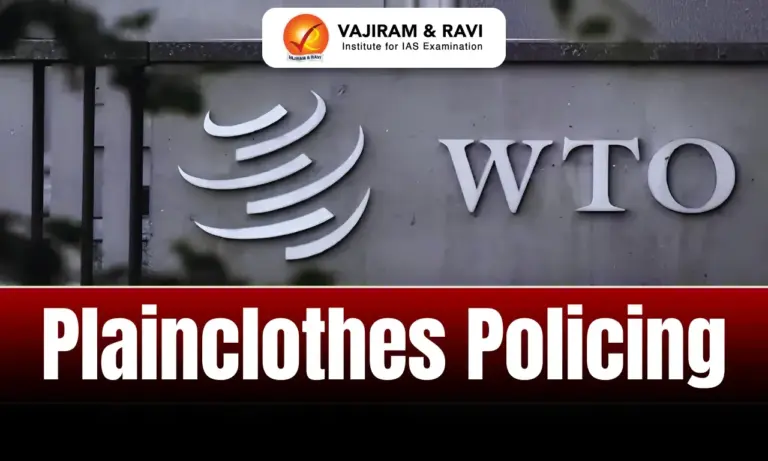
- India’s 8th Trade Policy Review (TPR) commenced at the World Trade Organization (WTO) in Geneva on 21 July 2026 (~65 WTO Members participated), covering the review period 1 January 2021–31 December 2025.
- Led by Commerce Secretary Rajesh Agarwal, India presented its trade policy achievements, economic performance and reform agenda while responding to questions from WTO members.
- The review serves as a transparency mechanism to assess members’ trade policies and their consistency with WTO principles.
What is the WTO Trade Policy Review Mechanism (TRPM)?
- The TPRM is a transparency exercise under the WTO. It enables members to periodically examine each other’s trade policies and practices.
- The objective is to improve transparency, predictability and accountability in the multilateral trading system rather than to enforce compliance.


India’s Economic and Trade Performance
- India highlighted its resilience despite geopolitical tensions, supply-chain disruptions and rising global protectionism.
- Key achievements:
-
- Recorded nearly 8% average annual GDP growth during 2021–2025.
- Achieved record exports of USD 863.1 billion in 2025–26.
- Continued pursuing the vision of Viksit Bharat @2047 while addressing the developmental needs of nearly one-fifth of the world’s population.
Major Trade and Economic Reforms Highlighted
- India showcased a broad range of structural and trade-related reforms aimed at enhancing competitiveness and integration with the global economy.
- Key initiatives:
- Aatmanirbhar Bharat: Strengthening domestic manufacturing while integrating with Global Value Chains (GVCs).
- Jan Vishwas initiative: Regulatory simplification and ease of doing business.
- Digital customs and trade facilitation measures.
- Logistics modernisation and quality infrastructure development.
- Expansion of Digital Public Infrastructure (DPI) for financial inclusion and trade efficiency.
- Promotion of Artificial Intelligence (AI), innovation and startups.
- Focus on sustainability, agricultural resilience and inclusive development.
- Expansion of Regional Trade Agreements (RTAs).
- Continued support through South-South Cooperation and the Indian Technical and Economic Cooperation (ITEC) Programme.
- India reiterated its support for balanced, development-oriented WTO reforms that strengthen the multilateral trading system while safeguarding the interests of developing countries.
Recognition from WTO Leadership and Members
- WTO TPR Body (TPRB):
- Recognised India as one of the fastest-growing major economies.
- Appreciated India’s leadership in digitally delivered services exports.
- Commended reforms in DPI, financial inclusion and trade facilitation.
- Welcomed India’s acceptance of the WTO Agreement on Fisheries Subsidies, following the deposit of its Instrument of Acceptance.
- Praised India’s timely responses to advance questions, reflecting transparency under the TPR mechanism.
- Active participant (Brazil): Brazil’s representative highlighted –
- Success of the Goods and Services Tax (GST) in creating a unified domestic market.
- India’s digital trade reforms and expanding export strategy.
- Importance of recent RTAs.
- India’s Duty-Free Tariff Preference (DFTP) Scheme for Least Developed Countries (LDCs).
- India’s DPI as a model for other developing countries.
Key Area of Conflict
- India and key WTO members are at loggerheads over the 66-nation Agreement on Electronic Commerce (ECA), with India challenging the legality of bypassing multilateral consensus.
- Core arguments and objections:
- Consensus rule:
- India maintains that adding any new plurilateral pact to Annex 4 requires the agreement of all WTO members under the Marrakesh Agreement.
- It failed to pass during General Council meetings in 2025.
- Annex 4 contains plurilateral trade agreements that are binding only on the specific member countries who choose to accept them.
- It currently includes two active pacts: the Agreement on Trade in Civil Aircraft and the Revised Agreement on Government Procurement.
- Interim validity: Following the deadlock, 66 participating countries issued a declaration, establishing an interim arrangement to operationalize the e-commerce pact.
- Institutional overreach: New Delhi formally questioned the institutional and legal basis, challenging a partial-membership deal.
- Consensus rule:
- Broader multilateral divide:
- Plurilateral push: Proponent nations argue that coalition-based “Joint Statement Initiatives” are necessary to prevent total paralysis on new-age trade rules when complete consensus is unachievable.
- Systemic risk: India contends that allowing subsets of countries to operationalize unapproved agreements undermines the core multilateral character of the global trading system.
Significance of TPR for India
- Soft power and cultural diplomacy: On the sidelines of the review, India organised an exhibition showcasing diverse Indian products, and traditional papier-mâché handicrafts.
- Reinforces: India’s image as a responsible stakeholder in the multilateral trading system.
- Demonstrates: India’s attempt to balance self-reliance (Aatmanirbhar Bharat) with greater global economic integration.
- Highlights: India’s growing role in digital trade, services exports, and South-South cooperation.
- Strengthens: India’s credibility in ongoing WTO negotiations and reform discussions.
- Reflects: India’s emphasis on inclusive, transparent and development-oriented global trade governance.
Source: PIB

 Last updated on Oct, 2026
→ UPSC 2027 Notification will be released on 13 January 2027 at upsconline.nic.in.
→ Check Nobel Prize 2026 Winners List here.
→ Download PIB PRiSM Monthly Magazine 2026 here.
→ Check UPSC Monthly Current Affairs Magazine The Recitals here.
→ Check out the latest UPSC Syllabus here.
→ Download UPSC Model Answers for Mains 2026
→ UPSC Mains Question Paper 2026 is out now for Essay & GS Paper 1, 2, 3 & 4.
→ UPSC Calendar 2027 has been released.
→ Enroll in Vajiram & Ravi’s UPSC Mains Test Series 2027 for structured answer writing practice, expert evaluation, and exam-oriented feedback.
→ Join Vajiram & Ravi’s UPSC Mentorship Program 2027 for personalized guidance, strategy planning, and one-to-one support from experienced mentors.
→ Go through the UPSC Mains Previous Year Papers to enhance your preparation.
→ UPSC has released UPSC Toppers List 2025 with the Civil Services final result on its official website.
→ Also check Best UPSC Coaching in India
WTO Trade Policy Review (TPR) FAQs
Q1. What is the primary objective of the WTO's Trade Policy Review Mechanism (TPRM)?+
Q2. How does Aatmanirbhar Bharat complement India's global trade strategy?+
Q3. Why is India's acceptance of the WTO Agreement on Fisheries Subsidies significant?+
Q4. What role does Digital Public Infrastructure (DPI) play in India's trade policy?+
Q5. Why are Quality Control Orders (QCOs) an important issue in WTO discussions on India?+
Tags: wto trade policy review (trp)