US-Saudi Nuclear Deal Latest News
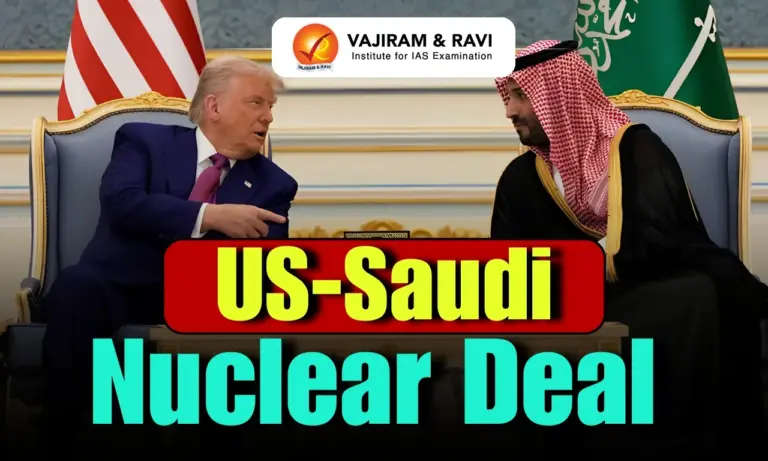
- The United States and Saudi Arabia have signed a landmark civilian nuclear cooperation agreement.
- Framed as a “peaceful nuclear cooperation agreement,” the 30-year pact has sparked concerns that it could enable Saudi Arabia to eventually develop nuclear weapons.
What the Deal Involves
- The agreement gives American companies substantial access to Saudi Arabia’s nuclear energy programme.
- Alongside it, a “bilateral safeguards agreement” was also signed, though the full text remains undisclosed.
- Reports suggest the deal could permit Saudi Arabia to enrich uranium domestically — fuel primarily meant for power plants, but which can also be diverted toward weapons-grade material.
- Some US media reports question whether the accompanying safeguards are robust enough.


The 123 Agreement: Legal Backbone of the Deal
- Named after Section 123 of the US Atomic Energy Act, 1954, a 123 Agreement is mandatory before the US can undertake significant nuclear cooperation with any country.
- It facilitates transfer of nuclear materials, equipment, and technology for peaceful purposes while ensuring non-proliferation compliance.
- India precedent: India’s 123 Agreement with the US, cleared by Congress on October 1, 2008, ended three decades of technology-denial restrictions. India agreed to place select civilian facilities under India-specific IAEA safeguards in exchange for uninterrupted fuel supply — a model frequently cited in nuclear diplomacy discussions.
- The Saudi deal must similarly be ratified by the US Congress — a politically uncertain process, since Saudi Arabia lacks the broad bipartisan support Israel enjoys in the US legislature.
Why the Deal Raises Concerns
- Regional arms race risk: West Asia already has one nuclear power (Israel) and one on the threshold (Iran). A Saudi enrichment capability could trigger a proliferation cascade.
- Iran factor: Saudi Arabia’s then-Crown Prince Mohammed bin Salman stated in 2018 that the Kingdom would pursue nuclear weapons if Iran did. The deal could embolden Iran’s own weapons ambitions and push it closer to China and Russia.
- Weak inspection regime: Unlike the 2009 US-UAE nuclear deal — under which Abu Dhabi does not enrich its own fuel and faces multiple restrictions — the Saudi pact may allow indigenous enrichment, setting a more permissive precedent.
- Geopolitical timing: The deal comes amid escalating US-Iran hostilities. Saudi Arabia hosts US military bases that have faced Iranian attacks, and it comes just two days after Yemen’s Houthis announced a maritime blockade against the Kingdom.
- Conflict of interest concerns: The Trump Organisation has significant financial dealings with Saudi Arabia, having raised around $50 million in 2024 alone from Saudi-linked business, raising questions about the deal’s underlying motivations.
Strategic and Economic Rationale
- For the US: Opens major sales opportunities for American nuclear firms, notably Westinghouse.
- For Saudi Arabia: Enables diversification away from oil-based electricity generation toward nuclear power, freeing more crude for export.
- Both governments have officially framed the deal as mutually beneficial and non-proliferation-compliant.
Conclusion
- The US-Saudi nuclear deal marks a major diplomatic win for Riyadh but carries significant proliferation risk in an already volatile West Asia.
- Its ultimate impact will hinge on the strength of safeguards, Congressional ratification, and whether it triggers a wider regional race for nuclear capability — making it a critical case study in the balance between energy diplomacy and non-proliferation.

 Last updated on Oct, 2026
→ UPSC 2027 Notification will be released on 13 January 2027 at upsconline.nic.in.
→ Check Nobel Prize 2026 Winners List here.
→ Download PIB PRiSM Monthly Magazine 2026 here.
→ Check UPSC Monthly Current Affairs Magazine The Recitals here.
→ Check out the latest UPSC Syllabus here.
→ Download UPSC Model Answers for Mains 2026
→ UPSC Mains Question Paper 2026 is out now for Essay & GS Paper 1, 2, 3 & 4.
→ UPSC Calendar 2027 has been released.
→ Enroll in Vajiram & Ravi’s UPSC Mains Test Series 2027 for structured answer writing practice, expert evaluation, and exam-oriented feedback.
→ Join Vajiram & Ravi’s UPSC Mentorship Program 2027 for personalized guidance, strategy planning, and one-to-one support from experienced mentors.
→ Go through the UPSC Mains Previous Year Papers to enhance your preparation.
→ UPSC has released UPSC Toppers List 2025 with the Civil Services final result on its official website.
→ Also check Best UPSC Coaching in India
US-Saudi Nuclear Deal FAQs
Q1. What is the significance of the US-Saudi Nuclear Deal? +
Q2. How does the 123 Agreement support the US-Saudi Nuclear Deal? +
Q3. Why has the US-Saudi Nuclear Deal generated non-proliferation concerns? +
Q4. How could the US-Saudi Nuclear Deal affect regional geopolitics?+
Q5. Why is the US-Saudi Nuclear Deal important for global nuclear governance?+
Tags: upsc current affairs upsc mains current affairs US-Saudi Nuclear Deal