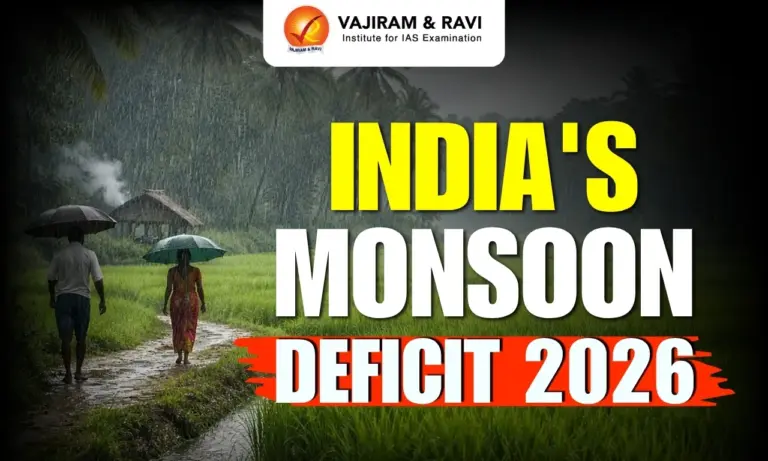
India’s Southwest Monsoon 2026 has remained below normal during much of the season, with the rainfall deficit becoming a major concern for agriculture, water resources and the rural economy. The India Meteorological Department (IMD) had forecast below-normal seasonal rainfall, and the cumulative deficit remained around 15% below the Long Period Average (LPA).
What is a Monsoon Deficit?
A monsoon deficit occurs when the rainfall received during the monsoon season is lower than the long-term average rainfall for the same period.
The deficit is generally expressed as a percentage departure from the Long Period Average (LPA).
Formula: Rainfall Deficit (%) = [(Actual Rainfall − Normal Rainfall) / Normal Rainfall] × 100
For example, if normal rainfall is 100 units but actual rainfall is 85 units, the rainfall departure is −15%, indicating a 15% deficit.
However, a national rainfall deficit does not necessarily mean that every state or district experiences drought-like conditions. Rainfall can be normal or excessive in one region and deficient in another.
Why is India’s Monsoon Deficient in 2026?
India’s 2026 monsoon deficit is mainly linked to the development of El Nino conditions, which can weaken the monsoon and reduce moisture flow towards India. The situation was further affected by an unfavourable Madden-Julian Oscillation (MJO), fewer low-pressure systems and long dry spells during important phases of the monsoon.
Factors Causing the 2026 Monsoon Deficit
- El Nino Conditions: Warming of the central and eastern Pacific Ocean affected global wind patterns and weakened the monsoon circulation over India.
- Weak Start to the Monsoon: The monsoon recorded a significant rainfall shortage during June, which contributed to the overall seasonal deficit.
- Fewer Low-Pressure Systems: A lack of sufficient low-pressure areas over the North Indian Ocean reduced the movement of moisture and rainfall towards several parts of India.
- Unfavourable MJO: The Madden-Julian Oscillation (MJO) was not favourable for sustained monsoon rainfall during important periods of the season.
- Long Dry Spells: Several parts of the country experienced prolonged gaps between rainfall events, increasing the overall deficit.
- Uneven Rainfall Distribution: Some areas received very heavy rainfall and floods, while others faced dry conditions. This uneven distribution reduced the effectiveness of rainfall for agriculture and water recharge.
- Climate Variability: Rising temperatures and changing atmospheric conditions are contributing to greater rainfall variability, making the monsoon more difficult to predict accurately.


Regional Pattern of Monsoon Deficit 2026
The 2026 monsoon deficit has not been uniform across India. While some regions received normal or heavy rainfall during certain periods, several areas recorded significant shortages. As of mid-September, Central India was comparatively better placed, while Northwest India, East and Northeast India, and parts of the Southern Peninsula continued to face below-normal rainfall.
- Northwest India: Several areas recorded below-normal rainfall, with Haryana, Punjab and Rajasthan among the regions facing significant deficits.
- East and Northeast India: This region experienced a notable rainfall shortage, affecting states such as Bihar, Arunachal Pradesh, Assam and Meghalaya.
- Central India: Central India received relatively better rainfall, supported by several low-pressure systems and depressions during July.
- Southern Peninsula: Parts of the southern peninsula are expected to end the season with below-average rainfall, although rainfall conditions have varied between states.
- Gujarat: Rainfall has been highly uneven. Kutch and Saurashtra recorded substantial deficits, while some southern districts such as Valsad and Navsari received above-normal rainfall.
- Andaman and Nicobar Islands: The islands are expected to experience near-normal rainfall compared with several other regions.
Impact of India’s Monsoon Deficit 2026
The monsoon deficit in 2026 can affect several sectors of the Indian economy, especially agriculture, water resources and rural livelihoods. The impact is not the same everywhere because rainfall has been uneven, with some areas facing dry spells while others have experienced heavy rainfall.
- Agriculture: Low or irregular rainfall can affect sowing, crop growth and yields, particularly in rain-fed farming areas.
- Kharif Crops: Crops such as rice, pulses, soybean, maize, cotton and groundnut may face water stress in rainfall-deficient areas.
- Water Resources: Poor rainfall can reduce the recharge of groundwater, reservoirs, lakes and rivers, creating pressure on water availability.
- Rural Income: Lower crop production can reduce farmers’ income and affect spending in rural areas.
- Food Prices: A fall in the production of some crops can put upward pressure on food prices, depending on supply, stocks and imports.
- Hydropower: Lower water inflows into reservoirs can affect hydroelectric power generation in some areas.
- Groundwater: Farmers may become more dependent on groundwater and irrigation when rainfall is insufficient, increasing pressure on groundwater reserves.
- Flood and Drought Risk: Uneven rainfall can create a dual risk of drought and flooding, long dry spells can be followed by intense rainfall and flash floods.

 Last updated on Oct, 2026
→ UPSC 2027 Notification will be released on 13 January 2027 at upsconline.nic.in.
→ Check Nobel Prize 2026 Winners List here.
→ Download PIB PRiSM Monthly Magazine 2026 here.
→ Check UPSC Monthly Current Affairs Magazine The Recitals here.
→ Check out the latest UPSC Syllabus here.
→ Download UPSC Model Answers for Mains 2026
→ UPSC Mains Question Paper 2026 is out now for Essay & GS Paper 1, 2, 3 & 4.
→ UPSC Calendar 2027 has been released.
→ Enroll in Vajiram & Ravi’s UPSC Mains Test Series 2027 for structured answer writing practice, expert evaluation, and exam-oriented feedback.
→ Join Vajiram & Ravi’s UPSC Mentorship Program 2027 for personalized guidance, strategy planning, and one-to-one support from experienced mentors.
→ Go through the UPSC Mains Previous Year Papers to enhance your preparation.
→ UPSC has released UPSC Toppers List 2025 with the Civil Services final result on its official website.
→ Also check Best UPSC Coaching in India
India's Monsoon Deficit 2026 FAQs
Q1. What is India's monsoon deficit in 2026?+
Q2. What are the main reasons for the 2026 monsoon deficit?+
Q3. How has the monsoon affected agriculture in 2026?+
Q4. Is the monsoon deficit the same across India?+
Q5. Can there be floods even during a monsoon deficit?+
Tags: india's monsoon deficit india's monsoon deficit 2026