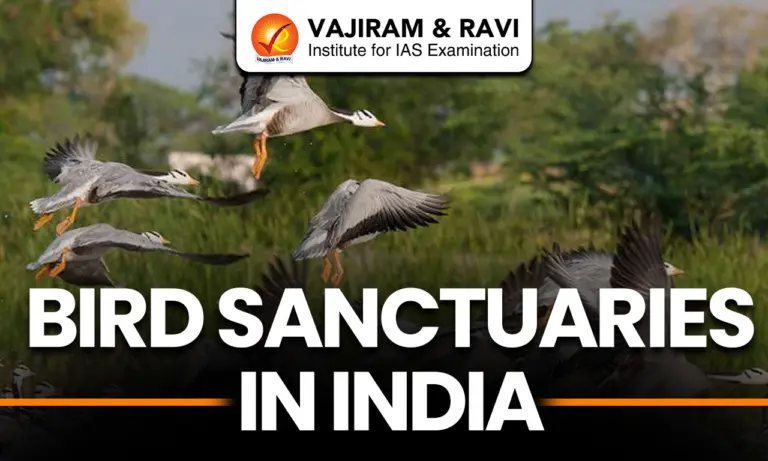
Bird sanctuaries in India are protected natural areas created for conserving resident and migratory bird species along with their habitats. India has nearly 72 major bird sanctuaries and around 1,210 recorded bird species. These sanctuaries include wetlands, grasslands, mangroves, lakes, estuaries, forests and coastal ecosystems. They support ecological balance through pollination, seed dispersal, pest control and biodiversity conservation while also promoting eco tourism, scientific research and environmental awareness across different regions of India.
Bird Sanctuaries in India
Bird Sanctuaries in India conserve avian biodiversity through protected habitats, legal safeguards, scientific monitoring and ecosystem management across India’s ecological regions.
- Definition: Bird sanctuaries are legally protected natural areas established for conserving indigenous and migratory birds, protecting breeding grounds, safeguarding wetlands and maintaining ecological balance through habitat preservation and regulated human activity.
- Diversity: Indian bird sanctuaries support nearly 1,210 bird species, including flamingos, pelicans, cranes, herons, storks, ibises, ducks, raptors, hornbills, bustards and endemic Western Ghats species.
- Habitat: Indian bird sanctuaries include freshwater lakes, mangrove forests, estuaries, grasslands, marshlands, river basins, coastal lagoons, reservoirs, islands and forest ecosystems supporting diverse feeding and nesting requirements.
- Migratory Importance: Sanctuaries receive migratory birds from Siberia, Central Asia, Europe, Russia, Kazakhstan, the Arctic Circle, Himalayas and Southeast Asia during winter between October and February every year.
- Ecological Functions: Birds assist in pollination, seed dispersal, pest control, scavenging, nutrient cycling and maintaining aquatic ecosystems while acting as indicators of environmental health and climate related ecological changes.
- Legal Framework: Most bird sanctuaries are protected under the Wildlife (Protection) Act, 1972, while wetlands receive additional protection under Ramsar Convention provisions and state forest conservation regulations.
- Ramsar Recognition: Important bird habitats like Vedanthangal, Chilika Lake, Soor Sarovar, Pong Dam Lake, Khijadiya and Nal Sarovar have international wetland recognition under the Ramsar Convention framework.
- Management Authorities: Bird sanctuaries are managed mainly by State Forest Departments, Wildlife Boards, Wetland Authorities and conservation agencies with support from BNHS and local community participation.
- Tourism and Research: Sanctuaries promote sustainable eco tourism, birdwatching, photography, biodiversity surveys, ecological studies, migratory tracking and conservation awareness among students, researchers and nature enthusiasts.
- Major Threats: Habitat degradation, pollution, invasive species, fishing pressure, agricultural runoff, climate change, urbanization, wetland shrinkage, illegal hunting and water scarcity threaten many Indian bird sanctuaries.
State Wise List of Bird Sanctuaries in India
Bird Sanctuaries in India are distributed across wetlands, forests, rivers, grasslands, mangroves and coastal ecosystems in multiple states and union territories.
Andhra Pradesh
- Kolleru Bird Sanctuary: Also known as Atapaka Bird Sanctuary, located between Krishna and Godavari deltas, Kolleru Lake supports grey pelicans and painted storks, both categorized as Near Threatened species under the IUCN Red List.
- Nelapattu Bird Sanctuary: Nellore district sanctuary is India’s major breeding site for spot billed pelicans and hosts black capped kingfishers, painted snipes, gull billed terns and whimbrels during migratory seasons.
- Rollapadu Great Indian Bustard Sanctuary: This grassland sanctuary protects the endangered Great Indian Bustard while also supporting floricans, larks, harriers and blackbucks in semi arid ecosystems.
- Sri Lankamalleswara Wildlife Sanctuary: The sanctuary protects dry deciduous forests and supports Indian long billed vultures, pied kingfishers, black winged stilts, open billed storks and monsoon migratory bird populations.
- Pulicat Lake Bird Sanctuary: India’s second largest brackish water lagoon hosts flamingos, pelicans, painted storks, ducks, gulls and terns while serving as an important feeding and nesting ground.
- Uppalapadu Bird Sanctuary: This sanctuary near Guntur is known for painted storks, pelicans, black headed ibises, pintail ducks and community led bird conservation practices around village water bodies.
Assam
- Bordoibam Bilmukh Bird Sanctuary: This wetland sanctuary protects migratory waterfowl and riverine biodiversity along the Brahmaputra floodplain ecosystem with rich aquatic vegetation and marsh habitats.
- Pani Dihing Bird Sanctuary: Located near the Dihing River, the sanctuary supports migratory ducks, storks, eagles and wetland birds in northeastern India’s floodplain ecosystem.
Bihar
- Bareli Jheel Salim Ali Bird Sanctuary: This wetland sanctuary supports migratory waterbirds, herons, storks and ducks while providing important feeding habitats in Bihar’s floodplain region.
- Kusheshwar Asthan Bird Sanctuary: Located in Darbhanga district, the sanctuary attracts migratory birds from Central Asia and Siberia while conserving floodplain wetlands and marsh ecosystems.
- Saraiya Man Bird Sanctuary: The sanctuary preserves freshwater wetlands supporting ducks, cranes, egrets and migratory birds during winter migration seasons across northern India.
- Nagi Dam Bird Sanctuary: Jamui district sanctuary hosts more than 136 bird species including bar headed geese, Indian courser, yellow wattled lapwing and Indian robin near Jharkhand border wetlands.
Chandigarh
- City Bird Sanctuary: Chandigarh’s urban bird sanctuary protects migratory and resident bird populations while promoting urban biodiversity conservation and environmental education activities.
Delhi
- Okhla Bird Sanctuary: Located on the Yamuna River near Noida, this wetland sanctuary supports Oriental skylarks, spot billed ducks, parakeets, stilts, kingfishers and winter migratory waterfowl.
- Najafgarh Drain Bird Sanctuary: This important urban wetland habitat supports sarus cranes, painted storks, black necked storks, black headed ibises and migratory waterbird populations near Delhi NCR.
Goa
- Salim Ali Bird Sanctuary: Located on Chorao Island along the Mandovi estuary, the mangrove sanctuary supports kingfishers, egrets, drongos, curlews, cormorants and migratory shorebirds.
Gujarat
- Naliya Grassland (Lala Bustard WLS): This grassland sanctuary in Kutch region conserves the critically endangered Great Indian Bustard along with desert birds and arid ecosystem fauna.
- Khijadiya Bird Sanctuary: Ramsar recognized wetland near Jamnagar supports flamingos, pelicans, geese, buntings, rollers, grebes, storks and migratory waterbirds across freshwater and marine habitats.
- Kutch Bustard Sanctuary: Sanctuary protects bustards, pelicans, painted storks, cranes and desert avifauna across saline grasslands and semi arid ecosystems of Kutch.
- Nal Sarovar Bird Sanctuary: Gujarat’s largest wetland bird sanctuary spreads over 120.82 square kilometers and hosts flamingos, pelicans, spoonbills, sarus cranes, ducks and marsh birds.
- Porbandar Bird Sanctuary: Urban wetland sanctuary supports flamingos, pelicans, geese, spoonbills, jacanas, gulls, storks, avocets and migratory shorebirds throughout winter months.
- Thol Lake Bird Sanctuary: Ramsar recognized wetland supports Dalmatian pelicans, flamingos, Indian skimmers, sarus cranes and greater spotted eagles in marshland ecosystems.
- Gaga Wildlife Sanctuary: Coastal grassland sanctuary conserves Great Indian Bustards, flamingos, partridges, sand grouses, jackals and blue bulls across western Gujarat.
- Wachana Bird Sanctuary (proposed): The sanctuary supports migratory wetland birds and local avifauna within Gujarat’s semi arid ecological landscapes and freshwater habitats.
Haryana
- Bhindawas Wildlife Sanctuary: Haryana’s largest wetland sanctuary supports Egyptian vultures, steppe eagles, black bellied terns, migratory ducks and diverse marshland biodiversity.
- Sultanpur Bird Sanctuary: Gurgaon district sanctuary hosts nearly 250 bird species including storks, kingfishers, egrets, doves, cranes and winter migratory birds from Europe and Central Asia.
- Khaparwas Wildlife Sanctuary: Wetland sanctuary supports peafowls, hornbills, barbets, nilgai, coucals and migratory waterfowl near the Bhindawas ecosystem.
Himachal Pradesh
- Bandli Wildlife Sanctuary: Himalayan sanctuary protects forest birds, pheasants and montane biodiversity across high altitude temperate forest ecosystems.
- Kais Wildlife Sanctuary: Located in Kullu valley, the sanctuary supports Himalayan birds, monals, pheasants and rich coniferous forest biodiversity.
- Pong Dam Lake Bird Sanctuary: Declared bird sanctuary in 1983, the Ramsar wetland attracts migratory bar headed geese, cranes, gulls and ducks from Central Asia.
- Gobind Sagar Bird Sanctuary: Reservoir ecosystem sanctuary supports aquatic birds, migratory waterfowl and wetland biodiversity along Sutlej basin habitats.
- Gamgul Sanctuary: Chamba district sanctuary conserves Himalayan fauna including ibex, musk deer, goral, tahr and high altitude bird species.
Jharkhand
- Udhuwa Lake Bird Sanctuary: Jharkhand’s only bird sanctuary supports migratory ducks, egrets, herons and wetland birds across twin oxbow lake ecosystems near the Ganga basin.
Karnataka
- Ghataprabha Bird Sanctuary: Sanctuary supports migratory waterbirds, cormorants, egrets and riverine avifauna along the Ghataprabha River reservoir ecosystem.
- Bankapur Peacock Conservation Reserve: Famous for large peacock populations, the reserve also supports owls, bee eaters, kingfishers, robins, parakeets and hornbills.
- Gudavi Bird Sanctuary: Shivamogga sanctuary hosts white ibises, cranes, herons, grebes and cormorants amid dense freshwater marsh vegetation.
- Kokkare Bellur Community Reserve: Community managed reserve is internationally known for spot billed pelicans and painted storks nesting near village habitats.
- Ranganathittu Bird Sanctuary: Karnataka’s largest bird sanctuary on the Kaveri River consists of six islands supporting storks, spoonbills, pelicans, river terns and kingfishers.
- Adichanchunagiri Wildlife Sanctuary: Sanctuary protects dry forest ecosystems and bird species associated with scrubland and rocky hill habitats in southern Karnataka.
- Attiveri Bird Sanctuary: Sanctuary hosts spoonbills, kingfishers, cormorants, hornbills, ibises and migratory waterbirds around reservoir ecosystems in Belagavi district.
- Kaggaladu Bird Sanctuary: This village sanctuary supports painted storks, grey pelicans, blackbucks and herons through community based conservation practices.
- Magadi Bird Sanctuary: Reservoir sanctuary supports flamingos, purple herons, ibis species, waterhens and migratory ducks across freshwater wetland habitats.
- Mandagadde Bird Sanctuary: River island sanctuary supports darters, storks, herons, egrets and kingfishers along the Tunga River ecosystem.
- Puttenahalli Lake Bird Sanctuary: Urban wetland sanctuary near Bengaluru hosts spoonbills, pelicans, storks, sandpipers, ducks and purple moorhens.
Kerala
- Kadalundi Bird Sanctuary: Estuarine sanctuary supports sandpipers, gulls, terns, cormorants, herons and Brahminy kites along Kerala’s coastal wetland ecosystems.
- Kumarakom Bird Sanctuary: Vembanad Lake sanctuary hosts nearly 180 bird species including herons, flycatchers, cranes, owls, ducks, gulls and Siberian migratory birds.
- Mangalavanam Bird Sanctuary: Urban mangrove wetland sanctuary in Kochi supports marsh sandpipers, greenshanks, waterhens and brahminy kites amid dense mangrove vegetation.
- Chulanur Peafowl Sanctuary: Kerala sanctuary mainly protects Indian peafowl populations while preserving dry deciduous forest habitats and associated avifauna.
- Thattekad Bird Sanctuary: Kerala’s first bird sanctuary established on Periyar River banks supports more than 280 species including Malabar hornbills and Ceylon frogmouths.
- Pathiramanal Sanctuary: Island sanctuary on Vembanad Lake supports jacanas, teals, terns, pygmy geese, kingfishers and migratory waterfowl populations.
Lakshadweep
- Pitti Wildlife Sanctuary: Coral island sanctuary protects nesting seabirds and marine avifauna within Lakshadweep’s fragile island and reef ecosystem.
Madhya Pradesh
- Ghatigaon Bustard Sanctuary: Sanctuary protects grassland ecosystems and endangered bustard populations in northwestern Madhya Pradesh.
- Karera Bustard Sanctuary: Historic bustard conservation area once supported Great Indian Bustards and grassland bird diversity near Shivpuri region.
- Sailana Kharmor Sanctuary: Ratlam sanctuary conserves Lesser Florican populations during monsoon breeding seasons across grassland ecosystems.
- Sardarpur Kharmor Sanctuary: Sanctuary protects Lesser Florican breeding habitats and migratory grassland birds in western Madhya Pradesh.
Maharashtra
- Mayani Bird Sanctuary: Satara wetland sanctuary attracts Siberian migratory birds including flamingos, spoonbills, ducks, ibis, kingfishers and painted storks.
- Great Indian Bustard Sanctuary: Nannaj sanctuary protects critically endangered Great Indian Bustards alongside shrikes, larks and arid grassland bird species.
- Jaikwadi Bird Sanctuary: Reservoir sanctuary supports flamingos, ducks, cranes, geese and aquatic birds around the Nath Sagar waterbody ecosystem.
- Jawaharlal Nehru Bustard Sanctuary: Grassland sanctuary protects bustards and dryland avifauna within Maharashtra’s semi arid ecological landscapes.
- Karnala Bird Sanctuary: Western Ghats sanctuary near Mumbai supports hornbills, parakeets, sunbirds, Malabar larks, pigeons and endemic forest birds.
- Naigaon Mayur Sanctuary: Sanctuary primarily conserves peafowl populations while supporting dry scrubland bird diversity in Maharashtra.
- Nandur Madhmeshwar Bird Sanctuary: Known as Maharashtra’s Bharatpur, the wetland sanctuary hosts flamingos, spoonbills, ducks, ibises, cranes, curlews and migratory waterfowl.
Nagaland
- Ghosu Bird Sanctuary: Community managed sanctuary protects Bunting, Cuckoo, Himalayan Black Bulbul, Great Eared Nightjar and other forest diversity through traditional conservation practices.
Odisha
- Nalabana Bird Sanctuary: Located within Chilika Lake, the sanctuary attracts flamingos, pelicans, herons and migratory birds from Siberia and Central Asia.
- Chilika Lake Bird Sanctuary: Asia’s largest brackish water lagoon supports over 160 bird species along with Irrawaddy dolphins, fishing cats and endangered wetland biodiversity.
- Mangalajodi Bird Sanctuary: It is a community driven conservation area located at the edge of Chilika Lake. Famous for birdwatching and sightseeing.
Punjab
- Harike Lake Bird Sanctuary: India’s largest wetland in northern plains supports migratory ducks, geese, cranes and aquatic biodiversity near the Sutlej Beas confluence.
Rajasthan
- Keoladeo National Park/ Bharatpur Bird Sanctuary: UNESCO World Heritage Site supports over 370 bird species including Siberian cranes, pelicans, pythons, deer and wetland biodiversity.
- Khichan Bird Sanctuary: It is located in the Jodhpur district of Rajasthan. The sanctuary supports the conservation of several migratory birds including Demoiselle Cranes.
Sikkim
- Kitam Bird Sanctuary: Himalayan sanctuary protects subtropical forest birds and migratory avifauna along riverine ecosystems in southern Sikkim.
Tamil Nadu
- Chitrangudi Bird Sanctuary: Sanctuary supports pelicans, painted storks, egrets and grey herons across shallow wetland habitats in Ramanathapuram district.
- Kanjirankulam Bird Sanctuary: Wetland sanctuary hosts ibises, egrets, painted storks and migratory nesting birds amid village tank ecosystems.
- Pulicat Lake Bird Sanctuary: It is located at the border of Andhra Pradesh and Tamil Nadu and hence shared by both of the states.
- Melaselvanur Kilaselvanur Bird Sanctuary: It is located in Ramanathapuram District and was designated in 2010. It protects- pelicans, storks, ibis, egrets, herons, etc.
- Therthangal Bird Sanctuary: It was designated in 2010 and was declared a Ramsar Site in 2024. It protects: pelicans, storks, herons, darters, etc.
- Koonthankulam Bird Sanctuary: Community supported sanctuary conserves pelicans, darters, pintails, pond herons and migratory ducks across freshwater wetlands.
- Sakkarakottai Bird Sanctuary: It was designated as a bird sanctuary in 2012 and was designated as Ramsar Site in 2024. It conserves 120 species of resident and migratory waterbirds such as pelicans, ibises, herons, darters, etc.
- Vedanthangal Bird Sanctuary: India’s oldest bird sanctuary established in 1936 hosts more than 40,000 migratory birds including teal, ibis, pelicans and spoonbills every winter.
- Vaduvoor Lake Bird Sanctuary: Wetland sanctuary supports migratory ducks, cranes, pelicans and freshwater birds in deltaic Tamil Nadu ecosystems.
- Vettangudi Bird Sanctuary: Small wetland sanctuary hosts darters, spoonbills, ibises, storks and herons in southern Tamil Nadu.
- Udayamarthandapuram Bird Sanctuary: Sanctuary hosts moorhens, ibises, cormorants, spoonbills, storks and migratory waterfowl in delta wetlands.
- Vellode Birds Sanctuary: Wetland ecosystem supports teals, pelicans, pintail ducks, cormorants and darters during winter migration seasons.
- Karikili Bird Sanctuary: Adjacent to Vedanthangal, the sanctuary supports ducks, pelicans, ibises and migratory waterbird populations.
- Kazhuveli Bird Sanctuary: It is a brackish water wetland. It supports waterbirds such as pelicans, storks, herons, terns, etc. and was designated a Ramsar Wetland in 2024.
- Oussudu Lake Bird Sanctuary: It is a freshwater wetland that supports herons, storks, pelicans, ducks, etc. It is also a Ramsar Site (2022).
- Karaivetti Bird Sanctuary: It supports birds like bar headed geese, pintail, garganey, herons, ibis and storks. It was declared a Ramsar Site in 2022 and acts as a major wintering habitat for waterfowl in Tamil Nadu.
- Koonthankulam Bird Sanctuary: It is the largest breeding waterbird reserve in Southern India and hosts 1000+ species such as pelicans, painted storks, herons, ibis and bar headed geese. It was designated as Ramsar Site in 2021.
Uttar Pradesh
- Okhla Bird Sanctuary: It is located at the border of Noida in the Gautam Buddha Nagar district. It protects: Shoveller Duck, Northern Pintail, Common Teal, Gadwall Duck and Blue Winged Teal
- Parvati Arga Bird Sanctuary: It is located in the Gonda District of UP under the Sohelwa Wildlife Division. It supports more than 153 species of avifauna.
- Bakhira Sanctuary: Eastern Uttar Pradesh wetland supports migratory ducks, cranes and marshland birds across extensive freshwater ecosystems.
- Nawabganj Bird Sanctuary: Sanctuary supports sarus cranes, jacanas, pheasant tailed birds, storks, ibises, rollers and diverse wetland avifauna.
- Shekha Jheel Bird Sanctuary: This freshwater wetland became India’s 99th Ramsar Site in 2026 and supports over 200 bird species including bar-headed goose, painted stork, northern pintail, and migratory waterfowl along the Central Asian Flyway while also aiding groundwater recharge and flood control.
- Soor Sarovar Bird Sanctuary: Keetham Lake sanctuary became Ramsar site in 2020 and supports nearly 24 migratory and resident bird species near Agra.
- Patna Bird Sanctuary: Wetland sanctuary supports geese, gadwalls, pintails, shovelers, wigeons and migratory aquatic birds during winter.
- Saman Sanctuary: Sanctuary protects sarus cranes, black necked storks, eagles, hawks, vultures and wetland birds across shallow lake ecosystems.
- Samaspur Sanctuary: Rae Bareli wetland sanctuary hosts teals, kingfishers, vultures and migratory aquatic birds during winter months.
- Sandi Bird Sanctuary: Ramsar wetland supports common teal, ferruginous ducks, red crested pochards and vulnerable sarus cranes.
- Lakh Bahosi Sanctuary: Twin wetland sanctuary supports migratory birds alongside jackals, fishing cats, blue bulls and wetland biodiversity.
- Sarsai Nawar Wetland: Important wetland habitat supports greylag geese, greenshanks, pintails and wigeon populations in central Uttar Pradesh.
- Surha Tal Bird Sanctuary: Large oxbow wetland supports migratory waterfowl and riverine bird diversity in eastern Uttar Pradesh.
Uttarakhand
- Asan Barrage Bird Sanctuary: Ramsar wetland near Dehradun attracts migratory waterbirds including geese, ducks, cormorants and riverine bird species.
- Naina Devi Himalayan Bird Conservation Reserve: Located near Nainital and supports more than 200 species of birds like- Himalayan Griffon, Koklass Pheasant, Hill Partridge, etc.
West Bengal
- Chintamoni Kar Bird Sanctuary: Kolkata sanctuary supports kingfishers, cuckoos, bee eaters, orchids, butterflies and urban forest bird biodiversity.
- Raiganj Wildlife Sanctuary/Kulik Bird Sanctuary: Sanctuary hosts one of Asia’s largest Asian Openbill colonies along with herons, cormorants and night herons.
- Pakhibitan Bird & Wildlife Sanctuary (Gajoldoba): It is an important stop over for the migratory birds arriving from Central Asian Flyway.
Puducherry
- Oussudu Bird Sanctuary: International wetland sanctuary supports migratory birds, marsh ecosystems and aquatic biodiversity across Tamil Nadu-Puducherry border landscapes.
Telangana
- Manjira Bird Sanctuary: Situated along the Manjira River reservoir system, this sanctuary protects aquatic birds, marshland ecosystems, crocodiles and freshwater biodiversity in the Deccan plateau region.


Famous Bird Sanctuaries in India
India’s famous bird sanctuaries attract migratory species globally and represent major wetland, grassland, mangrove and forest ecosystems.
The map for the major famous Bird Sanctuaries in India has been attached below:

Bharatpur Bird Sanctuary
- UNESCO Recognition: Keoladeo National Park in Rajasthan is a UNESCO World Heritage Site and among the world’s finest wetland bird conservation habitats.
- Bird Diversity: The sanctuary supports more than 370 bird species including pelicans, cranes, geese, ducks, hawks, eagles and the rare Siberian crane.
- Ecological Richness: Besides birds, the sanctuary supports deer, nilgai, pythons, turtles, fish species, amphibians and nearly 379 floral species.
- Migratory Importance: Thousands of migratory birds from Siberia, Central Asia and Europe arrive during winter, making it India’s most internationally recognized bird habitat.
- Historical Importance: The sanctuary derives its name from the ancient Keoladeo temple situated within the protected wetland landscape.
Nal Sarovar Bird Sanctuary
- Wetland Significance: Gujarat’s largest wetland bird sanctuary spreads over 120 square kilometers with marshes, shallow lakes and migratory bird habitats.
- Migratory Species: Flamingos, pelicans, spoonbills, sarus cranes, ducks, coots and avocets arrive in large numbers during winter migration periods.
- Ramsar Importance: Nal Sarovar is internationally recognized for wetland conservation and bird biodiversity within western India’s semi arid ecological zone.
- Tourism Value: Birdwatching, boating, wetland photography and ecological tourism attract thousands of visitors between November and February annually.
Vedanthangal Bird Sanctuary
- Oldest Sanctuary: Established in 1936, Vedanthangal is India’s oldest bird sanctuary and among the earliest organized wetland conservation areas in South Asia.
- Migratory Population: More than 40,000 migratory birds including garganey, teal, ibis, pelicans, spoonbills and herons visit annually during winter months.
- Ramsar Recognition: The sanctuary received Ramsar wetland status in 2022 for its international ecological and migratory bird conservation importance.
- Ecological Feature: Birds nest on partially submerged trees, creating unique breeding colonies within shallow freshwater lake ecosystems.
Ranganathittu Bird Sanctuary
- Riverine Ecosystem: Karnataka’s largest bird sanctuary consists of six islands formed across the Kaveri River near Mysuru and Mandya districts.
- Bird Species: The sanctuary hosts painted storks, spoonbills, pelicans, cormorants, ibis species, river terns, kingfishers and migratory waterbirds.
- Tourism Accessibility: Located near Bengaluru and Mysuru, the sanctuary is among southern India’s most visited birdwatching destinations.
- Conservation Value: River islands provide safe nesting habitats for breeding colonies and aquatic biodiversity within Karnataka’s river ecosystem.
Kumarakom Bird Sanctuary
- Ecosystem: Located near Vembanad Lake, the sanctuary supports around 180 bird species across Kerala’s famous backwater ecosystem.
- Migratory Birds: Siberian cranes, flycatchers, teals, gulls, terns, herons and ducks visit the sanctuary during winter migration seasons.
- Tourism Attraction: Houseboat based birdwatching across Kerala backwaters makes Kumarakom internationally famous among eco tourists and ornithologists.
- Biodiversity Importance: Wetland vegetation and aquatic habitats support fish diversity, migratory birds and ecological productivity in Kerala’s coastal plains.
Chilika Lake Bird Sanctuary
- Lagoon Ecosystem: Chilika is Asia’s largest brackish water lagoon covering nearly 1,100 square kilometers along Odisha’s eastern coastline.
- Migratory Habitat: More than 160 bird species arrive from Siberia, Russia, Central Asia and Himalayas between November and February annually.
- Ecological Diversity: The sanctuary also supports Irrawaddy dolphins, fishing cats, sea turtles, marshes, mudflats and island ecosystems.
- Flamingo Habitat: Chilika hosts one of the world’s largest congregations of flamingos and migratory waterbirds during winter seasons.
Salim Ali Bird Sanctuary
- Mangrove Habitat: Goa sanctuary preserves estuarine mangrove ecosystems along the Mandovi River supporting rich coastal bird biodiversity.
- Avian Diversity: The sanctuary supports kingfishers, curlews, drongos, herons, egrets, cormorants, sandpipers and migratory shorebirds.
- Scientific Legacy: Named after ornithologist Dr. Salim Ali, the sanctuary reflects India’s modern scientific bird conservation movement.
- Eco tourism Value: Boat safaris through mangrove creeks provide important opportunities for ecological tourism and bird observation activities.
First Bird Sanctuary in India
Vedanthangal Bird Sanctuary is the First Bird Sanctuary in India. It was established in 1936 in Tamil Nadu, Vedanthangal is India’s first officially recognized bird sanctuary covering nearly 30 hectares of wetland habitat.
- Historical Background: During the eighteenth century, the area served as a hunting ground before local conservation efforts gradually transformed it into a protected wetland reserve.
- Migratory Importance: The sanctuary attracts thousands of migratory birds annually from Siberia, Europe and Central Asia including pelicans, ibis, herons, spoonbills and pintails.
- Ecological Uniqueness: Birds nest on submerged trees within shallow water ecosystems, creating dense breeding colonies supporting long term avian population sustainability.
- Conservation: Vedanthangal became a model for later wetland conservation policies and influenced establishment of bird sanctuaries across India’s major ecological regions.
Largest Bird Sanctuaries in India
The extensive Bird Sanctuaries in India protect extensive wetland and grassland ecosystems supporting thousands of migratory and resident avian species annually. However there is no officially recognised Largest Bird Sanctuary in India, the widely considered largest sanctuaries include:
- Bharatpur Bird Sanctuary: Keoladeo National Park in Rajasthan is widely recognized as India’s largest and most important bird sanctuary with over 370 bird species recorded.
- Chilika Lake Bird Sanctuary: Odisha’s Chilika wetland covers nearly 1,100 square kilometers, making it India’s largest brackish water bird habitat and migratory waterfowl destination.
- Pulicat Lake Bird Sanctuary: Spread across Andhra Pradesh and Tamil Nadu, Pulicat Lake sanctuary covers nearly 759 square kilometers around India’s second largest brackish lagoon.
- Nal Sarovar Bird Sanctuary: Gujarat’s largest wetland bird sanctuary spreads across 120.82 square kilometers and supports extensive migratory bird populations during winter seasons.

 Last updated on Oct, 2026
→ UPSC 2027 Notification will be released on 13 January 2027 at upsconline.nic.in.
→ Check Nobel Prize 2026 Winners List here.
→ Download PIB PRiSM Monthly Magazine 2026 here.
→ Check UPSC Monthly Current Affairs Magazine The Recitals here.
→ Check out the latest UPSC Syllabus here.
→ Download UPSC Model Answers for Mains 2026
→ UPSC Mains Question Paper 2026 is out now for Essay & GS Paper 1, 2, 3 & 4.
→ UPSC Calendar 2027 has been released.
→ Enroll in Vajiram & Ravi’s UPSC Mains Test Series 2027 for structured answer writing practice, expert evaluation, and exam-oriented feedback.
→ Join Vajiram & Ravi’s UPSC Mentorship Program 2027 for personalized guidance, strategy planning, and one-to-one support from experienced mentors.
→ Go through the UPSC Mains Previous Year Papers to enhance your preparation.
→ UPSC has released UPSC Toppers List 2025 with the Civil Services final result on its official website.
→ Also check Best UPSC Coaching in India
Bird Sanctuaries in India FAQs
Q1. How many Bird Sanctuaries in India?+
Q2. Which is the first Bird Sanctuary in India?+
Q3. Which is the largest Bird Sanctuary in India?+
Q4. Which Indian Bird Sanctuary is a UNESCO World Heritage Site?+
Q5. Which is Asia’s Largest Brackish Water Bird Habitat in India?+
Tags: bird sanctuaries in india geography geography notes