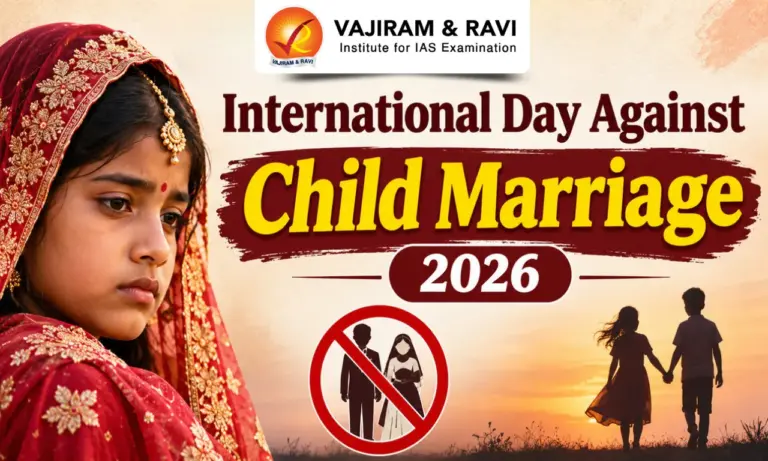
International Day Against Child Marriage 2026 highlights the global commitment to eliminating child, early and forced marriage as a violation of human rights. Observed on 27 November, the day promotes gender equality, girls’ education, child protection and coordinated efforts to end this harmful social practice by 2030.
International Day Against Child Marriage 2026 Latest News
In September 2026, the United Nations General Assembly designated 27 November as the International Day for the Elimination of Child, Early and Forced Marriage. In 2026, India also marks two years of its Bal Vivah Mukt Bharat campaign, launched to achieve a child marriage free nation by 2030. The second anniversary will be observed through a national event at Vigyan Bhawan, New Delhi, promoting coordinated action against child marriage.
International Day Against Child Marriage 2026
International Day Against Child Marriage is observed annually on 27 November following the adoption of UN General Assembly Resolution on 4 September 2026. It aims to eliminate child, early and forced marriage globally, in line with SDG Target 5.3, by 2030.
International Day for the Elimination of Child, Early and Forced Marriage is observed to strengthen global action against marriages involving children and adolescents. The observance promotes awareness, stronger legal frameworks, access to education and healthcare and the empowerment of girls to make independent decisions about their lives.


International Day Against Child Marriage 2026 Background
The United Nations established this International Day for the Elimination of Child, Early and Forced Marriage observance to strengthen international cooperation, accountability and awareness against harmful marriage practices.
- UN General Assembly Resolution: On 4 September 2026, the United Nations General Assembly adopted Resolution A/RES/80/309, formally designating 27 November as the international observance.
- Human Rights Recognition: The resolution recognises child, early and forced marriage as practices that violate human rights and disproportionately affect women and girls, particularly those facing vulnerable circumstances.
- International Cooperation: It encourages countries to develop comprehensive national strategies, strengthen legal protection, improve girls’ education and healthcare and ensure opportunities for married girls to resume their education.
What is Child Marriage?
Child Marriage refers to any formal marriage or informal union involving an individual below 18 years of age. It affects both girls and boys, although girls experience its consequences disproportionately. The practice restricts childhood, education, personal autonomy and opportunities for healthy development.
Under India’s Prohibition of Child Marriage Act, 2006, a child is defined as:
- A male who has not completed 21 years of age.
- A female who has not completed 18 years of age.
A marriage involving either party below the prescribed legal age falls within the definition of child marriage under the Act.
Status of Child Marriage in India 2026
India has recorded a decline in Child Marriage prevalence, although the practice continues to affect girls’ education, health and socioeconomic development.
- NFHS 6 Data (2023-24): Around 20.1% of women aged 20-24 years were married before completing 18 years, indicating the continued prevalence of the practice.
- Comparison with NFHS 5: The prevalence declined from 23.3% in 2019-21 to 20.1% in 2023-24, representing a reduction of 3.2 percentage points.
- International Context: Approximately 12 million girls worldwide are married before turning 18 every year, while an estimated 650 million women and girls alive in 2026 experienced childhood marriage.
- Regional Progress: Dadra and Nagar Haveli and Daman and Diu recorded a 10.1 percentage point decline, followed by Andaman and Nicobar Islands (7.4 points), Assam (6.5 points), Bihar (6.2 points) and Tripura (6.1 points).
- National Campaign Progress: Bal Vivah Mukt Bharat has conducted 6.85 lakh awareness programmes, reached 12.47 crore participants and registered 42.01 lakh pledges against child marriage.
Child Marriage Challenges
Child Marriage persists because of interconnected economic, social and institutional barriers that require sustained legal enforcement and community level interventions.
- Poverty and Economic Insecurity: Financial difficulties encourage some families to arrange early marriages to reduce household responsibilities, while economic vulnerability increases children’s exposure to exploitation and coercion.
- Gender Inequality: Patriarchal attitudes, discriminatory practices and the lower social value assigned to girls reinforce early marriage and restrict their independence, education and decision making opportunities.
- Educational Barriers: School dropouts, inadequate educational infrastructure, distance from secondary schools and limited access to opportunities increase the vulnerability of adolescent girls to early marriage.
- Social and Cultural Norms: Traditional practices, community expectations and concerns surrounding family honour often influence marriage decisions, making it difficult to challenge the practice through legislation alone.
- Weak Law Enforcement: Inadequate institutional capacity, under reporting, limited awareness of legal remedies and insufficient preventive intervention allow child marriages to continue despite existing legal prohibitions.
- Health and Psychological Consequences: Early pregnancy increases maternal health risks, while forced relationships expose children to gender based violence, emotional distress, exploitation and long term psychological harm.
- Intergenerational Poverty: Interrupted education, limited employment opportunities and financial dependence restrict economic mobility, allowing gender inequality and poverty to continue across successive generations.
Child Marriage Eradication Initiatives
India and international organisations have adopted legislative, educational and institutional measures to prevent child marriage and protect affected children.
- Prohibition of Child Marriage Act, 2006: The Act replaced the Child Marriage Restraint Act, 1929, establishing stronger provisions to prohibit child marriage and provide legal protection and relief to affected individuals.
- Child Marriage Prohibition Officers (CMPOs): Appointed under Section 16 of the Act, these officers prevent child marriages, collect evidence, counsel communities, create awareness and support legal action against offenders.
- Supreme Court Framework (2024): In Society for Enlightenment and Voluntary Action v. Union of India, decided on 18 October 2024, the Court emphasised dedicated CMPOs, coordinated institutional mechanisms, awareness programmes and technology enabled reporting.
- Beti Bachao Beti Padhao (2015): Launched on 22 January 2015, the initiative promotes the survival, protection and education of girls through awareness generation, community mobilisation and behavioural change.
- Bal Vivah Mukt Bharat Campaign (2024): Launched on 27 November 2024 by the Ministry of Women and Child Development, the campaign aims to eliminate child marriage through legal enforcement, public participation and community mobilisation by 2030.
- Bal Vivah Mukt Bharat Portal: The digital platform facilitates child marriage reporting, access to CMPO details, monitoring of awareness activities and online pledges, strengthening transparency and institutional accountability.
- International Frameworks: The Convention on the Rights of the Child (1989), CEDAW (1979) and SDG Target 5.3 provide international commitments for protecting children and eliminating discriminatory marriage practices.
International Day Against Child Marriage 2026 Significance
The International Day Against Child Marriage observance strengthens global commitment towards protecting childhood, promoting gender equality and ensuring that every child has opportunities for education, health and development.
- Protection of Human Rights: The day highlights the need to protect children’s rights to education, health, equality, personal freedom and development against harmful marriage practices.
- Promotion of Gender Equality: It encourages the elimination of discriminatory social norms that disproportionately affect girls and restrict their participation in educational, economic and social activities.
- Achievement of SDG 5.3: The observance supports the 2030 Agenda for Sustainable Development, particularly Target 5.3, which calls for eliminating child, early and forced marriage by 2030.
- Strengthening Institutional Accountability: It encourages governments, civil society and international organisations to improve legal enforcement, monitoring mechanisms, survivor support and coordinated preventive interventions.
- Education and Empowerment: The day reinforces the importance of quality education, healthcare, economic opportunities and community participation in enabling girls to make independent decisions about their futures.

 Last updated on Nov, 2026
→ UPSC Interview 2026 is scheduled from 7 December 2026 to 12 February 2027.
→ UPSC Interview Guidance Programme (IGP) 2026 by Vajiram & Ravi helps aspirants prepare confidently for the UPSC Personality Test.
→ UPSC DAF 2026 application form is available from 11 to 25 November 2026, till 6:00 PM.
→ UPSC 2027 Notification will be released on 13 January 2027 at upsconline.nic.in.
→ Download PIB PRiSM Monthly Magazine 2026 here.
→ Check UPSC Monthly Current Affairs Magazine The Recitals here.
→ Check out the latest UPSC Syllabus here.
→ UPSC Calendar 2027 has been released.
→ Enroll in Vajiram & Ravi’s UPSC Mains Test Series 2027 for structured answer writing practice, expert evaluation, and exam-oriented feedback.
→ Join Vajiram & Ravi’s UPSC Mentorship Program 2027 for personalized guidance, strategy planning, and one-to-one support from experienced mentors.
→ Go through the UPSC Mains Previous Year Papers to enhance your preparation.
→ UPSC has released UPSC Toppers List 2025 with the Civil Services final result on its official website.
→ Also check Best UPSC Coaching in India
International Day Against Child Marriage 2026 FAQs
Q1. When is International Day Against Child Marriage 2026 observed?+
Q2. Who declared 27 November as the International Day Against Child Marriage?+
Q3. What is the legal age of Marriage in India?+
Q4. What is the Bal Vivah Mukt Bharat campaign and when was it launched?+
Q5. What is the SDG Target for eliminating child marriage?+
Q6. Which Indian law provides the primary legal framework for preventing child marriage?+
Q7. What are the major international conventions addressing child marriage?+
Tags: international day against child marriage 2026