Internet Shutdowns Latest News
- Mobile internet services were shut down in parts of Central Delhi during the ‘Chalo Sansad’ protest, raising fresh concerns about the legal framework governing internet shutdowns and their impact on fundamental rights.
About Internet Shutdowns
- An internet shutdown, as defined by the web rights advocacy organisation Access Now, is “an intentional disruption of internet or electronic communications, rendering them inaccessible or effectively unusable, for a specific population or within a location, often to control the flow of information.”
- Forms of Internet Shutdowns
- Full network disruptions: complete blackout of internet services.
- Slowing down internet speed: throttling connectivity.
- Blocking specific platforms: restricting access to particular websites or apps.
- Mobile-only shutdowns: disabling mobile internet while keeping broadband active.
- When Are They Ordered?
- According to the International Federation of Journalists, most internet shutdowns are ordered when:
- Large numbers of people gather for political reasons.
- Peaceful demonstrations are expected to take place.
- Violent protests may occur.
- Religious celebrations draw large crowds.
- Public examinations are being conducted to prevent cheating.
- According to the International Federation of Journalists, most internet shutdowns are ordered when:


Legal Framework Governing Internet Shutdowns
- Earlier Framework
- Internet shutdowns in India were earlier governed by:
- Section 5(2) of the Indian Telegraph Act, 1885.
- Temporary Suspension of Telecom Services (Public Emergency or Public Safety) Rules, 2017.
- Current Framework
- Section 20 of the Telecommunications Act, 2023.
- Telecommunications (Temporary Suspension of Services) Rules, 2024.
- Under Section 20(2)(b) of the Telecommunications Act, 2023, telecommunication services may be suspended only:
- On the occurrence of a public emergency.
- In the interest of public safety.
- On the grounds specified in the provision.
- For reasons recorded in writing.
- Procedural Requirements
- Be reasoned and published.
- Be limited in area and duration.
- Be issued by the competent authority under the 2024 Rules.
- Consider whether less restrictive measures would be sufficient.
- Not remain in force for over 15 days.
- A protest, by itself, is not a lawful ground for suspending internet services.
Continued Use of Outdated Provisions
- Despite the updated legal framework, a review by the Digital Defenders Network found that several shutdown orders issued by State governments since late 2024 continue to invoke the older Indian Telegraph Act, 1885 and the 2017 Rules. For instance:
- The Secretary, Home Department, Uttar Pradesh, issued an internet suspension order for Bareilly district on October 2, 2025.
- The order invoked Section 7 of the Telegraph Act read with Rule 2(1) of the 2017 Rules.
- By continuing to rely on these outdated provisions, some States appear to have bypassed the procedural safeguards introduced under the 2024 Rules.
Supreme Court Rulings on Internet Shutdowns
- The Anuradha Bhasin Case (2020)
- In the landmark Anuradha Bhasin v. Union of India (2020) case, the Supreme Court held that access to the internet is closely connected to fundamental freedoms under the Constitution:
- Article 19(1)(a): freedom of speech and expression.
- Article 19(1)(g): freedom of trade and profession.
- The Court held that any shutdown must:
- Be backed by law.
- Pursue a legitimate objective.
- Be necessary and proportionate.
- Be the least restrictive measure available.
- Be limited in scope and duration.
- Be accompanied by detailed reasons.
- Be published for public scrutiny.
- Be reviewed by a competent committee.
- The Court observed that “complete broad suspension of telecom services, be it the internet or otherwise, must be considered by the State only if ‘necessary’ and ‘unavoidable’.”
India’s Track Record on Internet Shutdowns
- India continues to record one of the highest numbers of internet shutdowns in the world:
- Access Now’s 2025 report recorded 65 shutdowns across 12 States and Union Territories.
- India has recorded about 24 shutdowns in 2026 so far.
- According to the SFLC Internet Shutdown Tracker:
- Jammu & Kashmir: the highest number with about 449 since 2012.
- Rajasthan: 115 shutdowns.
- Manipur: 62 shutdowns.
News Summary
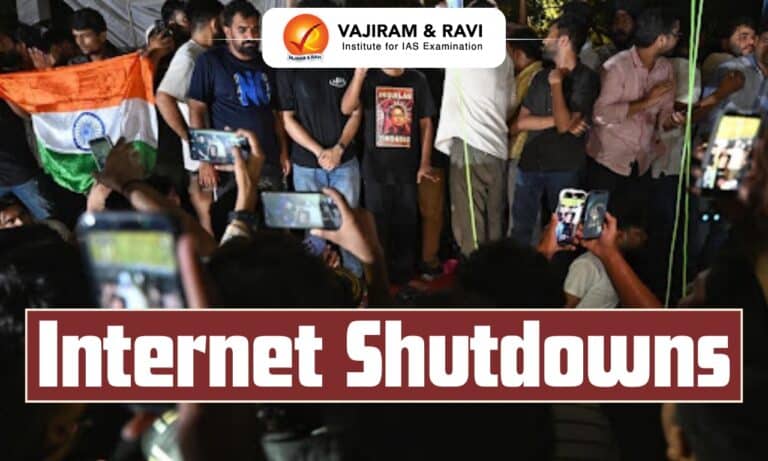
- Mobile internet services were shut down in parts of Central Delhi during the ‘Chalo Sansad’ protest organised by the Cockroach Janta Party (CJP). Key aspects include:
- Thousands of people gathered on the opening day of Parliament’s Monsoon Session.
- Protesters demanded the resignation of Union Education Minister Dharmendra Pradhan.
- The protest followed the NEET paper leaks and irregularities in the CBSE school examination process.
- The internet shutdown remained in place until the evening.
- The Ministry of Home Affairs imposed the order across 150 cell sites, according to an industry source.
- The order was imposed under Clause (b) of Sub-section (2) of Section 20 of the Telecommunication Act, 2023, read with the 2024 Rules.
Legal Recourse Against Shutdown Orders
- A shutdown order may be challenged in court through:
- High Court under Article 226: for writ petitions within a state’s jurisdiction.
- Supreme Court under Article 32: in appropriate cases involving fundamental rights.
- Courts can examine whether the order was:
- Lawful and issued by the competent authority.
- Proportionate to the situation.
- Properly limited in area and duration.
- Supported by valid reasons.
- Indefinite suspensions are unlawful. The government must publish its orders and provide reasons capable of judicial review.
Way Forward
- Legislative Reforms
- Ensure strict compliance with the Telecommunications Act, 2023 and the 2024 Rules.
- Discontinue the use of outdated Telegraph Act provisions.
- Establish clearer criteria for what constitutes a public emergency.
- Provide for automatic judicial review of shutdown orders.
- Institutional Safeguards
- Strengthen the review committee mechanism.
- Ensure timely publication of all shutdown orders.
- Maintain a central public database of shutdowns.
- Enable easier legal challenges to shutdown orders.
- Policy Approaches
- Explore less restrictive alternatives such as targeted platform blocking.
- Provide advance notice where possible.
- Ensure the shortest possible duration of shutdowns.
- Consider the cumulative impact on affected populations.
- Transparency Measures
- Regular reporting to Parliament on shutdowns.
- Public consultations on the framework.
- Enhanced judicial oversight of orders.
- Civil society engagement in policy formulation.
Source: TH

 Last updated on Oct, 2026
→ UPSC 2027 Notification will be released on 13 January 2027 at upsconline.nic.in.
→ Check Nobel Prize 2026 Winners List here.
→ Download PIB PRiSM Monthly Magazine 2026 here.
→ Check UPSC Monthly Current Affairs Magazine The Recitals here.
→ Check out the latest UPSC Syllabus here.
→ Download UPSC Model Answers for Mains 2026
→ UPSC Mains Question Paper 2026 is out now for Essay & GS Paper 1, 2, 3 & 4.
→ UPSC Calendar 2027 has been released.
→ Enroll in Vajiram & Ravi’s UPSC Mains Test Series 2027 for structured answer writing practice, expert evaluation, and exam-oriented feedback.
→ Join Vajiram & Ravi’s UPSC Mentorship Program 2027 for personalized guidance, strategy planning, and one-to-one support from experienced mentors.
→ Go through the UPSC Mains Previous Year Papers to enhance your preparation.
→ UPSC has released UPSC Toppers List 2025 with the Civil Services final result on its official website.
→ Also check Best UPSC Coaching in India
Internet S66hutdowns FAQs
Q1. Which law currently governs internet shutdowns in India?+
Q2. What was the significance of the Anuradha Bhasin v. Union of India (2020) case?+
Q3. How many internet shutdowns did India record in 2025?+
Q4. Which state has recorded the highest number of internet shutdowns in India?+
Q5. What is the maximum duration of an internet suspension order under the 2024 Rules?+
Tags: internet shutdowns mains articles upsc current affairs upsc mains current affairs