Plainclothes Policing Latest News
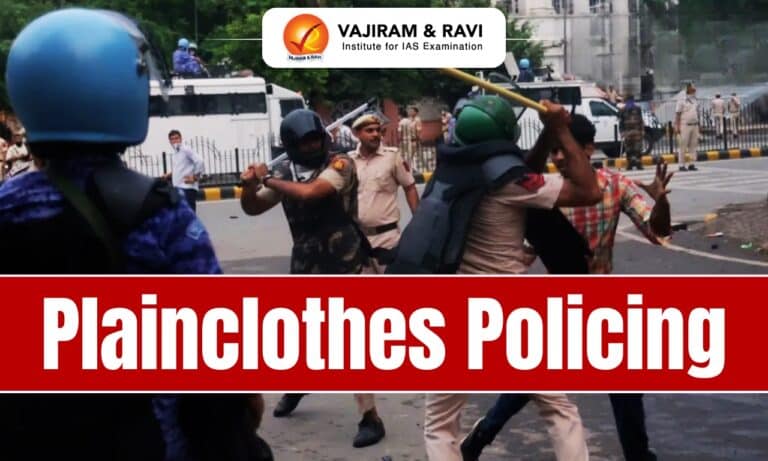
- Videos from the July 20 “Sansad Chalo” protest in Delhi showed police and Rapid Action Force (RAF) personnel in civilian clothes, or in uniform without visible nameplates.
- This has triggered a debate on the legality of unidentified policing during crowd control situations.
What Triggered the Controversy
- Protesters organised by the Cockroach Janata Party (CJP), demanding action over the NEET paper leak and the resignation of the Education Minister, marched towards Parliament.
- Police lathi-charged the swelling crowd, leading to violent clashes and injuries on both sides.
- Social media videos allegedly showed unidentified men in civilian clothes using police-style lathis against protesters, while uniformed personnel without nameplates ignored questions about their identity.
- Delhi Police has not officially responded, but has reportedly directed personnel at the protest site to report in uniform going forward.


Is Hiding Identity Legal?
- Certain operations — particularly intelligence gathering — genuinely require concealment of identity or even impersonation.
- However, routine policing is bound by statutory procedure and judicial guidelines, which generally require identifiability.
Statutory basis
- Maintenance of public order is governed by Chapter XI of the Bharatiya Nagarik Suraksha Sanhita (BNSS), Sections 148–160 (earlier Chapter X of the CrPC, formerly Chapter IX).
- While the law does not explicitly mandate identification, only a magistrate or a “police officer” is empowered to order a crowd to disperse — implying that the officer issuing such a command must be identifiable.
- Legal experts argue that an unidentifiable person cannot lawfully exercise this statutory power.
Judicial precedent
- In DK Basu vs State of West Bengal (1997), the Supreme Court mandated that arresting officers must carry clear, visible identification.
- Though this ruling concerned arrests rather than crowd control, it reflects the judiciary’s broader expectation that police be identifiable while exercising coercive authority.
- In August 2025, the Andhra Pradesh High Court questioned how citizens could recognise plainclothes personnel as police while they discharged official duties, in a case involving a YSRCP MLA accused of obstructing police work.
Why Police Avoid Identification
- Security concerns: The practice reportedly originated in conflict zones like Jammu and Kashmir, Punjab, and Chhattisgarh, where personnel avoided nameplates and rank insignia to reduce the risk of being targeted by militants.
- Personal safety in routine duty: Officers argue visible identification can expose them to prolonged litigation, online harassment, and threats to their families.
- Practice has spread: What began as a conflict-zone safeguard has gradually extended into routine law-and-order policing, a trend experts describe as contentious when applied outside genuine security threats.
- Logistical compulsion: When additional personnel are urgently summoned to a protest site, all available officers from a unit — including those in plain clothes — are required to report, often due to overwhelming crowd size rather than deliberate strategy.
Acknowledged Ambiguity
- While the law does not strictly bar deploying plainclothes personnel, senior officers concede the practice introduces ambiguity into already volatile protest situations.
- However, they argue such deployment remains important because anti-social elements can infiltrate protests and trigger violence or arson — special branch personnel are specifically tasked with blending into crowds to gather intelligence and monitor troublemakers.
Conclusion
- The plainclothes policing debate captures a real tension between operational security concerns and democratic accountability.
- While Indian law does not explicitly bar unidentified policing, statutory logic and judicial precedent point toward identifiability as essential to the legitimate exercise of police power — making transparency, not anonymity, the constitutional default for routine law enforcement.

 Last updated on Oct, 2026
→ UPSC 2027 Notification will be released on 13 January 2027 at upsconline.nic.in.
→ Check Nobel Prize 2026 Winners List here.
→ Download PIB PRiSM Monthly Magazine 2026 here.
→ Check UPSC Monthly Current Affairs Magazine The Recitals here.
→ Check out the latest UPSC Syllabus here.
→ Download UPSC Model Answers for Mains 2026
→ UPSC Mains Question Paper 2026 is out now for Essay & GS Paper 1, 2, 3 & 4.
→ UPSC Calendar 2027 has been released.
→ Enroll in Vajiram & Ravi’s UPSC Mains Test Series 2027 for structured answer writing practice, expert evaluation, and exam-oriented feedback.
→ Join Vajiram & Ravi’s UPSC Mentorship Program 2027 for personalized guidance, strategy planning, and one-to-one support from experienced mentors.
→ Go through the UPSC Mains Previous Year Papers to enhance your preparation.
→ UPSC has released UPSC Toppers List 2025 with the Civil Services final result on its official website.
→ Also check Best UPSC Coaching in India
Plainclothes Policing FAQs
Q1. Is Plainclothes Policing legally permitted in India?+
Q2. Why has Plainclothes Policing become controversial?+
Q3. What judicial principles govern Plainclothes Policing in India?+
Q4. Why do police agencies deploy Plainclothes Policing?+
Q5. What constitutional concern does Plainclothes Policing highlight?+
Tags: Plainclothes Policing upsc current affairs upsc mains current affairs