What’s in Today’s Article?
- What does Docking in Space Mean?
- SpaDex Mission Overview
- Challenges and Postponement of the SpaDex Mission
- Docking Procedure in the SpaDex Mission
- Future Applications of the SpaDex Mission
- Conclusion
Why in News?
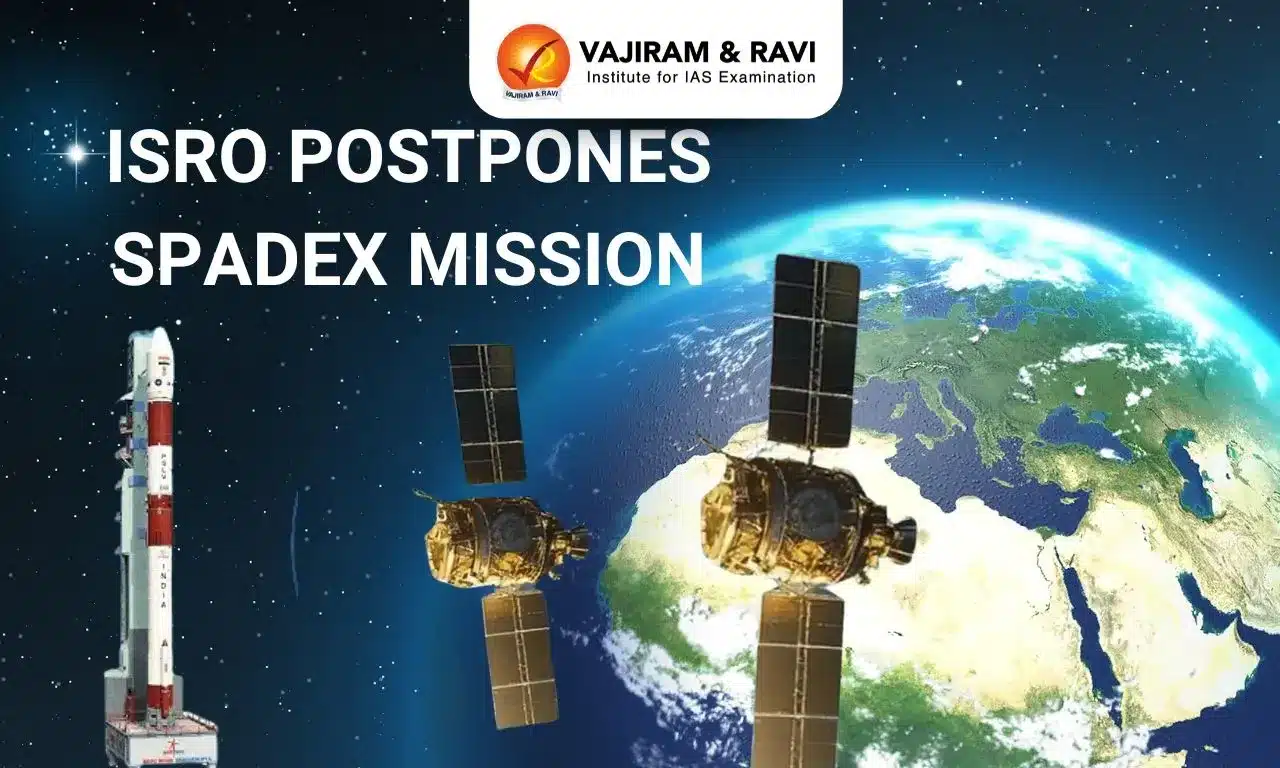
- The Indian Space Research Organisation (ISRO) has once again postponed its ambitious Space Docking Experiment (SpaDex) mission after encountering unexpected satellite drift during a critical maneuver.
- The mission aims to establish India as the fourth country (after the US, Russia and China) globally with space docking capabilities, crucial for future complex space missions.


What does Docking in Space Mean?
- Two space objects coming and joining together for a purpose is called ‘docking’.
- “Docking” happens when a spacecraft can maneuver and attach to a space station by itself.
- The National Aeronautics and Space Administration (NASA) defines docking as “mating operations where an active vehicle flies into the mating interface under its own power”.
- Meanwhile, ISRO explains that in-space docking technology is useful when multiple rockets are launched into space to achieve common mission objectives.
- For example, on the International Space Station (ISS), when a crew module connects to the station, pressure is equalised and the people are transferred.
SpaDex Mission Overview:
- Purpose of SpaDex mission:
- Docking and undocking technology: Demonstrates India’s ability to dock two satellites in space, paving the way for future projects involving modular spacecraft assembly.
- Significance: Critical for heavy-payload missions like the Bharatiya Antariksha Station (planned for 2028) and the Chandrayaan-4 mission, which involves lunar sample retrieval.
- Satellite details [Chaser (SDX01) and Target (SDX02)]: Launched on December 30, 2024, aboard the PSLV C60 rocket from Sriharikota.
Challenges and Postponement of the SpaDex Mission:
- Unexpected satellite drift:
- The satellites drifted more than expected during a maneuver to reduce their distance from 500m to 225m.
- The issue was identified after a non-visibility period when satellites were out of tracking range.
- Safety measures: Both satellites remain safe, according to ISRO’s statement. Further ground simulations are required to enhance accuracy.
- Timeline adjustments: Initial docking scheduled for January 7, postponed to January 9 for additional ground simulations.
Docking Procedure in the SpaDex Mission:
- Stepwise approach:
- Distance reduction: Sequential halts planned at 225m, 15m, and 3m before final docking.
- Docking mechanism: Extended rings on both satellites will connect, followed by rigidization to secure the connection.
- Integration and testing: Power sharing between satellites and synchronized command control as one unit will be tested.
Future Applications of the SpaDex Mission:
- Modular space station assembly: Enables assembly of heavy payloads in space, crucial for building the Bharatiya Antariksha Station.
- Chandrayaan-4 mission: Facilitates docking of the transfer module carrying lunar samples with the re-entry module in Earth’s orbit.
- Strategic importance: Achieving docking capabilities positions India alongside the US, Russia, and China in advanced space technology.
Conclusion:
- ISRO’s SpaDex mission is a significant step toward enhancing India’s space exploration capabilities.
- Despite the postponement, the mission underscores India’s commitment to mastering complex technologies necessary for future space endeavors.
Q.1. What is the Chandrayaan-4 mission?
The union cabinet has approved the mission to the moon, named Chandrayaan-4 to develop and demonstrate the technologies to come back to Earth after successfully landing on the Moon and also collect moon samples and analyse them on Earth.
Q.2. What is the Bharatiya Antariksha Station (BAS)?
The BAS, also known as India’s Space Station, is a planned space station that will be operated by the ISRO.

 Last updated on Oct, 2026
→ UPSC 2027 Notification will be released on 13 January 2027 at upsconline.nic.in.
→ Check Nobel Prize 2026 Winners List here.
→ Download PIB PRiSM Monthly Magazine 2026 here.
→ Check UPSC Monthly Current Affairs Magazine The Recitals here.
→ Check out the latest UPSC Syllabus here.
→ Download UPSC Model Answers for Mains 2026
→ UPSC Mains Question Paper 2026 is out now for Essay & GS Paper 1, 2, 3 & 4.
→ UPSC Calendar 2027 has been released.
→ Enroll in Vajiram & Ravi’s UPSC Mains Test Series 2027 for structured answer writing practice, expert evaluation, and exam-oriented feedback.
→ Join Vajiram & Ravi’s UPSC Mentorship Program 2027 for personalized guidance, strategy planning, and one-to-one support from experienced mentors.
→ Go through the UPSC Mains Previous Year Papers to enhance your preparation.
→ UPSC has released UPSC Toppers List 2025 with the Civil Services final result on its official website.
→ Also check Best UPSC Coaching in India