K Radhakrishnan Committee Latest News
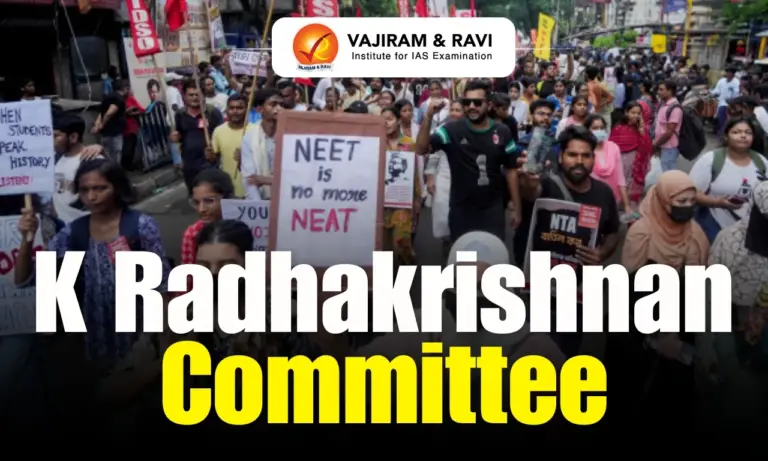
- As the Supreme Court heard petitions, seeking changes to NEET examination conduct following the 2026 paper leak controversy, the Centre informed the court that it has constituted a high-powered committee under Infosys co-founder Nandan Nilekani to recommend the next phase of exam reforms.
- The same day, the government introduced the Public Examinations (Prevention of Unfair Means) Amendment Bill in Lok Sabha to strengthen the anti-paper leak law. This has renewed attention on an earlier reform blueprint — the K Radhakrishnan Committee report.
Background: Why the K Radhakrishnan Committee Was Formed
- Constituted in 2024 following the NEET-UG 2024 paper leak controversy, amid rising public concern over the integrity of entrance tests.
- Headed by former ISRO Chairman Dr K Radhakrishnan, the committee submitted its report to the Ministry of Education in October 2024.
- The report was prepared after 23 formal full-day physical sittings and more than 37,000 public responses received via the MyGov portal.
- Its stated vision: transform the National Testing Agency (NTA) into “a nimble, zero-error, adaptive and integrative process.”


Original and Expanded Mandate
- Initial mandate: Improve examination processes, strengthen data security, and review the NTA’s structure and functioning.
- Expanded mandate: Following Supreme Court directions in Vanshika Yadav vs Union of India, additional terms of reference included examination security and administration, technological safeguards, policy and stakeholder engagement, international collaboration, staff training, and mental-health support for students.
Key Findings
- The report rejected treating paper leaks as isolated incidents, instead identifying vulnerabilities across the entire “Testing Life Cycle” — from printing and transporting question papers to candidate verification, centre management, and grievance redressal.
- It found the NTA operating as a “single window agency” despite having conducted over 240 examinations involving 5.4 crore candidates since inception, concluding its capacity and domain expertise needed significant augmentation.
Key Technological Recommendations
- Computer-assisted Secure Pen-and-Paper Testing (CPPT)
- The report’s central technological proposal, designed to eliminate breaches during printing, storage, and transportation of question papers.
- Encrypted papers would be transmitted electronically to secure servers at exam centres and printed shortly before the exam — while candidates continue writing conventional pen-and-paper tests.
- This eliminates long-distance transport of printed papers, reducing leak opportunities during transit.
- DIGI-EXAM
- A digital authentication framework modelled on “Digi Yatra,” ensuring only the candidate who wrote the exam joins the intended programme.
- Proposed continuous multi-stage authentication across application, examination, and admission stages using Aadhaar, biometrics, and AI-based analytics.
Institutional Overhaul of the NTA
- Recommended recasting the NTA’s Governing Body as an “empowered and accountable Apex Body”, headed by a Director General not below the rank of Additional Secretary to the Government of India.
- Proposed creating 10 dedicated verticals, including Nation-wide Testing Centre Infrastructure, Information Security, Vigilance and Forensics, and Research and Development.
- Called for reduced dependence on outsourced agencies for critical examination functions.
Testing Centre Reforms
- Recommended developing at least 1,000 “Secure Testing Centres” in phases at reputed government institutions, with adequate power supply, seating, technical support, phone lockers, ventilation, help desks, and family waiting areas.
- Proposed mobile testing centre buses equipped with laptops and servers for remote/underserved regions, capable of serving around 150 candidates each.
- For large-scale exams, recommended Multi-Session Testing spread over several days/weeks, with NEET-UG Multi-Stage Testing described as “a viable possibility.”
- Stressed transparent, well-documented score normalisation for multi-session exams.
- Recommended long-term transition toward Computer Adaptive Testing, where question difficulty adjusts to candidate performance.
Student Welfare Focus
- Recommended a dedicated mental-health cell within the NTA, tele-helplines, counselling services, and teacher sensitisation programmes.
- Suggested a regulatory oversight mechanism for coaching institutes, citing concerns over student stress and financial burden on families.
- Proposed equipping the NTA’s Grievance Reporting and Redressal Cell with AI/ML-based chatbots offering clarifications in candidates’ language of choice.
Implementation Mechanism
- Recognising that expert reports often remain unimplemented, the committee proposed a high-powered steering committee under the Ministry of Education to oversee implementation “in mission mode and within a time frame” — mentoring the NTA, resolving bottlenecks, and submitting regular progress reports.
Conclusion
- The K Radhakrishnan Committee offered a comprehensive, life-cycle approach to exam security — spanning technology, institutional capacity, and student welfare — yet much of it remains unimplemented nearly two years later, as evidenced by the 2026 NEET paper leak.
- Its fate underscores a recurring governance challenge: robust reform blueprints often falter not for lack of vision, but for lack of sustained, accountable execution — a gap the new Nilekani-led committee will need to address.
Source: IE

 Last updated on Oct, 2026
→ UPSC 2027 Notification will be released on 13 January 2027 at upsconline.nic.in.
→ Check Nobel Prize 2026 Winners List here.
→ Download PIB PRiSM Monthly Magazine 2026 here.
→ Check UPSC Monthly Current Affairs Magazine The Recitals here.
→ Check out the latest UPSC Syllabus here.
→ Download UPSC Model Answers for Mains 2026
→ UPSC Mains Question Paper 2026 is out now for Essay & GS Paper 1, 2, 3 & 4.
→ UPSC Calendar 2027 has been released.
→ Enroll in Vajiram & Ravi’s UPSC Mains Test Series 2027 for structured answer writing practice, expert evaluation, and exam-oriented feedback.
→ Join Vajiram & Ravi’s UPSC Mentorship Program 2027 for personalized guidance, strategy planning, and one-to-one support from experienced mentors.
→ Go through the UPSC Mains Previous Year Papers to enhance your preparation.
→ UPSC has released UPSC Toppers List 2025 with the Civil Services final result on its official website.
→ Also check Best UPSC Coaching in India
K Radhakrishnan Committee FAQs
Q1. Why was the K Radhakrishnan Committee constituted?+
Q2. What is the Computer-assisted Secure Pen-and-Paper Testing proposed by the K Radhakrishnan Committee?+
Q3. How does the K Radhakrishnan Committee propose to reform the National Testing Agency (NTA)?+
Q4. What student welfare measures were recommended by the K Radhakrishnan Committee?+
Q5. Why is the K Radhakrishnan Committee important for India's examination reforms?+
Tags: K Radhakrishnan Committee mains articles upsc current affairs upsc mains current affairs