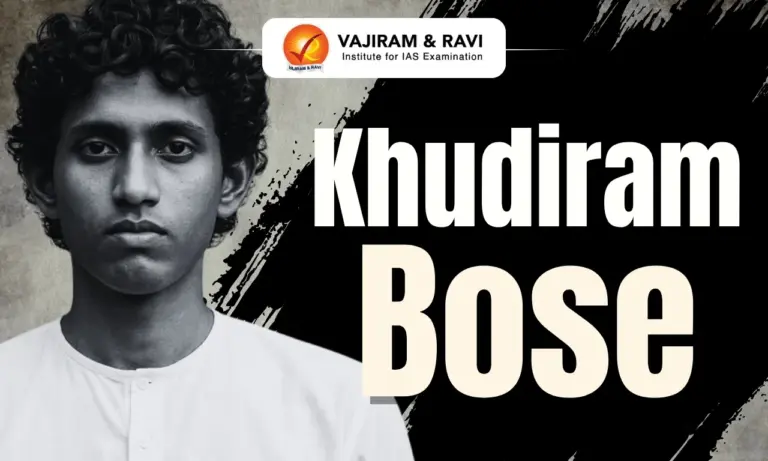
Khudiram Bose was a young Indian revolutionary from Bengal who opposed British colonial rule. He joined the freedom movement during the Swadeshi period and became associated with Anushilan Samiti. His revolutionary activities brought him into the Muzaffarpur Conspiracy Case of 1908. Khudiram Bose was executed on 11 August 1908 at only 18 years of age. His courage, sacrifice and early involvement made him an enduring figure in India’s freedom struggle.
Khudiram Bose Biography
Khudiram Bose was born on 3 December 1889 in Habibpur village of Midnapore, Bengal Presidency. His early life was shaped by personal loss and nationalist influences.
- Birth and Family: Khudiram Bose was born into a Bengali Kayastha family. His parents were Trailokyanath Bose and Lakshmipriya Devi. His father served as a Tehsildar in Midnapore Town.
- Early Life: He lost his mother at five and his father a year later. His elder sister Aparupa Roy then took responsibility for his upbringing and education.
- Education: Aparupa Roy brought him to Hatgacha village. Her husband Amritalal Roy admitted him to Hamilton High School in Tamluk.
- Nationalist Influence: Sri Aurobindo and Sister Nivedita visited Medinipur in 1902 and 1903. Their public speeches and revolutionary discussions strongly influenced the young Khudiram.
- Early Revolutionary Activity: At 15, Khudiram became an active volunteer during the Partition of Bengal in 1905. He was arrested for distributing pamphlets opposing British rule.
- Anushilan Samiti: Khudiram Bose joined Anushilan Samiti in 1908. He came into contact with revolutionary networks associated with Aurobindo Ghose and Barindra Ghose.
- Revolutionary Training: Under revolutionary leadership, Khudiram became involved in anti British activities. He also learned bomb making techniques as part of the revolutionary campaign.
Khudiram Bose Contributions
Khudiram Bose contributed to the revolutionary movement through underground activities and opposition to British officials during the Swadeshi period.
- Partition of Bengal Movement: Khudiram Bose actively participated in the anti Partition movement after Bengal was divided in 1905. His early activities included distributing nationalist pamphlets against British administration.
- Targeting Kingsford: Douglas H. Kingsford was identified as a target because of his harsh treatment of nationalists. Khudiram Bose and Prafulla Kumar Chaki were selected for the mission.
- Muzaffarpur Bomb Attack: On 30 April 1908, Khudiram and Prafulla threw bombs at a carriage they believed carried Kingsford near the European Club in Muzaffarpur, Bihar.
- Tragic Outcome: Kingsford was travelling in another carriage. The bomb instead killed Mrs. Kennedy and Miss Kennedy, the wife and daughter of barrister Pringle Kennedy.
- Escape and Capture: After the bombing, Khudiram Bose walked about 25 kilometres while attempting to escape. He was later captured at Waini station by armed constables.
- Prafulla Chaki: Prafulla Kumar Chaki attempted to evade arrest after the bombing. When surrounded during his escape, he died by suicide rather than being captured.
- Muzaffarpur Conspiracy Case: Khudiram Bose was tried for his role in the bombing. The case became one of the significant revolutionary trials associated with the anti British movement in Bengal.


Khudiram Bose Death
Khudiram Bose was sentenced to death after the trial and was executed at Muzaffarpur Central Jail on 11 August 1908.
- Trial: The court convicted Khudiram Bose in connection with the Muzaffarpur bombing. His appeal was later dismissed by the High Court.
- Execution: Khudiram Bose was hanged at approximately 6 AM on 11 August 1908. He was only 18 years old at the time of his execution.
- Final Conduct: Contemporary newspaper accounts described Khudiram as cheerful and composed while approaching the gallows. His conduct strengthened his image as a young revolutionary martyr.
- Public Response: Large crowds gathered around the prison and later followed his funeral procession. People carried flowers and publicly expressed admiration for his sacrifice.
- Contemporary Debate: Mahatma Gandhi condemned the violent method and the deaths of the two women. Bal Gangadhar Tilak defended the young revolutionaries and demanded immediate swaraj.
Khudiram Bose Honors and Recognitions
Khudiram Bose became a lasting symbol of youthful courage and sacrifice, particularly in Bengal, where his memory entered popular culture and public institutions.
- Popular Memory: Newspapers highlighted Khudiram Bose’s courage after his execution. His martyrdom quickly gained widespread public attention across Bengal and other parts of India.
- Folk Legacy: Poet Pitambar Das immortalised Khudiram through the Bengali song “Ek Baar Bidaye De Ma”. The song helped preserve his memory in Bengal’s cultural tradition.
- Memorial Institutions and Places: Several institutions and places bear his name, including Khudiram Bose Memorial Central Jail in Muzaffarpur, Khudiram Bose Pusa railway station, Shahid Khudiram Station in Kolkata, Khudiram Bose Hospital, Khudiram Anushilan Kendra, Sahid Khudiram Siksha Prangan, etc.
- Postal Recognition: India issued a commemorative stamp featuring Khudiram Bose in 1990, formally recognising his place in the national freedom movement.
- Cinematic Legacy: His life has been portrayed in films including Biplabi Kshudiram released in 1951, Main Khudiram Bose Hun released in 2017 and Khudiram Bose released in 2022.

 Last updated on Oct, 2026
→ UPSC 2027 Notification will be released on 13 January 2027 at upsconline.nic.in.
→ Check Nobel Prize 2026 Winners List here.
→ Download PIB PRiSM Monthly Magazine 2026 here.
→ Check UPSC Monthly Current Affairs Magazine The Recitals here.
→ Check out the latest UPSC Syllabus here.
→ Download UPSC Model Answers for Mains 2026
→ UPSC Mains Question Paper 2026 is out now for Essay & GS Paper 1, 2, 3 & 4.
→ UPSC Calendar 2027 has been released.
→ Enroll in Vajiram & Ravi’s UPSC Mains Test Series 2027 for structured answer writing practice, expert evaluation, and exam-oriented feedback.
→ Join Vajiram & Ravi’s UPSC Mentorship Program 2027 for personalized guidance, strategy planning, and one-to-one support from experienced mentors.
→ Go through the UPSC Mains Previous Year Papers to enhance your preparation.
→ UPSC has released UPSC Toppers List 2025 with the Civil Services final result on its official website.
→ Also check Best UPSC Coaching in India
Khudiram Bose FAQs
Q1. Who was Khudiram Bose?+
Q2. When was Khudiram Bose born?+
Q3. Why is Khudiram Bose famous?+
Q4. When did Khudiram Bose die?+
Q5. What was Khudiram Bose’s role in the Muzaffarpur Conspiracy Case?+
Q6. Why Khudiram Bose was Hanged?+
Q7. Was Bhagat Singh inspired by Khudiram Bose?+
Tags: khudiram bose khudiram bose birth khudiram bose death