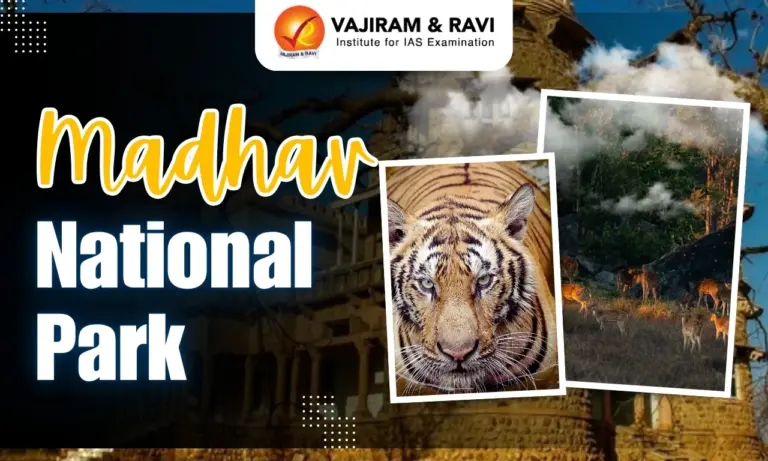
Madhav National Park is a prominent protected area located in the Shivpuri district of Madhya Pradesh. Spread across approximately 375 square kilometres, the park is known for its dry deciduous forests, rolling hills, grasslands, and scenic lakes.
Madhav National Park gained national attention after being declared India’s 58th Tiger Reserve, strengthening tiger conservation efforts in the country. Apart from tigers, Madhav National Park is home to a rich diversity of mammals, birds, reptiles, and plant species, making it an ecologically significant protected area.
Madhav National Park Location
Madhav National Park is situated in the Shivpuri district of Madhya Pradesh, within the northern part of the Vindhyan landscape. It lies along the Agra-Mumbai National Highway, making it one of the most easily accessible national parks in central India.
Madhav National Park Flora
The flora of Madhav National Park is dominated by Northern Tropical Dry Deciduous Forests, along with grasslands, scrub forests, and wetland vegetation that support a rich variety of wildlife.
- Northern Tropical Dry Deciduous Forests: Form the dominant vegetation type across the park.
- Teak (Tectona grandis): One of the most valuable timber species found in the forest.
- Kardhai (Anogeissus pendula): The dominant tree species, well adapted to dry climatic conditions.
- Khair (Acacia catechu): Commonly grows in dry and rocky areas and is known for its medicinal value.
- Salai (Boswellia serrata): Found on rocky slopes and valued for its aromatic resin.
- Dhaora (Anogeissus latifolia): Provides food and shelter for several herbivorous species.
- Mahua (Madhuca longifolia): Produces nutrient-rich flowers and fruits consumed by wildlife.
- Tendu (Diospyros melanoxylon): Widely distributed and economically important for its leaves.
- Palash (Butea monosperma): Adds vibrant orange-red blooms during the spring season.
- Ber (Ziziphus mauritiana): A hardy tree that provides fruits for birds and mammals.
- Grasslands: Support large herbivores such as Chital, Nilgai, and Sambar by providing abundant grazing areas.
- Wetland Vegetation: Flourishes around Sakhya Sagar and Madhav Sagar lakes, sustaining aquatic birds and other wetland fauna.


Madhav National Park Fauna
The fauna of Madhav National Park is highly diverse, comprising mammals, birds, reptiles, and aquatic species, supported by its forests, grasslands, and wetlands.
- Bengal Tiger: The flagship species following the park’s designation as India’s 58th Tiger Reserve.
- Leopard: An apex predator commonly found in the park’s rocky hills and forested areas.
- Chital (Spotted Deer): The most abundant herbivore and a key prey species for large carnivores.
- Sambar Deer: The largest deer species in the park, inhabiting dense forest patches.
- Nilgai (Blue Bull): Frequently seen grazing in open grasslands and woodland edges.
- Chinkara (Indian Gazelle): Found in scrub forests and open habitats.
- Sloth Bear: Inhabits forested areas and feeds on fruits, termites, and honey.
- Striped Hyena: A nocturnal scavenger that contributes to maintaining ecological balance.
- Indian Wolf: Occasionally spotted in the park’s grassland and scrubland habitats.
- Wild Boar: Widely distributed and plays an important role in seed dispersal and soil turnover.
- Golden Jackal: Commonly found in grasslands and forest fringes.
- Mugger Crocodile: Inhabits Sakhya Sagar and other water bodies within the park.
- Indian Rock Python: A large non-venomous snake found in forest and wetland areas.
- Monitor Lizard: Frequently observed near rocky outcrops and water sources.
- Avifauna: The park supports over 300 bird species, including Indian Peafowl, Painted Stork, Bar-headed Goose, Sarus Crane, Grey Heron, Egrets, Cormorants, Kingfishers, Eagles, and Owls.
- Migratory Birds: Sakhya Sagar Lake serves as an important wintering habitat for several migratory waterbirds, enhancing the park’s biodiversity.
Madhav National Park Climate
The climate of Madhav National Park is tropical with distinct summer, monsoon, and winter seasons, supporting dry deciduous forests, grasslands, and wetland ecosystems.
- Tropical Climate: Characterized by hot summers, moderate monsoon rainfall, and cool winters.
- Summer Season (March-June): Temperatures range between 30°C and 45°C, with dry weather prevailing.
- Monsoon Season (July-September): Receives moderate rainfall, replenishing forests, grasslands, and lakes.
- Winter Season (October-February): Temperatures range from 5°C to 25°C, offering favourable conditions for wildlife activity.
Madhav National Park Becomes India’s 58th Tiger Reserve
Madhav National Park was officially declared India’s 58th Tiger Reserve in 2025, marking a major milestone in the country’s tiger conservation efforts. The designation, approved under Project Tiger, aims to restore a viable tiger population, strengthen habitat protection, and enhance biodiversity conservation in the Shivpuri landscape of Madhya Pradesh.
- 58th Tiger Reserve: Declared as India’s 58th Tiger Reserve in 2025 under Project Tiger.
- State: Located in Shivpuri district, Madhya Pradesh, expanding the state’s network of protected tiger habitats.
- Tiger Reintroduction: Supports the reintroduction and long-term conservation of Royal Bengal Tigers in the region.
- Core and Buffer Areas: Managed through designated core and buffer zones to minimize human disturbance and improve habitat quality.
- Habitat Restoration: Focuses on improving forests, grasslands, water sources, and prey populations essential for tiger survival.
- Enhanced Protection: Strengthens anti-poaching measures, wildlife monitoring, and habitat management using modern conservation techniques.
- Ecological Connectivity: Improves wildlife corridors linking Madhav National Park with surrounding forest landscapes, facilitating animal movement and genetic exchange.
- Biodiversity Conservation: Benefits not only tigers but also leopards, sloth bears, wolves, deer, birds, and other wildlife species.
Madhav National Park Government Conservation Initiatives
The Government of India and the Government of Madhya Pradesh have implemented several conservation initiatives to protect the biodiversity of Madhav National Park, strengthen tiger conservation, and restore its forest ecosystem.
- Project Tiger: Included the park under Project Tiger following its declaration as India’s 58th Tiger Reserve to enhance tiger conservation.
- Tiger Reintroduction Programme: Reintroduced Royal Bengal Tigers to establish a sustainable breeding population and restore the park’s ecological balance.
- National Tiger Conservation Authority (NTCA): Provides technical guidance, financial assistance, and scientific monitoring for effective tiger reserve management.
- Habitat Restoration: Undertakes afforestation, grassland development, invasive species removal, and waterhole creation to improve wildlife habitats.
- Anti-Poaching Measures: Deploys forest protection teams, regular patrolling, camera traps, drones, and surveillance systems to prevent wildlife crimes.
- Prey Base Management: Conserves herbivore populations such as Chital, Sambar, Nilgai, and Wild Boar, ensuring an adequate prey base for large carnivores.
- Wetland Conservation: Protects Sakhya Sagar and other water bodies to conserve aquatic biodiversity and migratory bird habitats.
- Wildlife Monitoring: Uses camera traps, GPS-based tracking, and periodic wildlife censuses to assess the health of wildlife populations.
- Community Participation: Involves local communities through Eco-Development Committees (EDCs), awareness programmes, and sustainable livelihood initiatives.
- Forest Fire Management: Implements early warning systems, fire lines, and rapid response teams to reduce the impact of forest fires.

 Last updated on Oct, 2026
→ UPSC 2027 Notification will be released on 13 January 2027 at upsconline.nic.in.
→ Check Nobel Prize 2026 Winners List here.
→ Download PIB PRiSM Monthly Magazine 2026 here.
→ Check UPSC Monthly Current Affairs Magazine The Recitals here.
→ Check out the latest UPSC Syllabus here.
→ Download UPSC Model Answers for Mains 2026
→ UPSC Mains Question Paper 2026 is out now for Essay & GS Paper 1, 2, 3 & 4.
→ UPSC Calendar 2027 has been released.
→ Enroll in Vajiram & Ravi’s UPSC Mains Test Series 2027 for structured answer writing practice, expert evaluation, and exam-oriented feedback.
→ Join Vajiram & Ravi’s UPSC Mentorship Program 2027 for personalized guidance, strategy planning, and one-to-one support from experienced mentors.
→ Go through the UPSC Mains Previous Year Papers to enhance your preparation.
→ UPSC has released UPSC Toppers List 2025 with the Civil Services final result on its official website.
→ Also check Best UPSC Coaching in India
Madhav National Park FAQs
Q1. Where is Madhav National Park located?+
Q2. When was Madhav National Park established?+
Q3. Why is Madhav National Park famous?+
Q4. Which is India's 58th Tiger Reserve?+
Q5. Which river flows through Madhav National Park?+
Q6. What are the major animals found in Madhav National Park?+
Tags: environment