Maharashtra Drought Latest News
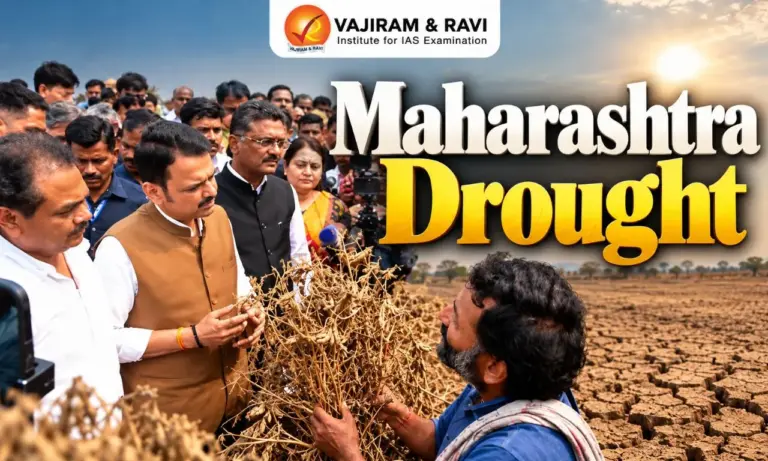
- Calls to declare a drought are rising in Maharashtra, as an El Niño-driven rainfall deficit hits the state’s agriculture-dependent economy hard. Water scarcity has compounded the crisis, setting back the kharif season and clouding prospects for rabi.
- Opposition leaders have demanded an official drought declaration. Maharashtra Chief Minister says the government is taking “all steps necessary” to address the “alarming” situation.
Why No Official Declaration Yet
- The timing constraint comes from national disaster-relief rules, not political reluctance.
- Under National Disaster Response Fund (NDRF) rules, drought declaration for the kharif season (June–October) requires an assessment that can begin only from October 5, once the monsoon starts withdrawing.
- For the rabi season (October–April), assessment can be held only in March 2027.
- There is no single, nationally accepted definition of drought. States have the authority to declare drought based on local conditions, but their report must conform to NDRF-specified parameters before the Centre releases disaster relief funds.
- Maharashtra has decided to submit its proposal to the Centre after October 5.


The Declaration Process
- The process runs through several defined steps:
- State-level surveys and panchanamas (on-ground crop-loss assessments) are already underway, to quantify losses in terms of food production and finances.
- Once the state submits its report, a central team visits the affected regions to conduct its own independent assessment.
- Only after this verification can relief funds be unlocked by the Centre.
The NDRF Criteria for Drought
- Drought declaration under NDRF norms rests on multiple indicators, not rainfall alone:
- Crop loss
- Moisture Adequacy Index (used to assess soil health)
- Rainfall deficit
- Decline in food production
- Labour migration in search of work
- Specific thresholds also apply:
- Sowing must fall below 50% of total cultivable kharif/rabi area.
- Drinking water shortage must be severe.
- Groundwater tables must be shrinking.
- There must be a fodder shortage.
- Rainfall deficit must reach up to 70%.
How the Kharif Season Was Hit
- Sowing this season was delayed due to erratic rainfall — instead of the usual June 10 start, sowing began only on July 15. Rain failure after sowing then stunted flowering and fruiting.
- The worst-hit crops are soybean and cotton — the mainstay of small and marginal farmers in Marathwada and Vidarbha.
- The dry spell has also stunted sugarcane growth in Marathwada and parts of western Maharashtra.
- Government response: During the July monsoon session, the CM announced a Rs 40,385-crore farm loan waiver, with an additional Rs 50,000 incentive for farmers who had been repaying loans regularly.
The Water Situation
- Drinking water scarcity is a major concern, with dam levels well below last year’s figures (data as of September 20):
- Region-wise water levels show sharp disparities:
- Marathwada (highest dam count at 929): just 46%, down from 81% last year.
- Amravati division: 64%
- Nagpur division: 72%
- Pune: 88%
- Nashik: 83%
- Konkan: 76%
- Marathwada stands out as the most severely affected region.
The Rainfall Picture
- According to the India Meteorological Department (IMD):
- 31 of 36 districts in Maharashtra are rain-deficient.
- 20 of these face a deficit of 25% to 58%.
- In more than 100 of the state’s 355 drought-hit talukas, gaps between rain spells have stretched to 40–60 days.
- As a result, the main kharif crop, sown across 147 lakh hectares, has withered.
- An unusual pattern has worsened the damage: where rain did fall, it came short and intense, damaging soil health and causing erosion in some areas, rather than providing steady, absorbable moisture.
- Structural vulnerability: Maharashtra’s agriculture is largely rain-fed. Its irrigation potential stands at under 20%, far lower than states like Uttar Pradesh and Bihar, leaving it especially exposed to monsoon variability.
Conclusion
- Maharashtra’s crisis is real on the ground but procedurally premature on paper. The NDRF’s rule-bound calendar, not denial, explains the delay.
- What the state needs now is not just an October declaration, but a longer-term shift — greater irrigation coverage — to reduce dependence on a monsoon that keeps growing less reliable.
Source: IE

 Last updated on Oct, 2026
→ UPSC 2027 Notification will be released on 13 January 2027 at upsconline.nic.in.
→ Check Nobel Prize 2026 Winners List here.
→ Download PIB PRiSM Monthly Magazine 2026 here.
→ Check UPSC Monthly Current Affairs Magazine The Recitals here.
→ Check out the latest UPSC Syllabus here.
→ Download UPSC Model Answers for Mains 2026
→ UPSC Mains Question Paper 2026 is out now for Essay & GS Paper 1, 2, 3 & 4.
→ UPSC Calendar 2027 has been released.
→ Enroll in Vajiram & Ravi’s UPSC Mains Test Series 2027 for structured answer writing practice, expert evaluation, and exam-oriented feedback.
→ Join Vajiram & Ravi’s UPSC Mentorship Program 2027 for personalized guidance, strategy planning, and one-to-one support from experienced mentors.
→ Go through the UPSC Mains Previous Year Papers to enhance your preparation.
→ UPSC has released UPSC Toppers List 2025 with the Civil Services final result on its official website.
→ Also check Best UPSC Coaching in India
Maharashtra Drought FAQs
Q1. Why cannot Maharashtra's drought be officially assessed before October 5?+
Q2. What factors determine a drought declaration in Maharashtra? +
Q3. How has rainfall affected Maharashtra's kharif season?+
Q4. Which region has been most affected by Maharashtra's drought conditions? +
Q5. How severe is the rainfall deficit in Maharashtra? +
Tags: Maharashtra Drought mains articles upsc current affairs upsc mains current affairs