Road Accident Claim Latest News
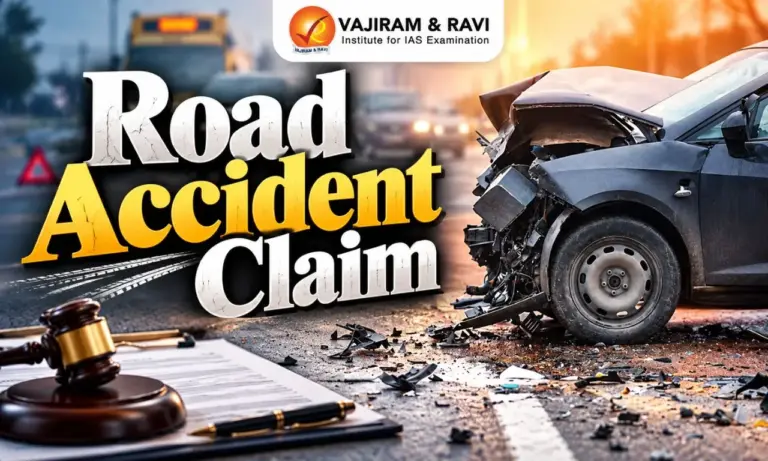
- With India recording 4,87,707 road accidents in 2024 that claimed 1,77,175 lives, understanding how compensation claims are adjudicated under the Motor Vehicles Act has become essential for claimants navigating the system.
The Scale of the Problem
- India has the world’s largest road network at about 6.7 million kilometres, larger than the US (6.59 million km) and China (5.49 million km). It also records the world’s highest road fatalities.
- According to the Road Accidents in India 2024 report by the Ministry of Road Transport and Highways, road crashes in 2024 injured 4,71,441 people, about 485 deaths a day or 20 an hour.
- The economic cost is estimated at around 3.14% of India’s GDP, falling most heavily on dependants of those killed or permanently disabled.


The Legal Framework
- The Motor Vehicles Act, 1988 is the principal law governing motor accident compensation. It covers the entire chain from regulation and driver duties to insurance, liability and compensation.
- Motor Accidents Claims Tribunals
- Section 165 empowers State governments to constitute Motor Accidents Claims Tribunals (MACTs) for specified areas to determine accident claims.
- Evidence Considered
- The Tribunal typically examines the FIR and chargesheet, site plan, Mechanical Inspection Report, post-mortem or medical records, insurance policy, and depositions of eyewitnesses and the investigating officer.
- Appeals
- Appeals under Section 173 lie before the High Court within 90 days, subject to depositing Rs. 25,000 or 50% of the awarded amount, whichever is less.
Criminal and Civil Proceedings Are Separate
- The same accident may generate two distinct proceedings, a criminal case for rash or negligent driving, and a separate MACT claim for compensation.
- As held in Reena v. Managing Director, KSRTC (2026), an acquittal in the criminal case does not affect MACT proceedings, since the two apply different standards of proof.
Who Is Liable to Pay
- Liability initially attaches to the negligent driver and, vicariously, to the owner of the offending vehicle. Where the vehicle is insured, the insurer generally satisfies the award.
- Section 146 mandates compulsory third-party insurance, while Section 150 requires insurers to satisfy third-party awards.
Limited Defences for Insurers
- Under Section 150(2), insurers may raise limited defences including specified policy breaches, unauthorised use, driving without a valid licence, and non-disclosure or misrepresentation in obtaining the policy.
- Pay and Recover
- Even where a defence is established, courts may apply the “pay and recover” principle, directing the insurer to pay the victim or legal representatives first, and recover the amount from the owner or driver afterwards.
- This ensures victims are not left without compensation due to a dispute between insurer and insured.
- No-Fault Liability
- A separate no-fault liability route dispenses with proof of negligence and provides:
- Rs. 5 lakh for death
- Rs. 2.5 lakh for grievous hurt
- These amounts, revised in the 2019 amendment, are payable by the owner or authorised insurer without proof of negligence.
- A separate no-fault liability route dispenses with proof of negligence and provides:
Calculating Compensation in Death Cases
- Section 168 requires an award of “just” compensation. Through Sarla Verma (2009) and Pranay Sethi (2017), the Supreme Court established standardised formulas.
- Once rash and negligent driving is proved, compensation is calculated in three stages:
- Foundational Facts
- Age: Determined from the date of birth in the school-leaving certificate, not Aadhaar (Saroj, 2024).
- Income: Actual income after tax. For salaried persons, the immediately preceding year’s ITR is ordinarily considered; for self-employed persons, the preceding three years’ average applies (Rashmirekha Tripathy, 2026). If income is unproven, the applicable State-notified minimum wage is used.
- Dependants: Legal representatives, including married and earning children, can claim compensation regardless of financial dependency (Jitender Kumar, 2025).
- Four Heads of Compensation
- Loss of income: Annual income + future prospects − personal expenses, multiplied by the applicable age-based multiplier.
- Future prospects: For permanent salaried/government employees: 50% (<40 age), 30% (40-50), 15% (50-60); none above 60. For self-employed/fixed-salary persons: 40%, 25% and 10%, respectively.
- Personal expenses: Usually 1/3 for 2-3 dependants, 1/4 for 4-6, 1/5 for 7+, and generally 1/2 for an unmarried deceased.
- Multiplier: Based solely on age, ranging from 18 for ages 15-25, progressively declining to 5 for ages 66-70.
- The remaining conventional heads are loss of estate (Rs. 15,000), funeral expenses (Rs. 15,000), and loss of consortium (Rs. 40,000 per eligible family member).
- Consortium includes spousal, parental and filial relationships. These amounts increase by 10% every three years.
- Aggregation
- The amounts under all four heads are aggregated to determine the compensation payable.
- Courts may additionally award interest under Section 171, generally around 6-9%.
Source: TH

 Last updated on Oct, 2026
→ UPSC 2027 Notification will be released on 13 January 2027 at upsconline.nic.in.
→ Check Nobel Prize 2026 Winners List here.
→ Download PIB PRiSM Monthly Magazine 2026 here.
→ Check UPSC Monthly Current Affairs Magazine The Recitals here.
→ Check out the latest UPSC Syllabus here.
→ Download UPSC Model Answers for Mains 2026
→ UPSC Mains Question Paper 2026 is out now for Essay & GS Paper 1, 2, 3 & 4.
→ UPSC Calendar 2027 has been released.
→ Enroll in Vajiram & Ravi’s UPSC Mains Test Series 2027 for structured answer writing practice, expert evaluation, and exam-oriented feedback.
→ Join Vajiram & Ravi’s UPSC Mentorship Program 2027 for personalized guidance, strategy planning, and one-to-one support from experienced mentors.
→ Go through the UPSC Mains Previous Year Papers to enhance your preparation.
→ UPSC has released UPSC Toppers List 2025 with the Civil Services final result on its official website.
→ Also check Best UPSC Coaching in India
Road Accident Claim FAQs
Q1. Who can file a road accident claim?+
Q2. What is the pay and recover principle?+
Q3. What is no-fault liability compensation?+
Q4. What are the four heads of compensation in a death case?+
Q5. What did the Supreme Court hold in Shishu Pal (2026)?+
Tags: mains articles road accident claim upsc current affairs upsc mains current affairs