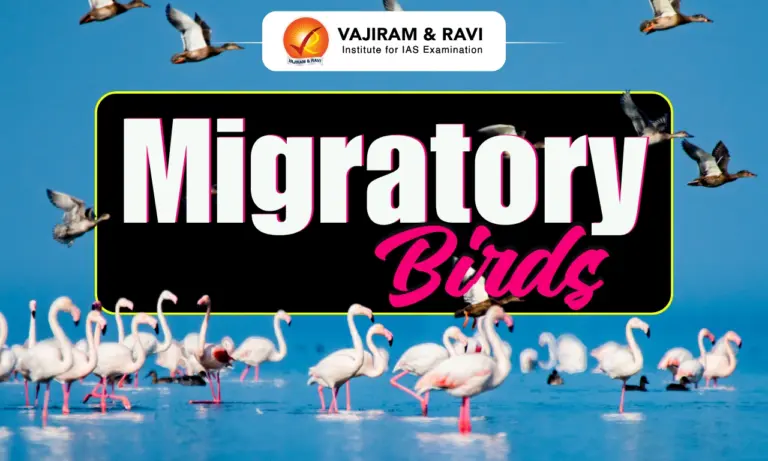
Migratory Birds are birds that travel regularly between different regions during specific seasons to find food, suitable breeding areas, nesting sites and favorable weather. Every year, millions of birds migrate across continents, connecting ecosystems across countries.
India is one of the world’s most important destinations for Migratory Birds because of its geographical location along major global flyways. These birds also help maintain ecological balance by supporting pollination, seed dispersal and natural pest control.
What is Migration of Birds?
Bird Migration is the seasonal and predictable movement of birds from one geographical region to another. Migration may occur over a few hundred kilometres or thousands of kilometres. Birds use specific migration routes known as flyways and often stop at wetlands, forests and grasslands for feeding and resting before continuing their journey.
Why Do Birds Migrate?
Migratory Birds travel long distances to improve their chances of survival and successful breeding.
- Food Availability: During winter, insects, seeds, aquatic plants and other food sources become scarce in colder regions. Birds migrate to warmer places like India where food remains available throughout the season.
- Breeding Success: Many birds breed in northern regions during summer because longer daylight hours, abundant food and fewer predators provide favourable conditions for raising chicks.
- Suitable Climate: Birds avoid harsh winters in Siberia, Central Asia and northern Europe by migrating to regions with moderate temperatures during winter.
- Safe Nesting Sites: Migration allows birds to reach habitats with suitable wetlands, grasslands, forests, or coastal areas that offer secure nesting and breeding opportunities.
- Seasonal Survival: Migration helps birds escape extreme weather while ensuring access to feeding, breeding and resting habitats during different seasons.


Migratory Birds in India
India serves as an important seasonal destination for Migratory Birds because of its diverse wetlands, rivers, forests, grasslands and coastal ecosystems.
- India becomes a winter home for Siberian Crane, Greater Flamingo, Demoiselle Crane and several other birds arriving mainly from Siberia, Central Asia and Europe for feeding, breeding and nesting.
- India lies along the Central Asian Flyway, making it one of the most important countries supporting hundreds of Migratory Bird populations during their annual movement.
- The protected areas comprising National Parks, Wildlife Sanctuaries, Reserve Forests and Conservation Reserves that support bird conservation are present at a vast scale in India.
Examples of Migratory Birds
Many bird species visit India annually through different migration routes. Most Migratory Birds arrive during winter, while some species also migrate during summer depending on breeding requirements and food availability.
- Siberian Crane: The Siberian Crane migrates from Siberia to India during winter to escape freezing temperatures and search for suitable feeding and wintering habitats. It is one of the best known Migratory Birds visiting India and is protected under CMS Appendix I.
- Greater Flamingo: Greater Flamingos migrate from Siberia and other northern regions to India during winter for feeding and nesting. They are commonly associated with large wetlands and shallow water bodies where they can easily find food.
- Demoiselle Crane: Demoiselle Cranes arrive from Siberia and Central Asia every winter. They migrate to India because of favourable climatic conditions, food availability and safe wintering habitats before returning to their breeding grounds.
- Bar-headed Goose: The Bar-headed Goose migrates through the Central Asian Flyway from Central Asia and nearby northern regions. It spends the winter in India and is among the important Migratory Bird species supported by the country’s wetlands and river systems.
- Black-necked Crane: The Black-necked Crane migrates through the Central Asian Flyway and uses suitable wetlands and high altitude habitats in India during its seasonal movement. It is also listed among the important Migratory Birds protected under international conservation efforts.
- Amur Falcon: The Amur Falcon migrates from East Asia through India while travelling towards Southern Africa. In India, it makes an important stop in Nagaland, where it rests and feeds before continuing its long migration. Community based conservation has reduced its hunting to zero since 2013.
- Northern Shoveler: The Northern Shoveler is one of the major migratory ducks that reaches India during winter. It is commonly found in wetlands, lakes and other freshwater habitats where it feeds before returning to its breeding areas.
- Gadwall: Gadwall is another important winter migratory duck visiting India. It migrates to Indian wetlands for food and favourable climatic conditions and is frequently recorded during seasonal waterbird surveys.
- Greylag Goose: Greylag Geese migrate to India during winter from northern breeding regions. They gather in wetlands and water bodies where they spend the winter months before migrating back.
- Pallas’s Gull: Pallas’s Gulls are seasonal migratory visitors that arrive in India during winter. They are generally observed around large wetlands and water bodies along with several other migratory waterbirds.
- Brown-headed Gull: Brown-headed Gulls migrate to India during winter in search of suitable feeding habitats. They are commonly found near lakes, reservoirs and other wetland ecosystems.
- Black-headed Gull: Black-headed Gulls are regular winter migrants to India. They use wetlands and freshwater habitats as feeding and resting sites during their seasonal migration.
- Coots: Coots are among the important migratory waterbirds that arrive in India every winter. They inhabit lakes, marshes and wetlands where they find abundant aquatic vegetation and food during the season.
Migratory Birds Flyways
Flyways are established migration corridors connecting breeding, feeding, resting and wintering habitats across continents.
- Americas Flyway: This system consists of three flyways connecting North America with the Caribbean, Central America and South America.
- African-Eurasian Flyway: Three major flyways connect Europe and northern Asia with the Mediterranean region, the Middle East and Africa.
- Central Asian Flyway: It connects northern Asia with southern Asia and the Middle East. India is one of its most important countries supporting Migratory Bird populations.
- East Asian-Australasian Flyway: This flyway links north-east Asia with south-east Asia, Australia and New Zealand and supports several Migratory Bird species.
Migratory Birds Challenges
Migratory Birds face increasing threats across breeding grounds, migration routes and wintering habitats.
- Population Decline: The UN State of the World’s Migratory Species Report 2024 interim update reported that 49% of CMS listed migratory species populations are declining, compared with 44% only two years earlier.
- Higher Extinction Risk: About 24% of CMS listed species now face extinction, while only 38% show stable or increasing population trends.
- Habitat Loss: Wetland reclamation, habitat degradation, urbanisation, pollution, agricultural expansion and fragmentation caused by roads, railways and fences reduce safe breeding and stopover sites.
- Emerging Diseases: Highly Pathogenic Avian Influenza (HPAI) H5N1 has caused mass mortality among several Migratory Birds, including cranes, pelicans and penguins.
- Overexploitation: Hunting, trapping, illegal killing, bycatch, poisoning, collisions with energy infrastructure and excessive pesticide use continue to threaten Migratory Bird populations.
- Climate Change: Warmer winters, altered rainfall patterns and changing migration timing are affecting bird movements and reducing the availability of suitable habitats and food.
- Shorebird Decline: Around 69% of CMS listed species reassessed into different IUCN categories are migratory shorebirds, mainly affected by habitat loss at key stopover and non breeding sites.
Migratory Birds Conservation
International cooperation and national conservation measures are essential because Migratory Birds cross several countries during their life cycle.
- Convention on Migratory Species (CMS)
-
- Also called the Bonn Convention, CMS is a legally binding UNEP treaty adopted in 1979.
- India became a Part in 1983.
- Appendix I provides strict protection to endangered migratory species through habitat conservation and restrictions on hunting, trapping and poisoning.
- Appendix II promotes international agreements for species requiring coordinated conservation.
- CMS recommends protecting and restoring critical habitats, improving ecological connectivity, restoring 30% of degraded ecosystems by 2030 and reducing impacts of infrastructure, pollution and climate change.
- Wild Life (Protection) Act 1972: Rare and endangered Migratory Birds receive the highest legal protection under Schedule I. The Act also prescribes stringent punishment for illegal hunting and trade.
- Government Initiatives: Important bird habitats have been notified as Protected Areas. Financial and technical assistance is provided to States and Union Territories for habitat management, while the Wildlife Crime Control Bureau combats illegal wildlife trade.
- Species Conservation: Community participation has helped eliminate the killing of Amur Falcons in Nagaland since 2013. India has also signed CMS Memorandums of Understanding for the conservation of Siberian Cranes and Raptors, while vulture conservation is supported under the Integrated Development of Wildlife Habitats programme.

 Last updated on Oct, 2026
→ UPSC 2027 Notification will be released on 13 January 2027 at upsconline.nic.in.
→ Check Nobel Prize 2026 Winners List here.
→ Download PIB PRiSM Monthly Magazine 2026 here.
→ Check UPSC Monthly Current Affairs Magazine The Recitals here.
→ Check out the latest UPSC Syllabus here.
→ Download UPSC Model Answers for Mains 2026
→ UPSC Mains Question Paper 2026 is out now for Essay & GS Paper 1, 2, 3 & 4.
→ UPSC Calendar 2027 has been released.
→ Enroll in Vajiram & Ravi’s UPSC Mains Test Series 2027 for structured answer writing practice, expert evaluation, and exam-oriented feedback.
→ Join Vajiram & Ravi’s UPSC Mentorship Program 2027 for personalized guidance, strategy planning, and one-to-one support from experienced mentors.
→ Go through the UPSC Mains Previous Year Papers to enhance your preparation.
→ UPSC has released UPSC Toppers List 2025 with the Civil Services final result on its official website.
→ Also check Best UPSC Coaching in India
Migratory Birds FAQs
Q1. What are Migratory Birds?+
Q2. Why do Migratory Birds come to India?+
Q3. Which flyway is most important for India?+
Q4. What are the major threats to Migratory Birds?+
Q5. Which international convention protects Migratory Species?+
Tags: environment and ecology geography migratory birds