Monroe Doctrine Latest News
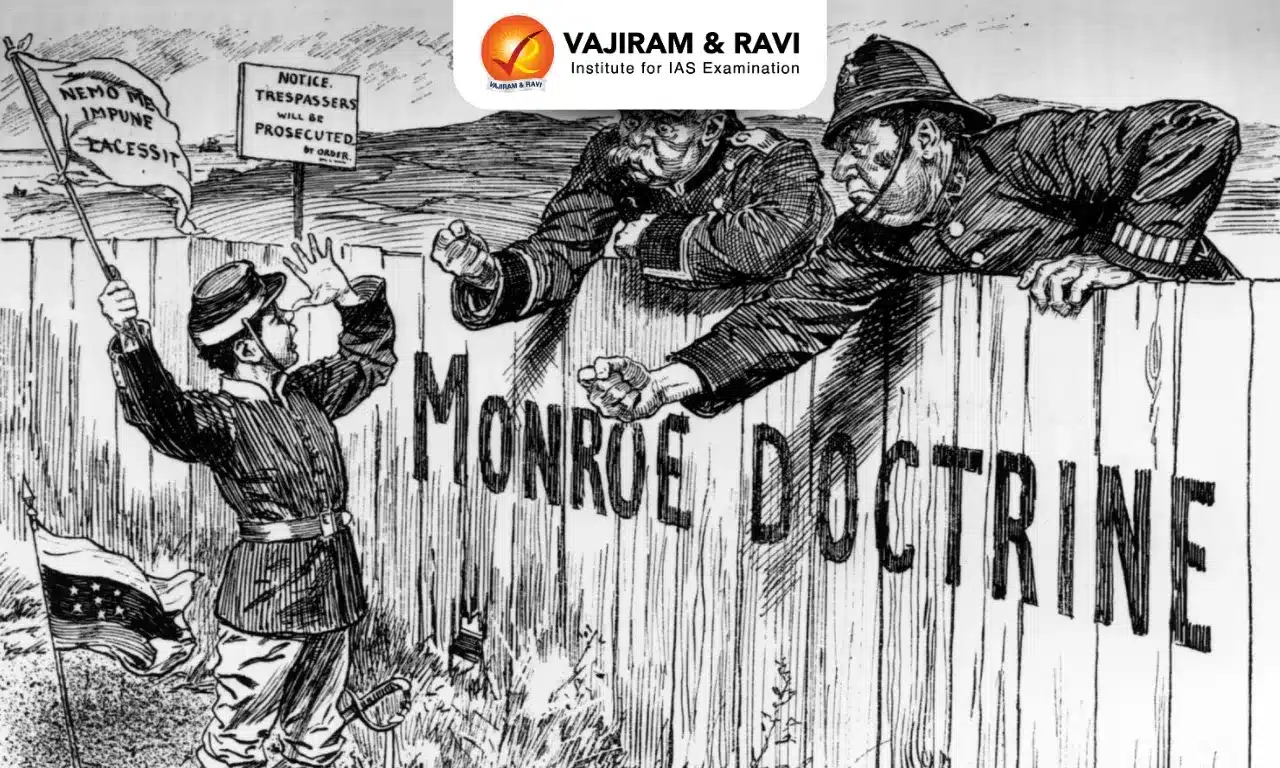
The US National Security Strategy, released recently, described Trump’s vision as one of “flexible realism” and argued that the U.S. should revive the 19th-century Monroe Doctrine, which declared the Western Hemisphere to be Washington’s zone of influence.
About Monroe Doctrine
- The Monroe Doctrine, articulated by U.S. President James Monroe in 1823, is a significant U.S. foreign policy statement aimed at preventing European intervention in the Americas.
- Primarily the work of Secretary of State John Quincy Adams, the Monroe Doctrine forbade European interference in the American hemisphere but also asserted U.S. neutrality in regard to future European conflicts.
- The origins of the Monroe Doctrine stem from attempts by several European powers to reassert their influence in the Americas in the early 1820s.
- In North America, Russia had attempted to expand its influence in the Alaska territory, and in Central and South America, the U.S. government feared a Spanish colonial resurgence.
- Britain too was actively seeking a major role in the political and economic future of the Americas, and Adams feared a subservient role for the United States in an Anglo-American alliance.
- The United States invoked the Monroe Doctrine to defend its increasingly imperialistic role in the Americas in the mid-19th century.
- However, it was not until the Spanish-American War in 1898 that the United States declared war against a European power over its interference in the American hemisphere.
- The doctrine has had lasting impacts on U.S. relations with its southern neighbors, reflecting America’s desire to assert its influence while advocating for independence and self-determination in the region.
- The isolationist position of the Monroe Doctrine was also a cornerstone of U.S. foreign policy in the 19th century.
- It took the two world wars of the 20th century to draw a hesitant America into its new role as a major global power.
Source: TP


 Last updated on Oct, 2026
→ UPSC 2027 Notification will be released on 13 January 2027 at upsconline.nic.in.
→ Check Nobel Prize 2026 Winners List here.
→ Download PIB PRiSM Monthly Magazine 2026 here.
→ Check UPSC Monthly Current Affairs Magazine The Recitals here.
→ Check out the latest UPSC Syllabus here.
→ Download UPSC Model Answers for Mains 2026
→ UPSC Mains Question Paper 2026 is out now for Essay & GS Paper 1, 2, 3 & 4.
→ UPSC Calendar 2027 has been released.
→ Enroll in Vajiram & Ravi’s UPSC Mains Test Series 2027 for structured answer writing practice, expert evaluation, and exam-oriented feedback.
→ Join Vajiram & Ravi’s UPSC Mentorship Program 2027 for personalized guidance, strategy planning, and one-to-one support from experienced mentors.
→ Go through the UPSC Mains Previous Year Papers to enhance your preparation.
→ UPSC has released UPSC Toppers List 2025 with the Civil Services final result on its official website.
→ Also check Best UPSC Coaching in India
Monroe Doctrine FAQs
Q1. What is the Monroe Doctrine?+
Q2. The Monroe Doctrine was articulated in which year?+
Q3. The Monroe Doctrine was announced by which U.S. President?+
Q4. What does Monroe Doctrine primarily aims at?+
Q5. What position did the Monroe Doctrine take regarding future European conflicts?+
Tags: monroe doctrine prelims pointers upsc current affairs upsc prelims current affairs