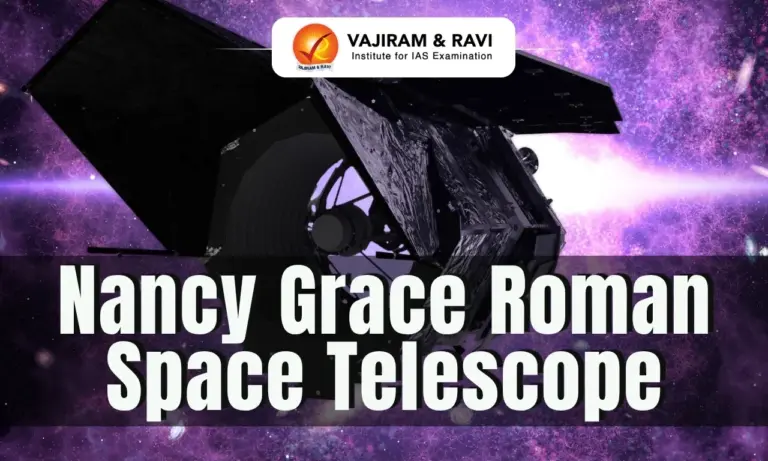
Nancy Grace Roman Space Telescope Latest News
Nasa’s Nancy Grace Roman Space Telescope is set to begin its journey to a new home in deep space on August 30.
About Nancy Grace Roman Space Telescope
- It is NASA’s next flagship orbital observatory.
- It is designed to settle essential questions in the areas of dark energy, exoplanets, and infrared astrophysics.
- Scientists by using this telescope will focus on three main topic areas: dark energy, exoplanets, and dark matter.
- It will provide one of the deepest-ever views into the heart of our Milky Way galaxy.
- It will orbit around a special place in space called the second Sun-Earth Lagrange point, or L2.
- Objectives: It will monitor hundreds of millions of stars in search of tell-tale flickers that betray the presence of planets, distant stars, small icy objects that haunt the outskirts of our solar system and isolated black holes.


Instruments of Nancy Grace Roman Space Telescope
- Wide Field Instrument
- It is a 300–megapixel infrared camera.
- It will have a field of view that is 100 times greater than the Hubble infrared instrument, capturing more of the sky with less observing time.
- It will measure light from a billion galaxies over the course of the mission lifetime.
- It will perform a microlensing survey of the inner Milky Way to find ~2,600 exoplanets.
- Coronagraph Instrument
-
- It is a technology demonstration which will perform high contrast imaging and spectroscopy of individual nearby exoplanets.
- Its Galactic Bulge Time-Domain Survey will focus on the Milky Way.
Source: IT

 Last updated on Oct, 2026
→ UPSC 2027 Notification will be released on 13 January 2027 at upsconline.nic.in.
→ Check Nobel Prize 2026 Winners List here.
→ Download PIB PRiSM Monthly Magazine 2026 here.
→ Check UPSC Monthly Current Affairs Magazine The Recitals here.
→ Check out the latest UPSC Syllabus here.
→ Download UPSC Model Answers for Mains 2026
→ UPSC Mains Question Paper 2026 is out now for Essay & GS Paper 1, 2, 3 & 4.
→ UPSC Calendar 2027 has been released.
→ Enroll in Vajiram & Ravi’s UPSC Mains Test Series 2027 for structured answer writing practice, expert evaluation, and exam-oriented feedback.
→ Join Vajiram & Ravi’s UPSC Mentorship Program 2027 for personalized guidance, strategy planning, and one-to-one support from experienced mentors.
→ Go through the UPSC Mains Previous Year Papers to enhance your preparation.
→ UPSC has released UPSC Toppers List 2025 with the Civil Services final result on its official website.
→ Also check Best UPSC Coaching in India
Nancy Grace Roman Space Telescope FAQs
Q1. What is the primary objective of Roman Telescope?+
Q2. Nancy Grace Roman Space Telescope is being developed by which organisation?+
Tags: nancy grace roman space telescope