New Hoverfly Species Latest News
Researchers from the Zoological Survey of India (ZSI) recently discovered two new species of hoverflies named Eristalinus sapphirinus and Eristalinus brunettii from the Gangetic Plains of West Bengal.
About Eristalinus sapphirinus and Eristalinus brunettii
- These are two new species of hoverflies.
- They were discovered from the Gangetic Plains of West Bengal.
- Eristalinus sapphirinus is named for its striking, sapphire-blue metallic coloration.
- Eristalinus brunettii is named in honour of entomologist Enrico Adelelmo Brunetti, acknowledging his immense historical contributions to the study of Indian Diptera (flies).
- The discovery expands the known diversity of the Eristalinus genus in India, with the last major contribution to the group’s taxonomy dating back to 1923.
- Members of the Eristalinus genus support ecosystems in two distinct life stages.
- As adults, they act as critical pollinators for wild and cultivated plants.
- As larvae (commonly known as “rat-tailed maggots“), they develop in aquatic habitats where they decompose organic matter and recycle essential nutrients.


What are Hoverflies?
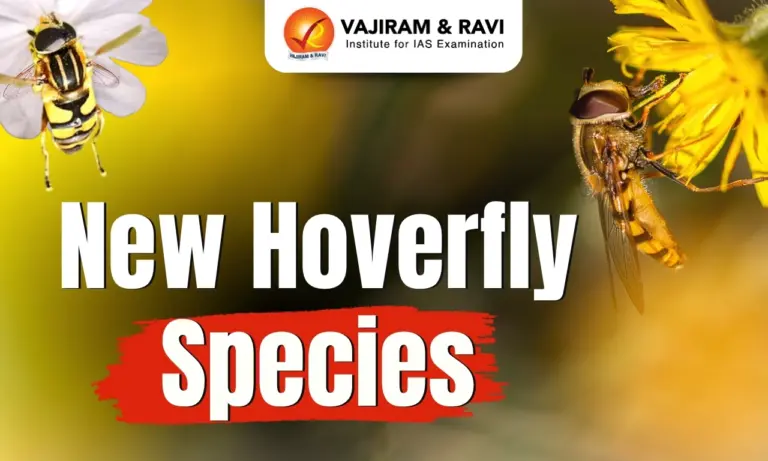
- Hoverflies, often referred to as flower flies or drone flies, are beneficial insects that appear in large numbers during the spring and summer.
- They belong to the order Diptera and the family Syrphidae.
- They are often mistaken for bees or wasps and can cause undue fear over possible stings.
- However, they do not possess stingers.
- Hoverflies can be readily distinguished from wasps and bees by their single pair of wings. In comparison, bees and wasps have two pairs of wings.
- Hover flies also have a typical fly head with short antennae and bulbous eyes.
- Adult hover flies are 4-10 mm long and have dark flattened bodies with black and yellow markings.
- During flight, many hover flies move in a characteristic way. As their name suggests, they hover over objects but will also dart to and fro.
- Hoverflies are among the most important pollinators globally, providing pollination services to many crops and natural vegetation.
Source: PIB

 Last updated on Oct, 2026
→ UPSC 2027 Notification will be released on 13 January 2027 at upsconline.nic.in.
→ Check Nobel Prize 2026 Winners List here.
→ Download PIB PRiSM Monthly Magazine 2026 here.
→ Check UPSC Monthly Current Affairs Magazine The Recitals here.
→ Check out the latest UPSC Syllabus here.
→ Download UPSC Model Answers for Mains 2026
→ UPSC Mains Question Paper 2026 is out now for Essay & GS Paper 1, 2, 3 & 4.
→ UPSC Calendar 2027 has been released.
→ Enroll in Vajiram & Ravi’s UPSC Mains Test Series 2027 for structured answer writing practice, expert evaluation, and exam-oriented feedback.
→ Join Vajiram & Ravi’s UPSC Mentorship Program 2027 for personalized guidance, strategy planning, and one-to-one support from experienced mentors.
→ Go through the UPSC Mains Previous Year Papers to enhance your preparation.
→ UPSC has released UPSC Toppers List 2025 with the Civil Services final result on its official website.
→ Also check Best UPSC Coaching in India
New Hoverfly Species FAQs
Q1. What are Eristalinus sapphirinus and Eristalinus brunettii?+
Q2. Where were Eristalinus sapphirinus and Eristalinus brunettii discovered?+
Q3. Why was Eristalinus sapphirinus given its name?+
Q4. Who is Eristalinus brunettii named after?+
Tags: new hoverfly species prelims pointers upsc current affairs upsc prelims current affairs