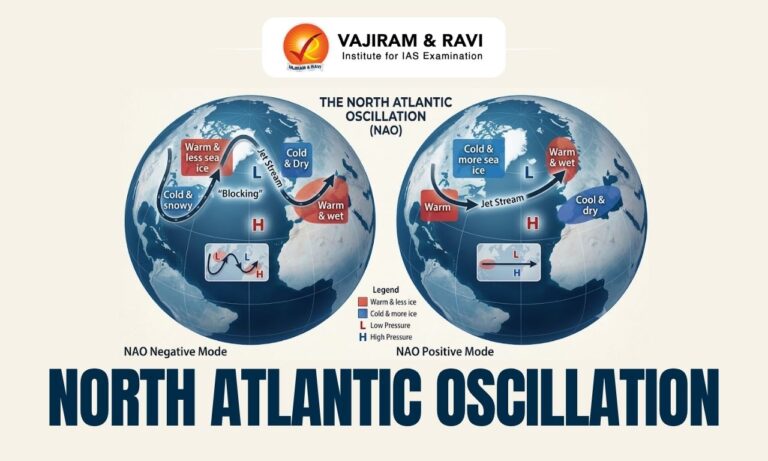
The North Atlantic Oscillation (NAO) is an important pattern of atmospheric variability that influences weather across the North Atlantic region and beyond. Changes in the NAO affect westerly winds, the jet stream and storm tracks, thereby influencing temperature and rainfall, particularly over Europe and North America.
What is North Atlantic Oscillation?
The North Atlantic Oscillation (NAO) is a pattern of change in air pressure over the North Atlantic Ocean. It mainly involves two pressure systems – the Azores High in the south and the Icelandic Low in the north.
The pressure difference between these two systems changes over time. This changes the strength of the westerly winds, which then affects the jet stream, storm tracks, temperature and rainfall over Europe and North America.
North Atlantic Oscillation Phases
The NAO has two phases – positive and negative. The key difference between them is whether the pressure difference between the Azores High and Icelandic Low is stronger or weaker than normal.
North Atlantic Oscillation Positive Phase
In the positive phase, the pressure difference between the Azores High and Icelandic Low is stronger than normal. This produces stronger westerly winds across the North Atlantic. As a result:
- Northern Europe generally experiences milder and wetter winters as warmer, moist Atlantic air moves into the region.
- Northeastern North America generally experiences relatively milder winter conditions.
- Greenland and northeastern Canada tend to experience colder and drier conditions.
- Southern Europe and the Mediterranean generally receive less winter rainfall.
- The Atlantic storm track tends to favour northern Europe.
North Atlantic Oscillation Negative Phase
In the negative phase, the pressure difference between the Azores High and Icelandic Low is weaker than normal. The westerly winds therefore become weaker. As a result:
- Northern Europe is more likely to experience colder and relatively drier winters.
- Northeastern North America becomes more vulnerable to cold Arctic air, cold waves and snowfall.
- Southern Europe and the Mediterranean generally receive more winter rainfall.
- Parts of Greenland can experience relatively warmer conditions.
- The Atlantic storm track can shift towards a more southerly path.
North Atlantic Oscillation Impacts
The NAO changes the strength and position of westerly winds and the jet stream. This changes the movement of air masses, storms and moisture, producing wider effects on weather and human activities.
Weather and Climate
- Temperature: Positive NAO generally brings milder winters to Northern Europe, while negative NAO increases the likelihood of colder conditions.
- Rainfall and Snowfall: Positive NAO generally produces wetter conditions in Northern Europe and drier conditions around the Mediterranean, while negative NAO tends to reverse this pattern.
- Storms: Changes in the jet stream alter the North Atlantic storm track, affecting the distribution and intensity of storms, rainfall and snowfall.
- Cold Waves: Negative NAO can allow Arctic air to move southwards, increasing the likelihood of cold waves and heavy snowfall in parts of Europe and eastern North America.
Agriculture and Economy
- Agriculture: Changes in winter temperature and precipitation influence soil moisture, crop growth and agricultural productivity.
- Energy: Colder winters increase heating requirements and energy consumption, particularly in Europe.
- Transport: Changes in the North Atlantic storm track can affect shipping and aviation, as strong winds and storms influence travel conditions.
- Infrastructure: Severe storms, heavy snowfall and extreme winter conditions can damage infrastructure and disrupt economic activity.
Ocean Circulation and Long-Term Climate
- Ocean Circulation: Persistent changes in the NAO can influence North Atlantic ocean circulation through changes in wind patterns and heat exchange.
- Long-Term Climate: Through its interaction with ocean circulation, the NAO can contribute to climate variations over several years or decades, although it is only one of several factors influencing long-term climate change.


Impact of North Atlantic Oscillation on India
The NAO can indirectly influence Indian winter weather by affecting the westerly circulation and subtropical jet stream. This can influence the movement of Western Disturbances, which bring winter rainfall to northwestern India and snowfall to the Western Himalayas. These changes are important for Rabi crops, especially wheat, and for water availability from Himalayan snowfall. However, the NAO-India relationship is indirect and variable, as Western Disturbances are influenced by several other atmospheric factors.

 Last updated on Oct, 2026
→ UPSC 2027 Notification will be released on 13 January 2027 at upsconline.nic.in.
→ Asian Games 2026 are being held in Aichi-Nagoya, Japan, from 19 September to 4 October.
→ Check Nobel Prize 2026 Winners List here.
→ Download PIB PRiSM Monthly Magazine 2026 here.
→ Check UPSC Monthly Current Affairs Magazine The Recitals here.
→ Check out the latest UPSC Syllabus here.
→ Download UPSC Model Answers for Mains 2026
→ UPSC Mains Question Paper 2026 is out now for Essay & GS Paper 1, 2, 3 & 4.
→ UPSC Calendar 2027 has been released.
→ Enroll in Vajiram & Ravi’s UPSC Mains Test Series 2027 for structured answer writing practice, expert evaluation, and exam-oriented feedback.
→ Join Vajiram & Ravi’s UPSC Mentorship Program 2027 for personalized guidance, strategy planning, and one-to-one support from experienced mentors.
→ Go through the UPSC Mains Previous Year Papers to enhance your preparation.
→ UPSC has released UPSC Toppers List 2025 with the Civil Services final result on its official website.
→ Also check Best UPSC Coaching in India
North Atlantic Oscillation (NAO) FAQs
Q1. What is the North Atlantic Oscillation?+
Q2. Why is it called an oscillation?+
Q3. What are the two phases of North Atlantic Oscillation (NAO)?+
Q4. What happens during a positive North Atlantic Oscillation (NAO)?+
Q5. What happens during a negative North Atlantic Oscillation (NAO)?+
Tags: north atlantic oscillation