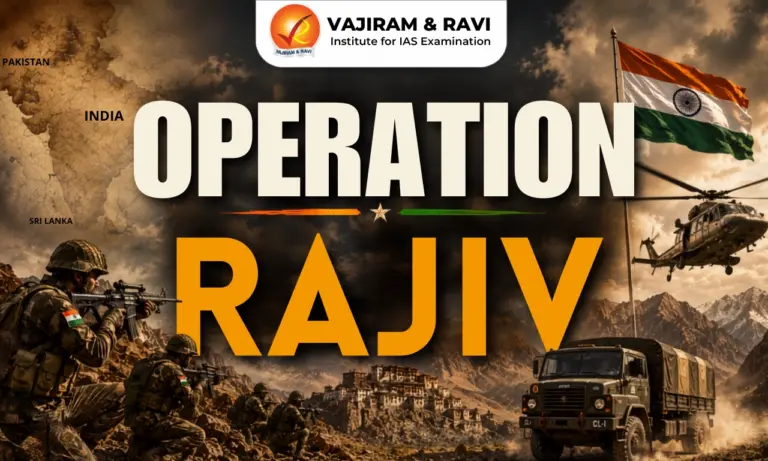
Operation Rajiv was a major Indian Army operation launched in 1987 to capture the strategically important Quaid Post from the Pakistan Army in the Bilafond La sector of the Saltoro Ridge on the western flank of the Siachen Glacier. The mission successfully secured the highest military position in the region, strengthened India’s control over the Bilafond La sector and remains one of the most remarkable high altitude military operations conducted under extreme weather and terrain conditions.
What is Operation Rajiv 1987?
Operation Rajiv was the codename of the Indian Army mission launched on 23 June 1987 to recapture the Left Shoulder peak, which Pakistan had occupied in 1986 and renamed Quaid Post. After the successful assault on 26 June 1987, the post was renamed Bana Post (Bana Top) in honour of Naib Subedar Bana Singh. The operation secured India’s tactical advantage in the Bilafond La sector and eliminated a major threat to Indian positions on the Siachen Glacier.
Operation Rajiv Background
Operation Rajiv 1987 was launched after Pakistan occupied the dominating Left Shoulder feature overlooking Indian positions in the Bilafond La sector. The capture of this height had altered the tactical balance in the region, making it necessary for India to regain control.
- Operation Meghdoot 1984: India secured the Siachen Glacier during Operation Meghdoot and established important military positions including Sonam Post and Amar Post in the Bilafond La sector of the Saltoro Ridge.
- Pakistan Occupies Left Shoulder: In November 1986, Pakistan established a post on the Left Shoulder peak and renamed it Quaid Post, placing it above the Indian held Sonam and Amar Posts.
- Strategic Importance: Located at 6,553 metres (21,500 feet), Quaid Post overlooked the Indian supply route from the Siachen Base Camp to Bilafond La, allowing direct observation and fire on Indian movement.
- Difficult Terrain: The post was protected by nearly 457 metre high vertical ice walls with slopes of about 80° to 85°, making any assault extremely difficult under sub zero temperatures reaching nearly -50°C.
- Threat to Indian Positions: Pakistan’s control over Quaid Post enabled machine gun and rocket fire against Sonam and Amar Posts, threatening logistics, helicopter operations and movement across the western Siachen sector.
- Attack on Sonam Post: On 18 April 1987, Pakistani troops opened heavy fire from Quaid Post, killing Indian soldiers at Sonam Post and disrupting maintenance of forward positions.
- Rajiv Pande’s Patrol: On 29 May 1987, Second Lieutenant Rajiv Pande led a 13 member patrol to identify an assault route. The patrol reached within about 30 metres of the objective before coming under heavy fire, resulting in ten fatalities.
- Naming of the Operation: The mission was named Operation Rajiv in memory of Second Lieutenant Rajiv Pande, whose reconnaissance and sacrifice provided the approach route later used during the successful assault.


Operation Rajiv Course 1987
Operation Rajiv was executed through multiple carefully planned assaults before the final capture of Quaid Post on 26 June 1987 under extremely hostile high altitude conditions.
- Formation of the Assault Force: The 8th Battalion, Jammu and Kashmir Light Infantry formed a 62 member task force under Major Varinder Singh, assisted by Captain Anil Sharma, to execute the operation.
- Extensive Preparation: Due to frequent blizzards and limited carrying capacity of HAL Cheetah helicopters, assembling the assault force required nearly 20 days and approximately 200 helicopter sorties.
- Observation and Fire Support: Captain Ram Prakash established an observation position ahead of Sonam Post, while artillery and machine gun teams were deployed to support the advancing assault groups.
- First Assault, 23 June 1987: Major Varinder Singh’s team attempted to locate the rope fixed earlier by Rajiv Pande’s patrol but failed because heavy snowfall reduced visibility and slowed movement through waist deep snow.
- Second Assault, 24 June 1987: Subedar Harnam Singh’s team located the ropes and began climbing, but Pakistani machine gun fire caused casualties while extreme cold jammed Indian weapons, forcing another withdrawal.
- Third Assault, 25 June 1987: Subedar Sansar Chand’s team advanced close to the objective with artillery support, but communication failed and reinforcements could not reach the leading party.
- Final Assault, 26 June 1987: Major Varinder Singh launched a coordinated daytime attack while Naib Subedar Bana Singh led a five member assault team consisting of Riflemen Chuni Lal, Laxman Das, Om Raj and Kashmir Chand.
- Capture of Quaid Post: Taking advantage of a blizzard, Bana Singh’s team approached from an unexpected direction, destroyed the bunker using grenades, fought hand to hand with bayonets and secured the post after fierce combat.
- Successful Completion: By 26 June 1987, the Indian Army had captured the highest military post in the Siachen region, restoring tactical superiority in the Bilafond La sector.
Operation Rajiv Results and Impacts
Operation Rajiv significantly improved India’s tactical position on the Saltoro Ridge and permanently changed the military balance in the Bilafond La sector.
- Capture of the Highest Post: India successfully secured Quaid Post, the highest military position in the Siachen region, ending Pakistan’s advantage over Indian positions in Bilafond La.
- Renaming to Bana Post: Following the victory, Quaid Post was officially renamed Bana Post or Bana Top in recognition of Naib Subedar Bana Singh’s exceptional leadership during the assault.
- Securing Bilafond La: The operation ensured India’s continued control over Bilafond La, Sonam Post, Amar Post and surrounding strategic heights on the Saltoro Ridge.
Operation Rajiv Soldiers
Operation Rajiv 1987 showcased outstanding leadership and exceptional bravery by several officers and soldiers who played decisive roles in the mission’s success.
- Naib Subedar Bana Singh: Led the final assault team that captured Quaid Post on 26 June 1987 and was awarded the Param Vir Chakra, India’s highest gallantry award, in 1988.
- Major Varinder Singh: Commanded the overall assault force, led repeated attacks despite heavy casualties, remained in command after being wounded and received the Vir Chakra.
- Second Lieutenant Rajiv Pande: Led the reconnaissance patrol that identified the assault route before sacrificing his life on 29 May 1987. The operation was named in his honour and he received the Vir Chakra.
- Subedar Harnam Singh: Led the second assault under intense enemy fire, displaying exceptional courage during the difficult climb towards Quaid Post and was awarded the Maha Vir Chakra.
- Subedar Sansar Chand: Commanded the third assault team that reached close to the objective despite communication failure and continuous enemy fire, earning the Maha Vir Chakra.
- Captain Ram Prakash: Established the forward observation position ahead of Sonam Post, enabling artillery coordination and supporting the assault teams during successive attacks.
- Final Assault Team: Riflemen Chuni Lal, Laxman Das, Om Raj and Kashmir Chand accompanied Bana Singh during the decisive attack. Riflemen Chuni Lal and Om Raj were awarded the Sena Medal.

 Last updated on Oct, 2026
→ UPSC 2027 Notification will be released on 13 January 2027 at upsconline.nic.in.
→ Check Nobel Prize 2026 Winners List here.
→ Download PIB PRiSM Monthly Magazine 2026 here.
→ Check UPSC Monthly Current Affairs Magazine The Recitals here.
→ Check out the latest UPSC Syllabus here.
→ Download UPSC Model Answers for Mains 2026
→ UPSC Mains Question Paper 2026 is out now for Essay & GS Paper 1, 2, 3 & 4.
→ UPSC Calendar 2027 has been released.
→ Enroll in Vajiram & Ravi’s UPSC Mains Test Series 2027 for structured answer writing practice, expert evaluation, and exam-oriented feedback.
→ Join Vajiram & Ravi’s UPSC Mentorship Program 2027 for personalized guidance, strategy planning, and one-to-one support from experienced mentors.
→ Go through the UPSC Mains Previous Year Papers to enhance your preparation.
→ UPSC has released UPSC Toppers List 2025 with the Civil Services final result on its official website.
→ Also check Best UPSC Coaching in India
Operation Rajiv 1987 FAQs
Q1. What was Operation Rajiv 1987?+
Q2. Why was Operation Rajiv 1987 launched?+
Q3. When was Operation Rajiv conducted?+
Q4. What is the strategic importance of Quaid Post (Bana Post)?+
Q5. Who were the major soldiers of Operation Rajiv 1987?+
Tags: defence operation operation rajiv