Ordinance Latest News
- The Supreme Court Collegium’s acceptance of an Ordinance creating four additional judges’ posts has raised significant questions about judicial independence, security of tenure, and the appearance of detachment from the executive.
About Ordinances in India
- An Ordinance is a temporary law promulgated by the President of India under Article 123 of the Constitution.
- It is an extraordinary legislative power that can be exercised when Parliament is not in session and when immediate action is necessary.
- Key Features of Ordinances
- Article 123: Empowers the President to promulgate ordinances when Parliament is not in session.
- Force of Law: An ordinance has the same force and effect as an Act of Parliament during its operation.
- Duration: An ordinance ceases to operate six weeks after Parliament reassembles, unless approved by both Houses.
- Withdrawal: The President may withdraw an ordinance at any time.
- Disapproval: Both Houses may disapprove it by resolution.
- Re-promulgation: While constitutionally permissible, repeated re-promulgation has been deemed unconstitutional by the Supreme Court.


Judicial Pronouncements on Ordinances
- The Supreme Court has, over time, established important principles to prevent misuse of the ordinance-making power:
- D.C. Wadhwa vs State of Bihar (1986): The Court held that governance by repeatedly re-promulgated ordinances is a “fraud on the Constitution.”
- Krishna Kumar Singh vs State of Bihar (2017): A seven-judge Bench ruled against using the ordinance-making power as a parallel source of legislation, emphasising that ordinances are meant for exceptional circumstances.
Judicial Independence as a Basic Feature
- Constitutional Framework
- Article 124(1) of the Constitution states that the Supreme Court shall consist of a Chief Justice and such other judges, not exceeding the number Parliament may prescribe by law.
- The number of Supreme Court judges has been increased from time to time through legislation.
- The NJAC Judgment
- In Supreme Court Advocates-on-Record Association vs Union of India (2015), the Supreme Court struck down the 99th Constitutional Amendment and the National Judicial Appointments Commission (NJAC) Act. Key observations included:
- Judicial independence is part of the basic structure of the Constitution.
- The NJAC, despite its seemingly neutral composition, allowed the Law Minister and one eminent person to potentially veto judicial appointments.
- This was held to destroy the judiciary’s primacy in its own appointments.
- The Court has consistently held that judicial independence is not just about freedom from external pressure but also about the appearance of detachment from the executive.
News Summary
- On May 16, 2026, the President promulgated an Ordinance lifting the sanctioned strength of the Supreme Court from 34 to 38 judges. Following this:
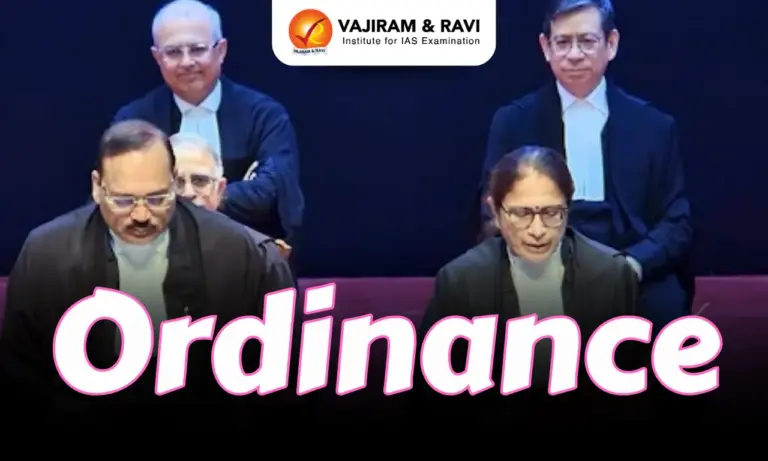
- Five judges took the oath in Delhi
- Of these, two filled lawful vacancies that already existed (the Court was sitting at 32 against a sanctioned 34).
- Three judges occupy chairs that no statute has created; they sit only by virtue of the Ordinance.
Constitutional Concerns
- The acceptance of the Ordinance by the Supreme Court Collegium raises several significant concerns:
- Security of Tenure
- Three judges hold their positions based on an Ordinance that:
- Can be withdrawn at any time by the President.
- May be disapproved by either House of Parliament.
- Will cease to operate six weeks after Parliament reassembles unless replaced by an Act.
- A court that owes three chairs to a six-week renewable Ordinance holds them at the executive’s sufferance.
- Three judges hold their positions based on an Ordinance that:
- Judicial Independence
- The fundamental concern is whether the court can hold its seats free of obligation to the political branch.
- Judges whose tenure depends on the government’s willingness to convert the Ordinance into an Act may face questions about their detachment in matters involving the Union government.
- Appearance of Bias
- In matters touching the Union, the government whose parliamentary majority must regularise the appointments may appear before these judges.
- A judge whose tenure lies, even loosely, in one party’s gift cannot wear the detachment the office demands.
Potential Constitutional Challenges
- If the Bill Replaces the Ordinance
- The anomaly closes.
- The judges’ positions are regularised through proper legislation.
- Constitutional concerns are addressed.
- If the Bill is Not Passed
- The apex court’s strength reverts to 34.
- The executive cannot bridge the gap by re-promulgation; this would be the “fraud” condemned in the Wadhwa case.
- The status of judges appointed to Ordinance-created posts becomes uncertain.
Validity of Judgments
- The validity of judgments delivered by judges appointed to Ordinance-created posts is protected under the de facto doctrine, as affirmed in Gokaraju Rangaraju vs State of Andhra Pradesh (1981).
- This doctrine holds that acts of officials who hold office under colour of authority are valid, even if their appointment is later found to be defective.
- Removal Question
- Whether a judge appointed to an Ordinance-created post can be removed once that post lapses remains constitutionally untested.
Broader Implications
- For Judicial Independence
- The acceptance of Ordinance-based appointments may weaken the structural independence of the judiciary.
- Sets a precedent for the executive to influence the composition of the court without parliamentary scrutiny.
- May affect the perception of judicial impartiality.
- For Constitutional Governance
- Raises questions about the proper use of ordinance-making powers.
- Tests the limits of the D.C. Wadhwa principle.
- Potential for further litigation on the validity of the Ordinance.
- For the Collegium System
- The Collegium’s acceptance of the Ordinance may be seen as a calculated risk.
- Stakes the institution’s reputation on the political process completing the transition to a statute.
- May affect future negotiations between the judiciary and the executive.
Concerns Raised by Experts
- Security of tenure is a cornerstone of judicial independence that may be compromised.
- The appearance of detachment from the executive is essential for public confidence in the judiciary.
- Historical precedents like the Roosevelt court-packing plan demonstrate the dangers of executive interference in court composition.
- The Supreme Court’s own jurisprudence in D.C. Wadhwa and Krishna Kumar Singh warns against using ordinances as parallel legislation.
Source: TH

 Last updated on Oct, 2026
→ UPSC 2027 Notification will be released on 13 January 2027 at upsconline.nic.in.
→ Check Nobel Prize 2026 Winners List here.
→ Download PIB PRiSM Monthly Magazine 2026 here.
→ Check UPSC Monthly Current Affairs Magazine The Recitals here.
→ Check out the latest UPSC Syllabus here.
→ Download UPSC Model Answers for Mains 2026
→ UPSC Mains Question Paper 2026 is out now for Essay & GS Paper 1, 2, 3 & 4.
→ UPSC Calendar 2027 has been released.
→ Enroll in Vajiram & Ravi’s UPSC Mains Test Series 2027 for structured answer writing practice, expert evaluation, and exam-oriented feedback.
→ Join Vajiram & Ravi’s UPSC Mentorship Program 2027 for personalized guidance, strategy planning, and one-to-one support from experienced mentors.
→ Go through the UPSC Mains Previous Year Papers to enhance your preparation.
→ UPSC has released UPSC Toppers List 2025 with the Civil Services final result on its official website.
→ Also check Best UPSC Coaching in India
Ordinance FAQs
Q1. What is an Ordinance under the Indian Constitution?+
Q2. What did the Ordinance dated May 16, 2026 do?+
Q3. What is the principle from the D.C. Wadhwa case?+
Q4. What is the de facto doctrine?+
Q5. What happens if the Ordinance is not replaced by an Act?+
Tags: mains articles ordinance upsc current affairs upsc mains current affairs