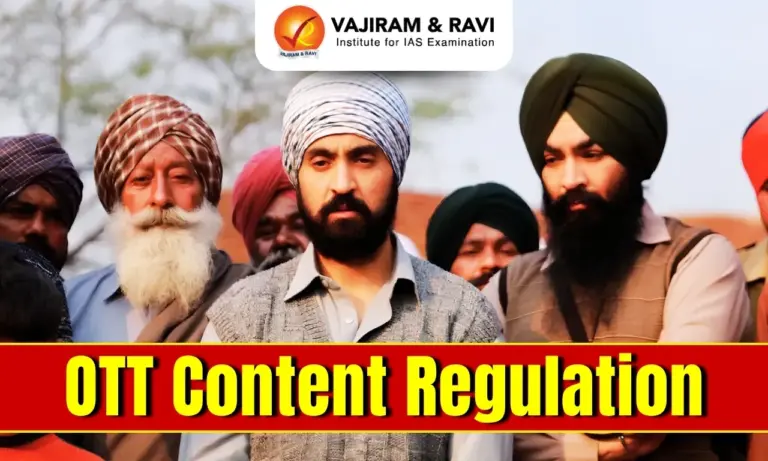
OTT Content Regulation Latest News
- The film Satluj, based on the life of rights activist Jaswant Singh Khalra, premiered on ZEE5, after being stuck for nearly three years over certification issues.
- Just two days later, it was taken off the platform in India, though it remains available internationally. Government sources cited “security concerns,” and an Inter-Departmental Committee under the IT Rules, 2021 has been set up to examine the matter.
- The episode has spotlighted India’s two separate regulatory regimes: the Cinematograph Act for theatres and the IT Rules for streaming platforms.
Background: Why Was Satluj Banned
- The film chronicles the life and death of Jaswant Singh Khalra, an Amritsar-based activist who investigated the alleged illegal cremation of thousands of unidentified bodies by police during Punjab’s militancy years.
- He was abducted and killed in 1995, a case in which several police officials were convicted.
- Originally titled Ghallughara, the film was renamed Punjab ’95 after CBFC scrutiny, when the board demanded 127 cuts for theatrical release.
- The makers refused, so the film never reached cinemas. It later arrived on OTT, without cuts, under the new title Satluj.
- The makers had also challenged the CBFC’s objections in the Bombay High Court in 2023 but later withdrew the petition.


How CBFC Certification Works
- Theatrical releases are governed by the Cinematograph Act, 1952.
- Under Section 4, anyone wishing to publicly exhibit a film must obtain certification from the CBFC, a statutory body under the Ministry of Information and Broadcasting.
- Screening uncertified films in cinemas is a criminal offence.
- The CBFC certifies films as U (unrestricted), UA (unrestricted with parental guidance), A (adults only), and S (restricted to specialised audiences).
- The Cinematograph (Amendment) Act, 2023 split the UA category into age-based sub-categories and made certificates perpetually valid, removing the earlier 10-year limit.
- The Act allows the CBFC to refuse certification or demand cuts if a film threatens India’s sovereignty and integrity, state security, friendly relations with foreign states, public order, decency, morality, or involves defamation or contempt of court.
- These mirror the “reasonable restrictions” under Article 19(2) of the Constitution.
- Until 2021, filmmakers could appeal CBFC decisions before a dedicated tribunal (FCAT).
- Tribunal rationalisation reforms abolished FCAT and shifted its functions to High Courts, making appeals slower and costlier for time-sensitive releases, and removing specialised judicial expertise in cinema matters.
How Streaming Platforms Are Regulated
- OTT platforms historically operated with minimal oversight since the Cinematograph Act covers only public exhibition, not private viewing.
- In 2019, the Karnataka High Court dismissed a plea to bring OTT content under the Cinematograph Act, distinguishing public exhibition from private streaming.
- OTT content is instead regulated under Part III of the IT (Intermediary Guidelines and Digital Media Ethics Code) Rules, 2021.
- These rules prescribe a code of ethics and a three-tier grievance redressal structure: self-regulation by publishers, self-regulatory bodies, and government oversight via the Information & Broadcasting Ministry.
- This framework is currently under challenge, with the Bombay and Madras High Courts staying the provision.
- The 2023 Broadcasting Services (Regulation) Bill, which sought to classify OTT platforms as broadcasting services, was later withdrawn.
- In Satluj’s case, the government invoked its takedown power under Section 69A of the IT Act.
Understanding Section 69A
- Section 69A empowers the government to block content, exercised through the IT (Procedure and Safeguards for Blocking Access of Information by Public) Rules, 2009.
- The government must record reasons for blocking in writing, and a designated Review Committee examines whether such orders comply with Section 69A.
- In this case, the I&B Ministry constituted a high-level Inter-Departmental Committee under Rule 14 of the IT Rules to examine the film’s content.
- The committee can recommend a warning, an apology or disclaimer, reclassification or modification of content, or complete deletion and blocking under Section 69A.
Conclusion
- The Satluj episode reveals a regulatory gap: filmmakers can bypass strict CBFC theatrical scrutiny via OTT, but face parallel, less-defined IT Rules oversight instead.
- This highlights the need for a coherent, rights-respecting framework governing content across both platforms, balancing free expression with genuine security concerns.

 Last updated on Oct, 2026
→ UPSC 2027 Notification will be released on 13 January 2027 at upsconline.nic.in.
→ Check Nobel Prize 2026 Winners List here.
→ Download PIB PRiSM Monthly Magazine 2026 here.
→ Check UPSC Monthly Current Affairs Magazine The Recitals here.
→ Check out the latest UPSC Syllabus here.
→ Download UPSC Model Answers for Mains 2026
→ UPSC Mains Question Paper 2026 is out now for Essay & GS Paper 1, 2, 3 & 4.
→ UPSC Calendar 2027 has been released.
→ Enroll in Vajiram & Ravi’s UPSC Mains Test Series 2027 for structured answer writing practice, expert evaluation, and exam-oriented feedback.
→ Join Vajiram & Ravi’s UPSC Mentorship Program 2027 for personalized guidance, strategy planning, and one-to-one support from experienced mentors.
→ Go through the UPSC Mains Previous Year Papers to enhance your preparation.
→ UPSC has released UPSC Toppers List 2025 with the Civil Services final result on its official website.
→ Also check Best UPSC Coaching in India
OTT Content Regulation FAQs
Q1. Why has the Satluj case intensified the debate on OTT Content Regulation?+
Q2. How does OTT Content Regulation differ from film certification in India?+
Q3. What role does Section 69A play in OTT Content Regulation?+
Q4. Why is OTT Content Regulation facing legal challenges?+
Q5. What reforms are needed in India's OTT Content Regulation framework?+
Tags: OTT Content Regulation upsc current affairs upsc mains current affairs