India’s First Hydrogen Train Latest News
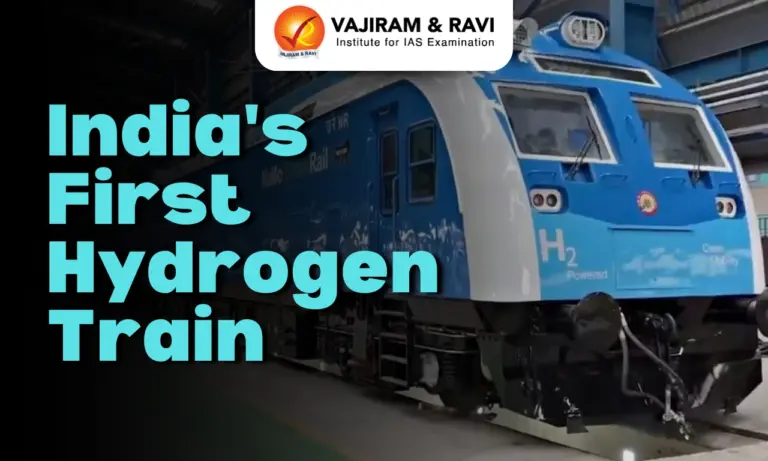
- PM Modi will flag off India’s first hydrogen-powered train in Jind, Haryana, on July 17, 2026.
- With this, India joins an elite group of countries, including Japan, South Korea, the US, and Canada, that operate hydrogen trains (“H-trains”), marking a major milestone in green transportation technology.
Key Features of the Train
- India’s hydrogen train is among the world’s longest and most powerful hydrogen trainsets, with the following specifications:
- Configuration: Eight passenger cars and two driving power cars (10 coaches total)
- Power: 2400 kilowatts (3200 hp)
- Capacity: 682 seats, with a total passenger capacity of 2,600
- Route: 89-km Jind-Sonipat section via 12 stations, with a 2-hour travel time
- Speed: Operational speed of 75 km/h, maximum speed of 120 km/h
- Operations: Two round trips daily, covering 356 km and consuming about 300 kg of hydrogen
- Emissions: Zero CO2 emissions; the only by-product is harmless water vapour


Global Context: Hydrogen Trains Elsewhere
- French rolling stock giant Alstom first presented hydrogen train technology at a 2016 exhibition in Berlin.
- Its Coradia iLint trainset was launched in Germany in 2018, becoming the world’s first hydrogen-powered passenger train.
- Japan, China, and the US subsequently launched their own hydrogen trains.
- However, the technology remains in an evolving stage for mass transportation of passengers and freight, which is why few countries operate such trains, and mostly for short-haul routes.
How Do Hydrogen Trains Work?
- Unlike conventional electric locomotives that draw alternating current from overhead wires, hydrogen trains generate their own electricity by combining hydrogen with oxygen.
- In India’s hydrogen train, each of the two power cars houses four integrated power packs, comprising hydrogen fuel cells and lithium ferro phosphate batteries.
- The fuel cell draws hydrogen stored on board (440 kg, at high pressure) and combines it with oxygen from the outside air to generate electrical energy.
Power distribution
- Each power pack generates 300 kW (115 kW from the fuel cell, 185 kW from the battery).
- Four power packs together provide 1200 kW per power car, and with two power cars, total power reaches 2400 kW, comparable to conventional electrical or diesel-electric multiple unit trains on similar routes.
Working mechanism
- The fuel cell delivers constant power output. At start-up, when power demand is low, surplus fuel cell electricity charges the battery.
- As speed and power demand increase, the battery supplements the fuel cell.
- Near the station, as demand drops again, the battery recharges using surplus fuel cell energy, ending the journey nearly 80% charged.
- The train was essentially created by replacing diesel engines in old diesel-electric multiple unit (DEMU) rakes with this hydrogen-electric propulsion system.
- The core fuel cell technology has been imported from Canadian company Ballard.
The Storage Challenge
- Storing and transporting hydrogen safely is the biggest technical hurdle.
- While normal atmospheric pressure is one “bar,” hydrogen must be stored at 200-500 bar, making it highly flammable and difficult to handle.
- Additionally, hydrogen production levels remain low globally, and transportation is logistically challenging.
- To address this, Indian Railways has set up a 3,000-kg-capacity fuelling facility at Jind, along with a chiller plant that cools hydrogen to minus 15°C during dispensing, converting it into a liquid state for safer and easier handling.
Conclusion
- India’s first hydrogen train marks a significant stride toward clean, zero-emission rail transport, placing the country among a handful of global pioneers.
- However, challenges around hydrogen storage, production, and cost mean its long-term expansion will depend heavily on the pilot project’s real-world performance on the Jind-Sonipat route.

 Last updated on Oct, 2026
→ UPSC 2027 Notification will be released on 13 January 2027 at upsconline.nic.in.
→ Check Nobel Prize 2026 Winners List here.
→ Download PIB PRiSM Monthly Magazine 2026 here.
→ Check UPSC Monthly Current Affairs Magazine The Recitals here.
→ Check out the latest UPSC Syllabus here.
→ Download UPSC Model Answers for Mains 2026
→ UPSC Mains Question Paper 2026 is out now for Essay & GS Paper 1, 2, 3 & 4.
→ UPSC Calendar 2027 has been released.
→ Enroll in Vajiram & Ravi’s UPSC Mains Test Series 2027 for structured answer writing practice, expert evaluation, and exam-oriented feedback.
→ Join Vajiram & Ravi’s UPSC Mentorship Program 2027 for personalized guidance, strategy planning, and one-to-one support from experienced mentors.
→ Go through the UPSC Mains Previous Year Papers to enhance your preparation.
→ UPSC has released UPSC Toppers List 2025 with the Civil Services final result on its official website.
→ Also check Best UPSC Coaching in India
India's First Hydrogen Train FAQs
Q1. Why is India's First Hydrogen Train a landmark for Indian Railways?+
Q2. How does India's First Hydrogen Train generate electricity?+
Q3. What are the major challenges facing India's First Hydrogen Train?+
Q4. Why is India's First Hydrogen Train important for India's energy transition?+
Q5. How does India's First Hydrogen Train compare with global hydrogen rail projects?+
Tags: India's First Hydrogen Train mains articles upsc current affairs upsc mains current affairs