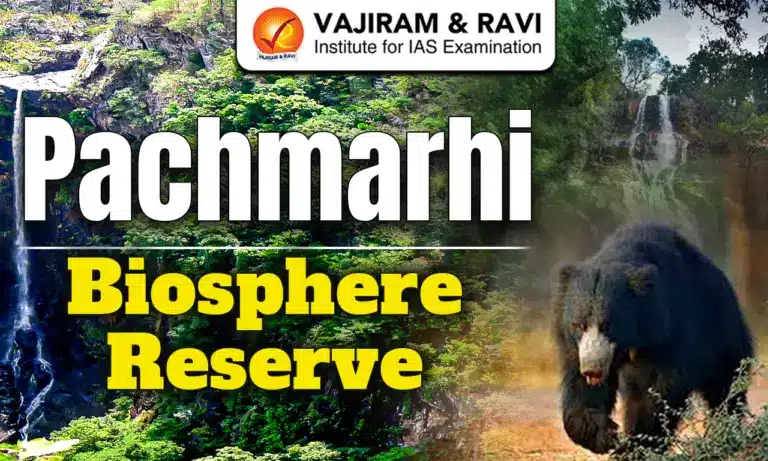
Pachmarhi Biosphere Reserve is one of the country’s most important conservation landscapes. Located in the Satpura Range of Madhya Pradesh, it is renowned for its rich biodiversity, unique ecological location, tribal heritage, prehistoric rock art, and pioneering role in scientific forest management. Recognising its ecological significance, UNESCO included Pachmarhi in the World Network of Biosphere Reserves under the Man and the Biosphere (MAB) Programme in 2009.
Pachmarhi Biosphere Reserve Location and Extent
Pachmarhi Biosphere Reserve is situated in the Satpura hills of Madhya Pradesh and covers parts of Narmadapuram (Hoshangabad), Betul, and Chhindwara districts.
- Spread over approximately 4,926 sq. km., it is the largest biosphere reserve in Madhya Pradesh.
- The reserve derives its name from “Panch” (five) and “Marhi” (caves), referring to the famous Pandav Caves.
- Dhoopgarh (1,350 m), the highest peak of the Satpura Range, lies within the reserve.
- The Denwa River, a tributary of the Tawa River, flows through the region and supports its ecosystem.
Pachmarhi Biosphere Reserve Establishment and Recognition
The ecological richness of the region led to its formal recognition as a biosphere reserve.
- Declared a Biosphere Reserve on 3 March 1999 by the Government of India.
- Included in UNESCO’s Man and the Biosphere (MAB) Programme in 2009.
- In 2000, parts of the reserve were also notified as the Satpura Tiger Reserve under Project Tiger.
- Pachmarhi is one of the three biosphere reserves in Madhya Pradesh, alongside Achanakmar-Amarkantak and Panna Biosphere Reserve.


Zonation of the Pachmarhi Biosphere Reserve
Pachmarhi Biosphere Reserve follows the three-tier zonation model prescribed under UNESCO’s Man and the Biosphere (MAB) Programme, ensuring a balance between biodiversity conservation and sustainable development.
- Core Zone: Satpura National Park (524.37 sq. km.) forms the core zone of the reserve, where human interference is strictly restricted and the primary focus is on protecting biodiversity, wildlife habitats, and ecological processes through scientific conservation and research.
- Buffer Zone: Bori Wildlife Sanctuary and Pachmarhi Wildlife Sanctuary constitute the buffer zone, where regulated activities such as research, environmental education, eco-tourism, and conservation programmes are permitted without disturbing the ecological integrity of the core area.
- Transition Zone: The outermost zone supports human settlements and sustainable livelihood activities, encouraging community participation in resource management while promoting harmony between conservation objectives and local development needs.
This zonation enables Pachmarhi Biosphere Reserve to serve as a successful model of sustainable coexistence between people and nature.
Pachmarhi Biosphere Reserve Biogeographic and Ecological Significance
Pachmarhi occupies a unique ecological position in India and serves as an important biodiversity corridor.
- Falls within the Deccan Peninsula Biogeographic Zone.
- Often referred to as the “Genetic Express Highway” because it acts as a bridge between the biodiversity-rich regions of the Eastern Himalayas and the Western Ghats.
- Represents a meeting point of northern and southern floral and faunal elements.
- Supports tropical moist deciduous forests, tropical dry deciduous forests, and subtropical hill forests.
- Bori Reserve Forest (1862), located within Pachmarhi Biosphere Reserve, is regarded as one of India’s earliest scientifically managed forests and marks the beginning of scientific forest conservation in the country.
- Plays an important role in maintaining ecological connectivity across Central India.
The reserve is therefore considered a living laboratory for studying species migration, adaptation, and ecosystem interactions.
Rich Floral Diversity: The reserve supports exceptional plant diversity due to variations in altitude, climate, and soil conditions.
- Teak (Tectona grandis) is the dominant tree species.
- Contains the westernmost natural groves of Sal (Shorea robusta), usually associated with eastern India.
- Rich in medicinal plants, orchids, ferns, and economically important forest species.
- Supports high floristic diversity with several endemic and rare plant species.
- Many plant species are traditionally used by tribal communities for food, medicine, and cultural practices.
Faunal Diversity: Pachmarhi Biosphere Reserve is one of the most important wildlife habitats in Central India.
- Supports flagship mammals such as Tiger, Leopard, Gaur, Sloth Bear, Sambar, Chital, Barking Deer, and Indian Giant Squirrel.
- Provides habitat to more than 250 bird species.
- Important birds include Malabar Pied Hornbill, Malabar Whistling Thrush, Paradise Flycatcher, Crested Serpent Eagle, Black Eagle, and Honey Buzzard.
- Home to around 30 reptile species, indicating healthy ecosystem diversity.
- Supports more than 50 butterfly species, including the Orange Oakleaf butterfly.
Pachmarhi Biosphere Reserve Tribal and Cultural Heritage
Pachmarhi is not only a biodiversity hotspot but also a centre of tribal culture and traditional knowledge.
- The Gond tribe forms the largest tribal community in the region.
- The Korku tribe is known for introducing potato cultivation and commercial honey collection.
- The Bharia tribe, classified as a Particularly Vulnerable Tribal Group (PVTG), inhabits the nearby Patalkot region.
Prehistoric Rock Art Heritage
Apart from ecological importance, Pachmarhi is also a significant archaeological landscape.
- Numerous rock shelters and caves contain prehistoric paintings dating back thousands of years.
- The paintings depict hunting scenes, social life, rituals, and human-animal interactions.
- These rock art sites provide valuable insights into the cultural evolution of early human societies in Central India.
Thus, Pachmarhi represents a rare combination of natural and cultural heritage.

 Last updated on Oct, 2026
→ UPSC 2027 Notification will be released on 13 January 2027 at upsconline.nic.in.
→ Check Nobel Prize 2026 Winners List here.
→ Download PIB PRiSM Monthly Magazine 2026 here.
→ Check UPSC Monthly Current Affairs Magazine The Recitals here.
→ Check out the latest UPSC Syllabus here.
→ Download UPSC Model Answers for Mains 2026
→ UPSC Mains Question Paper 2026 is out now for Essay & GS Paper 1, 2, 3 & 4.
→ UPSC Calendar 2027 has been released.
→ Enroll in Vajiram & Ravi’s UPSC Mains Test Series 2027 for structured answer writing practice, expert evaluation, and exam-oriented feedback.
→ Join Vajiram & Ravi’s UPSC Mentorship Program 2027 for personalized guidance, strategy planning, and one-to-one support from experienced mentors.
→ Go through the UPSC Mains Previous Year Papers to enhance your preparation.
→ UPSC has released UPSC Toppers List 2025 with the Civil Services final result on its official website.
→ Also check Best UPSC Coaching in India
Pachmarhi Biosphere Reserve FAQs
Q1. In which state is Pachmarhi Biosphere Reserve located?+
Q2. Under which UNESCO programme is Pachmarhi Biosphere Reserve included?+
Q3. Which protected areas constitute the Pachmarhi Biosphere Reserve?+
Q4. In which biogeographic zone is Pachmarhi Biosphere Reserve located?+
Q5. Why is Pachmarhi Biosphere Reserve known as the “Genetic Express Highway”?+
Q6. Which tribal communities are associated with Pachmarhi Biosphere Reserve?+
Tags: pachmarhi biosphere reserve