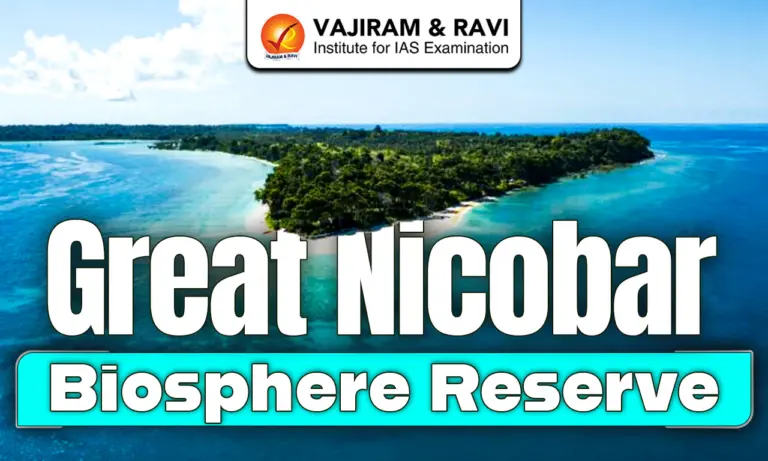
The Great Nicobar Biosphere Reserve is a protected natural area located in the southernmost part of India in the Andaman and Nicobar Islands. It is known for its tropical forests, coastal ecosystems, and rich biodiversity. The reserve plays an important role in conservation of unique species and protection of fragile island ecosystems. It is recognized for its ecological importance and supports both biodiversity conservation and the livelihoods of local communities.
Great Nicobar Biosphere Reserve Location
- The biosphere reserve is located in the southernmost part of India, encompassing most of Great Nicobar Island, and lies close to the equatorial belt, which influences its warm, humid, and stable climatic conditions throughout the year.
- It is part of the Nicobar group of islands, geographically separated from mainland India, which has helped preserve its ecosystems in a relatively pristine and undisturbed condition.
- The reserve represents a rare integration of terrestrial, coastal, and marine ecosystems, making it one of the most ecologically complex and biologically rich regions in the country.
- It was designated under UNESCO’s Man and Biosphere Programme in 2013, recognizing its global importance in promoting sustainable development alongside biodiversity conservation.
- Its strategic location near Southeast Asia makes it a biogeographical transition zone where Indian and Southeast Asian species intermingle, enhancing species diversity.
- The region also holds geopolitical and maritime significance due to its proximity to international shipping routes in the Indian Ocean.
- The low level of urbanization and human interference contributes to high ecological integrity and natural habitat continuity.
Also Read : Great Nicobar Project
Great Nicobar Biosphere Reserve Unique Biodiversity
The unique biodiversity of the Great Nicobar Biosphere Reserve is reflected in its rich variety of flora and fauna, which are discussed in detail below. Its ecosystems support many endemic and rare species, making it an important hotspot of biological diversity. This highlights the reserve’s significance in conservation and ecological balance.
Flora:
- The vegetation is dominated by dense tropical evergreen forests, characterized by multi-layered canopies, high biomass, and year-round greenery due to heavy rainfall.
- Coastal belts support mangrove forests and littoral vegetation, which play a crucial role in protecting shorelines from erosion, tidal surges, and extreme weather events.
- The region hosts a large number of endemic plant species, including pandanus, canes, palms, and orchids, which have evolved in isolation over long periods.
- Forest ecosystems provide vital ecosystem services such as carbon sequestration, oxygen production, soil fertility maintenance, and hydrological cycle regulation.
- The diversity and density of vegetation support a complex ecological network, sustaining herbivores, predators, and decomposers.
- The presence of medicinal plants and economically important species also highlights the potential for sustainable bio-resource utilization.
Fauna:
- The biosphere reserve supports a wide variety of endemic and endangered fauna, including the Nicobar macaque, Nicobar tree shrew, and Nicobar megapode, which are unique to this region.
- It is also home to reptiles such as the saltwater crocodile, as well as amphibians adapted to humid tropical conditions.
- Unique species like the giant robber crab, the largest terrestrial arthropod, highlight the ecological uniqueness of the island ecosystem.
- The fauna exhibit specialized adaptations to island ecosystems, such as niche specialization and reduced competition due to isolation.
- Many species are highly vulnerable due to restricted geographic distribution and habitat specificity, making conservation essential.
- The reserve also supports migratory bird species, enhancing its ecological significance.
Marine Life:
- The surrounding marine environment is rich in coral reefs, seagrass beds, and diverse marine fauna, forming a critical part of the Indian Ocean ecosystem.
- These ecosystems serve as breeding, nesting, and feeding grounds for species like dugongs, dolphins, and numerous fish species.
- The beaches of the reserve are globally important nesting sites for the leatherback turtle, the largest sea turtle species.
- Coral reefs act as natural protective barriers, reducing wave energy and protecting coastal habitats from storm damage.
- Marine ecosystems also support traditional fishing practices, contributing to local livelihoods in a sustainable manner.
- The high marine biodiversity contributes to nutrient cycling and ecological balance in coastal regions.
Also Read : Endemic Species


Great Nicobar Biosphere Reserve Protected Ecosystems
- The biosphere reserve includes core conservation zones such as Campbell Bay National Park and Galathea National Park, which are strictly protected from human interference.
- These protected areas conserve critical habitats for endemic and endangered species, ensuring ecological stability and biodiversity preservation.
- The reserve follows a zonation model (core, buffer, transition zones), allowing controlled human activities while maintaining conservation priorities.
- It is recognized as one of the most significant nesting grounds for leatherback turtles in the Indian Ocean region, enhancing its global ecological value.
- Coastal ecosystems such as mangroves, estuaries, coral reefs, and sandy beaches are protected for their ecological functions.
- These ecosystems also serve as sites for long-term ecological research and environmental monitoring.
- Protection measures help maintain ecological connectivity between different habitats, supporting species migration and genetic diversity.
Great Nicobar Biosphere Reserve Geological & Climatic Features
- The terrain of the island includes undulating hills, river valleys, coastal plains, and dense forests, shaped by tectonic movements and long-term geological processes.
- The region lies in a seismically active zone, making it prone to earthquakes and tsunamis, which have historically reshaped its landscape.
- The climate is tropical, hot, and humid, with heavy rainfall during monsoon months, creating favorable conditions for dense vegetation growth.
- Rivers such as the Galathea, Alexandra, and Dagmar provide freshwater and contribute to fertile ecosystems and biodiversity.
- The combination of climate and topography leads to high ecological productivity and species richness.
- Natural disturbances like storms and seismic activity contribute to ecological succession and habitat diversification.
- The region’s soils are generally rich in organic matter, supporting lush vegetation.
Great Nicobar Biosphere Reserve Cultural & Indigenous Importance
- The reserve is inhabited by indigenous communities such as the Shompens (a Particularly Vulnerable Tribal Group) and the Nicobarese, each with distinct cultural identities.
- The Shompens practice a semi-nomadic, forest-based lifestyle, relying on hunting and gathering, while the Nicobarese follow settled agriculture and fishing practices.
- These communities possess rich traditional ecological knowledge, which helps in sustainable management of forests and marine resources.
- Their cultural practices are deeply connected with natural cycles, biodiversity, and environmental conservation.
- Protection of their rights is crucial for ensuring inclusive and community-based conservation strategies.
- External influences and development pressures may threaten their cultural identity and traditional lifestyles, requiring careful policy interventions.
- Integrating indigenous knowledge with modern conservation can lead to more effective and sustainable outcomes.
Great Nicobar Biosphere Reserve Socio-Economic Features
- The local economy is largely subsistence-oriented, based on fishing, coconut cultivation, and small-scale agriculture.
- Common crops include coconut, banana, arecanut, and tapioca, mainly for local consumption rather than commercial markets.
- The region faces challenges of limited infrastructure, transportation, healthcare, and educational facilities due to its remoteness.
- Low population density reduces environmental pressure but also results in limited workforce and economic diversification.
- Government initiatives focus on improving connectivity, livelihoods, and access to basic services while ensuring ecological sustainability.
- Eco-tourism is being promoted carefully to generate income while maintaining strict environmental safeguards.
- The dependence on natural resources highlights the need for sustainable livelihood strategies.
Great Nicobar Biosphere Reserve Ecological Challenges
- The region is extremely vulnerable to natural disasters such as cyclones, earthquakes, and tsunamis, which can cause large-scale ecological and human damage.
- Climate change impacts, including rising sea levels, coral bleaching, and changing rainfall patterns, pose long-term threats to ecosystems.
- Developmental pressures such as infrastructure expansion and deforestation may lead to habitat loss and ecological imbalance.
- Invasive species threaten native biodiversity by competing with endemic species and altering habitats.
- Limited accessibility and resources make effective monitoring and conservation implementation difficult.
- Human-wildlife conflicts, though limited, may increase with expanding human activities.
- Balancing conservation with development remains a critical governance challenge.
Great Nicobar Biosphere Reserve Conservation Measures
- Strengthening legal frameworks and environmental regulations to prevent unplanned development and ecological degradation.
- Promoting community-based conservation approaches, involving indigenous people in decision-making processes.
- Encouraging sustainable practices in agriculture, fishing, and forestry to minimize environmental impact.
- Implementing climate adaptation and disaster risk reduction strategies to improve resilience.
- Enhancing scientific research, biodiversity monitoring, and data-driven policymaking for better conservation outcomes.
- Developing eco-tourism in a regulated and sustainable manner, ensuring minimal ecological disturbance.
- Increasing awareness and environmental education among local communities and visitors.
- Collaborating with international organizations like UNESCO for funding, training, and sharing best practices.
- Promoting restoration of degraded ecosystems, such as mangroves and coral reefs.
Great Nicobar Biosphere Reserve Significance
- The reserve is a global biodiversity hotspot, supporting a wide range of endemic and endangered species.
- It plays a key role in climate regulation, carbon storage, and disaster risk reduction, particularly through forests and mangroves.
- It acts as a natural laboratory for ecological and environmental research, providing insights into island ecosystems.
- The reserve demonstrates the principle of sustainable development by integrating conservation with human livelihoods.
- It enhances India’s strategic, ecological, and environmental presence in the Indian Ocean region.
- Its inclusion in the global biosphere network promotes international cooperation and knowledge exchange.
- It contributes to global biodiversity conservation goals and climate action efforts.

 Last updated on Oct, 2026
→ UPSC 2027 Notification will be released on 13 January 2027 at upsconline.nic.in.
→ Check Nobel Prize 2026 Winners List here.
→ Download PIB PRiSM Monthly Magazine 2026 here.
→ Check UPSC Monthly Current Affairs Magazine The Recitals here.
→ Check out the latest UPSC Syllabus here.
→ Download UPSC Model Answers for Mains 2026
→ UPSC Mains Question Paper 2026 is out now for Essay & GS Paper 1, 2, 3 & 4.
→ UPSC Calendar 2027 has been released.
→ Enroll in Vajiram & Ravi’s UPSC Mains Test Series 2027 for structured answer writing practice, expert evaluation, and exam-oriented feedback.
→ Join Vajiram & Ravi’s UPSC Mentorship Program 2027 for personalized guidance, strategy planning, and one-to-one support from experienced mentors.
→ Go through the UPSC Mains Previous Year Papers to enhance your preparation.
→ UPSC has released UPSC Toppers List 2025 with the Civil Services final result on its official website.
→ Also check Best UPSC Coaching in India
Great Nicobar Biosphere Reserve FAQs
Q1. What is the Great Nicobar Biosphere Reserve known for?+
Q2. Where is the Great Nicobar Biosphere Reserve located?+
Q3. Why is Great Nicobar Biosphere Reserve important for biodiversity?+
Q4. What type of vegetation is found in Great Nicobar Biosphere Reserve?+
Q5. Which animals are found in the Great Nicobar Biosphere Reserve?+
Tags: environment environment notes great nicobar biosphere reserve